



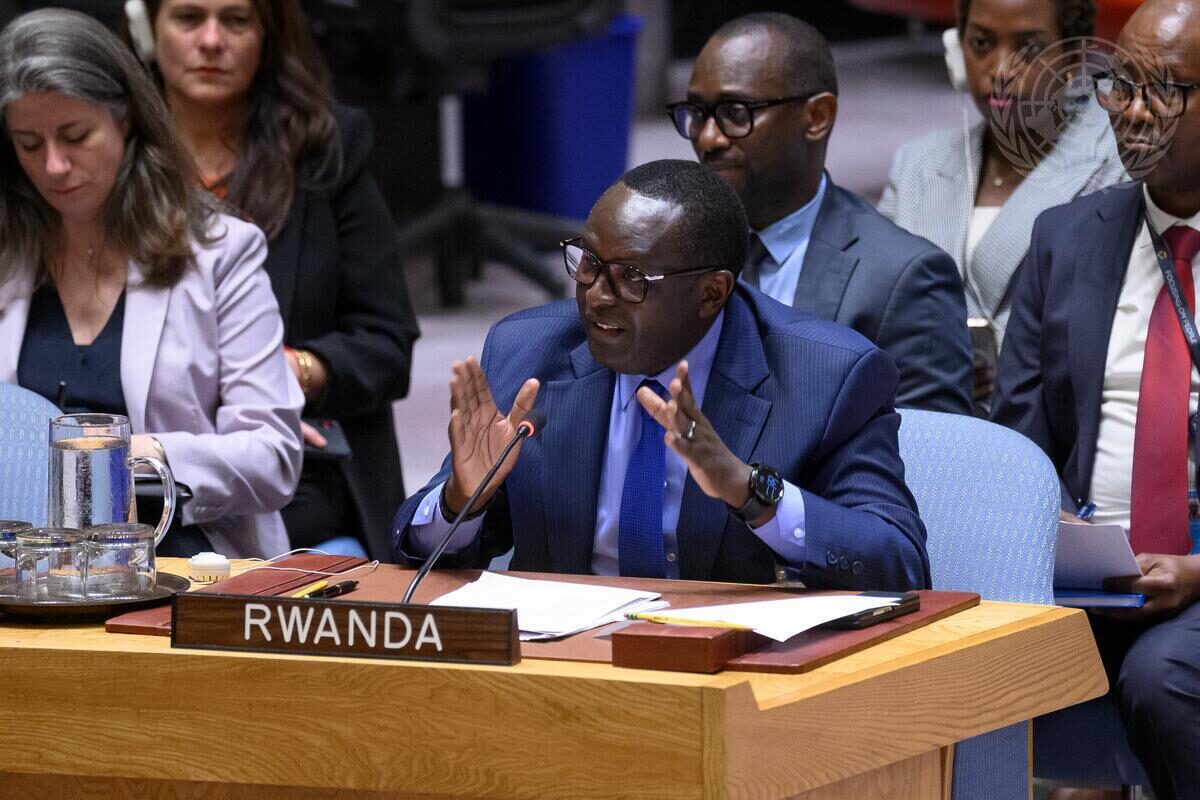
Martin Ngoga, Ambassador and Permanent Representative of Rwanda to the United Nations, at a UN Security Council meeting. (Courtesy photo)
A peaceful prosperous Great Lakes region is not only possible but could be within immediate reach, but for the intervention of Western nations, trumpeted by Western media organisations and individuals, and encouraged by a servile response from the African Union, and the regional block itself.
For the Great Lakes region of Africa, the Democratic Republic of Congo (DRC), is a running sore which generations of Congolese have inflicted upon themselves, a perverse act of extreme self harm that is encouraged by Western nations, for whom the very idea of a peaceful Congo has always seemed anathema. How else to explain these powers’ determined effort to direct attention away from the underlying causes of the DRC crisis.
Add to that what is a virtually inherent characteristic of most Africans, to defer to the West on issues that affect the continent and, or, be absent, in abdication of any responsibility to seek solutions to crises in their own countries, and what remains are nations on whom the West’s hold is not too far off what it was during full blown colonialism.
And as under colonialism, Western nations seek to direct the course of African countries in a direction that serves not the interests of those countries but of the respective Western nations. There is often an argument that derides the notion of “Western interests” on the basis that the West is not a monolith any more than is Africa.
It is an argument that disintegrates in any proximity with reality. While it is accurate that different nations of the West pursue their own national interest in Africa, often even in competition with each other, there is nonetheless a shared outlook in their dealings with the continent. When hyenas pursue weakened prey, it is each attacker for itself, yet they all attack in concert.
The demonstrably pernicious consequences of the combination of Africans ceding their responsibilities to Western powers, with these powers’ readiness to condemn African countries to any form of misery, if it serves Western interests, has been playing out in Congo for well over a Century, since Belgium’s Leopold II, was granted it as his personal possession.
The then Belgian King’s salivating at his “magnificent African cake,” not only resonates with his Belgian successors, but with all of today’s powerful nations of the West.
Where Leopold II and his representatives all but pruriently wallowed in the unspeakable cruelty needlessly visited upon the Congolese, his successors now veil such dehumanisation behind a wall of incessant cacophonous platitudes claiming regard for human rights. For their part, the Congolese seem to masochistically prefer to entrench the Western grip on their country.
There is now a plethora of agreements, processes, accords, all supposedly designed to bring about peace in Congo. The word complex has rarely been more overused. Yet anyone of average intelligence with the slightest interest in understanding the DRC crisis will need no more than a few minutes to be left wondering why the crisis persists, why it is regarded as intractable. Far from resolving a “complex” crisis, the many processes are an exercise in avoidance, so much so that the assertion of complexity is an insult to that average intelligence.
Listen to any Western politician, commentator, journalist, about the crisis in the DRC, and among the first words to be mentioned, will be Rwanda, and minerals.
But there are three and only three causes to the DRC crisis: lack of any governance worthy of the description in the DRC, which in turn leads to the persecution of Kinyarwanda-Speaking Congolese, turning the country, especially the Eastern part, the Kivus, into nothing more than a mirror image of the genocidal so called Democratic Forces for the Liberation of Rwanda (FDLR).
The lack of any semblance of governance is at the root of the decades old persecution of Kinyarwanda-Speaking Congolese, which forced them to take up arms to defend their communities.
When Congo’s President, Felix Tshisekedi squeezes his corpulent bulk into designer clothing, accessorised with expensive watches that would feed thousands of his immiserated citizens for years, and climbs into a flying palace, to shuttle around the world to weep crocodile tears to move the powerful to pity his long suffering people, it is a diversionary dance, in step with his Western audience.
Both he and his audience of Western leaders and opinion formers know that the solution to the crisis lies back at home. The AFC/M23 (Congo River Alliance/M23), which came out of the National Congress for the Defence of the People (CNDP), was as it says, born out of a need to protect Kinyarwanda-Speaking Congolese, against successive governments of the DRC which perversely turned the duty of any state to protects its citizens upside down to instead become a deadly threat against that section of its population.
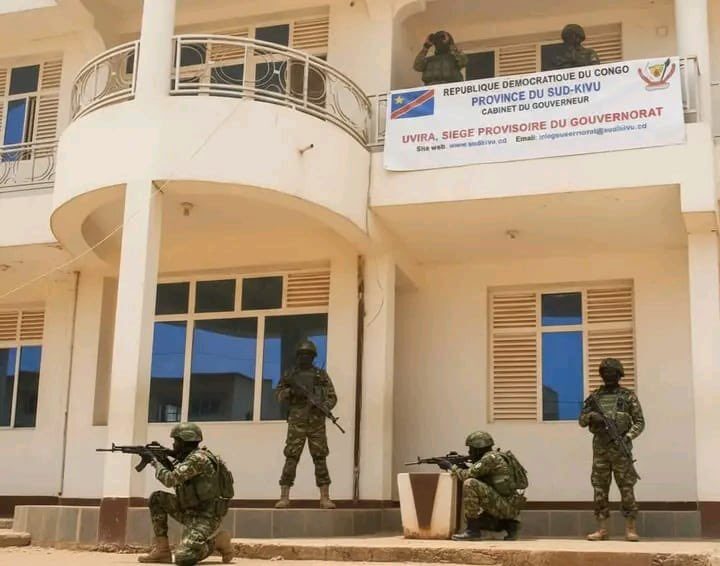
AFC/M23 fighters in Uvira following its capture, which they later evacuated voluntarily.
Now widened into a broader Congolese movement to fight against abuses suffered by Congolese of all background, the rebel movement has maintained its stance that an end to their country’s crisis lies in a negotiated settlement, and not a military solution.
When Western powers talk of a ceasefire, they are, to misquote Shakespeare, more knaves than fools. They are perfectly aware that it is in the gift of Tshisekedi, whether or not any ceasefire holds. While the rebels have respected every agreement they signed, including when it meant ceding territory they had taken from government forces, Tshisekedi has reneged on every agreement he has signed.
Prior to the so called Washington Accords, signed between Rwanda and the DRC, a murderous siege had been laid against the Kinyarwanda-Speaking Congolese Banyamulenge communities, in Minembwe especially. With their Burundi allies, the DRC government rained bombs on the Minembwe communities, after shutting off all of the community’s means of escape from what was an almost medieval siege with modern armaments, including Unmanned Aerial Vehicles or drones.
As so often happens, the AFC/M23 rebels issued a statement to all and any international observers, that if the siege was not lifted and the bombardment ceased, they would intervene on behalf of the communities under the attack. And as it so often is, their warnings were ignored.
Before the ink on Washington agreement was dry, AFC/M23 had captured the city of Uvira and its surrounding areas, ending the siege of Minembwe.
What followed was highly instructive. In the United Nations Security Council (UNSC), America’s ambassador to the United Nations Mike Waltz, abandoned all pretence of evenhandedness expected of a mediator, to launch a blistering onslaught against Rwanda, with an outburst that all but echoed Tshisekedi’s standard anti Rwanda claims.
His Rwandan counterpart, Martin Ngoga, a lawyer by background, gave a magisterial response, which demonstrated exactly the UNSC’s role in perpetuating the DRC crisis.
Beginning with the much discussed ceasefire stipulated in the Washington agreements, he not only outlined how the DRC never even intended to honour it but informed anyone who cared to know of that very fact.
He would not, he said, reiterate Rwanda’s position that it would not lift its defensive measures, as long as the threat from FDLR, supported by successive DRC governments remained. He instead restricted himself to the situation that led to the AFC/M23’s capture of Uvira.
“Allow me to highlight just a few incidents which are part of this systematic and sustained campaign of persecution of the Banyamulenge Kinyarwanda-Speaking Tutsi ethnic group, since 2017” he began. “More than eighty-five percent of Banyamulenge villages in South Kivu, were destroyed, an estimated 700,000 cattle, which is their economic lifeline were raided and killed…” The cattle are hacked to death with machetes, a practice that is a carbon copy of Rwanda’s genocidal Interahamwe militias, who similarly targeted Tutsi owned cattle.
Ngoga went on to give exact dates of attacks against Banyamulenge, in the last year alone. 25th August 2025, the so-called Wazalendo militia, who it should be noted are often led by elements of the FDLR, issued a ten day ultimatum to all Banyamulenge to leave Uvira, or they would be killed. Within those ten days, they were not to leave their immediate areas, access water supply water points, markets or shops. In short, they were prohibited from seeking any services needed to sustain life.
From 5-8th of September 2025, a number of Banyamulenge civilians were rounded up and shot, as “mobs chanted for the end of the Banyamulenge…” The siege of Banyamulenge was set by coordinated forces of Barundi, tens of thousands of whom have been deployed in the DRC, Wazalendo militias, FDLR and mercenaries from diverse parts of the world, mainly Europe and lately South America.
On the 6th of September 2025, around eight hundred Banyamulenge, mostly women who had tried to slip through the siege to find food, were ambushed, by Burundi soldiers with Mai mai militias, subjected to torture, sexual assaults and a number of them killed. Ngoga challenged anyone to dispute these and other attacks.
Nor can the Council claim not to have been aware of them. “Rwanda has not been silent” he said, “our minister of foreign affairs [Oliviere Nduhungirehe] has raised the blockade directly with the mediators, United States and Qatar, with representatives of the European Union and the African Union, and I have raised it with individual members of the Council…with heads of mechanisms in the region [the Great Lakes region], and nothing happened.”
“Taking into account the facts of the situation and the wider context of hate ideology in the DRC, the inherent legal and moral obligation…allow me to ask the question: has the Security Council not been aware of this situation, or did this situation not merit your attention…?”
The question was rhetorical and may as well have been directed at his American counterpart, for whom the plight of Banyamulenge seemed of little consequence. Waltz’s onslaught against Rwanda, follows a time honoured pattern that goes back decades.
At each moment when Kinyarwanda-Speaking Congolese seem about to force a negotiated settlement that holds a promise of ending generations of persecution against them, the government in Kinshasa turns to Western powers, dangling keys to mineral rights, so long as the status quo is maintained. And as happened in 2012, those powers gang up on Rwanda, demanding it do something to reverse the steps taken by the Kinyarwanda-Speaking Congolese. It is from that same playbook that Waltz was reading.
For almost two years now, the DRC’s political establishment has sought to depict the AFC/M23 rebel group as Rwandan. It is an insidious form of hate speech, a dog whistle that Kinyarwanda-Speaking Congolese are “foreigners,” that the crisis is because of Rwanda as the “aggressor.” Today, in the DRC, it is normal for government supporting mobs to set upon anyone considered to be Tutsi, batter them into semi consciousness, set them alight and cannibalise them. That is what becomes of such hate speech.
And it is what becomes of the West’s amplifying of Tshisekedi’s anti Rwanda claims, which are designed to distract attention away from the causes of the crisis in the DRC. “The real causes of the crisis in the DRC” has now become a sentence much derided by Western commentators, because Rwanda so often repeats it.
You would have a better chance of finding a needle in a haystack in pitch darkness, than finding any of these commentators, or indeed anyone among the Western political classes, who will acknowledge that Rwanda so often repeats the sentence because it is true and it is so often ignored.
When he launched his anti Rwanda onslaught, Waltz was fully aware of the atrocities outlined by his Rwandan counterpart, Martin Ngoga. When at the end of a speech clearly written to threateningly fulminate fulminated against Rwanda, in support of Tshisekedi, Waltz threw in platitudes about avoidance of hate speech, he was demonstrating he and his team had consciously chosen to put their might behind Tshisekedi’s refuge from the truth.
The East African Peace Keeping force, the Luanda process, the Nairobi process, the Doha process, now the so called Washington accords, all become “complex” the moment they reach a point when Tshisekedi has to deliver on the agreements he signed. It is at such moments that he climbs into his private jet and flees to the West, horrified at the prospect of the truth and peace, because that truth, that peace threatens to be the end of him.
It is also at such moments that the West casts about for whom to blame, and Rwanda is once again seen as a convenient scapegoat, and the truth becomes drowned in accusations against it, threats of sanctions, and the status quo in the DRC is maintained.
And of what of the African Union, the regional processes? They are barely worth a sentence, they are mentioned in passing, as they mumble “African solutions for African problems.” All they need do is reiterate the position no less eminent Africans than Nelson Mandela, Julius Nyerere, and Thabo Mbeki, who consistently declared the cause of the Congo crisis to be the presence of the FDLR and the persecution of the Kinyarwanda-Congolese by the Congolese state.
There is no complexity about the crisis in the DRC, peace can be a given, but for it to be realised, the Africans will have to grow a backbone, and stand up for the truth against the apparent preference of the most powerful nations of the world to pervert that truth and maintain the status quo in the DRC.
