


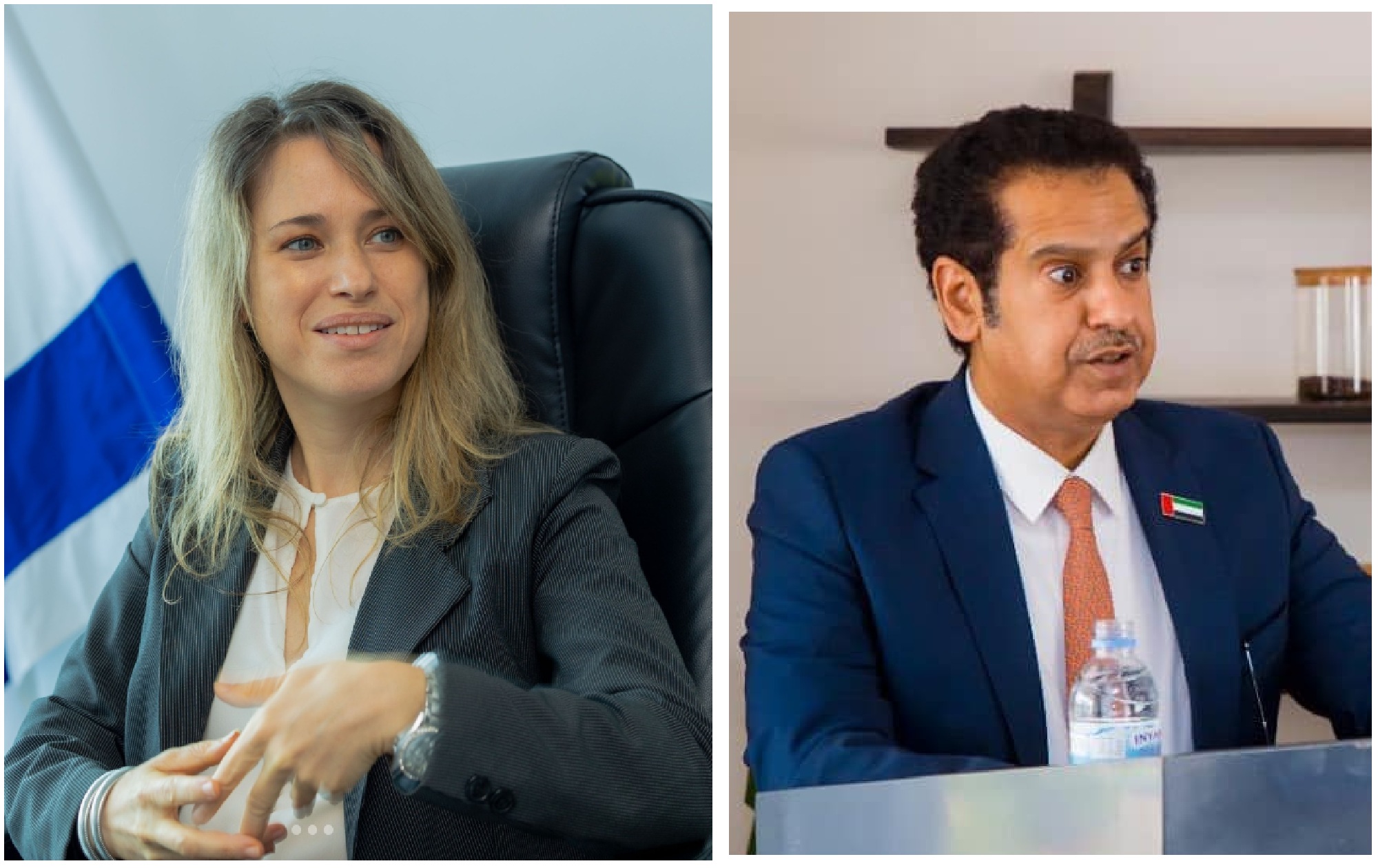
Left: Einat Weiss, Israel’s Ambassador to Rwanda, briefed journalists in Kigali on Middle East tensions. On right is UAE Envoy to Rwanda, Hazza Mohammed Falah Kharsan AlQahtani. KT Press recieved transcript from the embassy
KIGALI — In two starkly framed briefings this week, Israel’s envoy to Rwanda and senior officials from the United Arab Emirates presented competing but complementary justifications for a widening military confrontation in the Middle East that is pitting Iran against the west and regional allies.
One side of the diplomatic corp is emphasizing preventive action against a long-standing adversary, the other cataloging the pace and human cost of repeated attacks on Gulf skies.
Speaking in Kigali on March 5, the Israeli ambassador, Einat Weiss, described a campaign she called necessary to blunt what she said were the dual threats of a resurgent missile program and an accelerating nuclear effort in Iran.
The strikes, which began in late February, were portrayed as “intelligence-driven” attempts to dismantle infrastructure and proxies that, the ambassador argued, have repeatedly menaced her country and the region.
The Israeli envoy framed the operation as painful but unavoidable: allow Iran to mature its arsenal, she said, and the future cost would be “a thousand times more painful.”
The ambassador stressed close cooperation with the United States, saying the partnership in intelligence and military planning had been “unprecedented” under President Donald Trump and Prime Minister Benjamin Netanyahu.
She also took pains to address the safety of expatriates and foreign nationals, noting that civilian shelters, sirens and civil-defence protocols — including warnings issued by the Home Front Command — were in place to protect residents and visitors alike.
The envoy said Kigali and Tel Aviv were in daily contact about Rwandan citizens in Israel and that officials had no major concerns about their safety.
The Israeli diplomat also criticized what she called international double standards toward Israel and urged a clearer condemnation of Iran’s support for militant groups.
At the same time, officials in Abu Dhabi painted an intense picture of life under near-constant aerial threat.
The United Arab Emirates’ briefing on March 4 — led by defence, interior and emergency management spokespeople — documented hundreds of intercepted projectiles and dozens of fragments falling on Emirati soil, and outlined the broader logistical and economic strain the country has borne.
The briefing, provided to KT Press by the embassy in a translated transcript, cataloged interceptions of ballistic missiles, cruise missiles and drones and described the country’s integrated air-defence response.
“Air defences have dealt with 186 ballistic missiles launched toward the country,” the UAE’s Ministry of Defence spokesperson said, according to the transcript.
The officials emphasized that most incoming threats had been destroyed in flight, but they also warned that interception debris and isolated impacts had caused civilian casualties and material damage.
The government’s message mixed reassurance — that national systems remain resilient and daily life continues — with a blunt reminder of its right to self-defence.
UAE ministers and spokespeople outlined the knock-on effects on commerce and travel, noting contingency plans to maintain essential supplies and to run phased repatriation flights for stranded passengers.
The economy minister described strategic food stockpiles, market monitoring and plans to scale flights as part of an effort to preserve the country’s role as a civil-aviation and commercial hub.
Emergency officials stressed that joint national media cells and early-warning systems were operating around the clock to keep the public informed and to discourage rumor.
Taken together, the two briefings reveal how different capitals are navigating the same crisis through distinct lenses: Israel emphasizing deterrence and regime-level change in Tehran, Gulf states emphasizing immediate defense, civilian protection and the economic fallout of cross-border strikes.
Analysts say the two narratives are not mutually exclusive. Israel’s public framing focuses on long-term risk reduction — removing the capacity for strikes and degrading support networks that arm proxies across the Levant — while Gulf governments have been compelled to demonstrate readiness and resilience to reassure multinational populations and global markets.
The result has been an uneasy alignment of priorities that, in practice, binds intelligence sharing, diplomatic pressure and military planning across a widening coalition.
In Kigali, the ambassador argued that the operation could ultimately create a safer regional environment, by curbing Iran’s ability to export instability and by empowering internal movements inside Iran that seek political change.
In Abu Dhabi, the message was that the immediate imperative is to protect lives and infrastructure and to keep supply chains and skies open. Both sets of officials urged restraint from third parties and a return to diplomacy as the only durable path to stability — though their descriptions of what that would require diverged sharply.
For ordinary civilians across the Middle East and for the millions of people whose lives depend on fragile transport and trade corridors, the choices under discussion in diplomatic salons and command centers have concrete consequences: shuttered airspace, disrupted shipping through the Strait of Hormuz and the prospect of sporadic missile and drone strikes spilling into neighboring countries.
As both the Israeli envoy and Gulf officials warned, the coming days will likely test whether a mixture of military pressure, international diplomacy and local resilience can avert an even broader conflagration — or whether the cycle of strikes and retaliation will draw more capitals and populations into an increasingly costly conflict.
