




Bank of Kigali formally presented the BK Open API to key clients
KIGALI, Rwanda — Even if you bank with someone else, paying salaries, settling bills or receiving payments in Rwanda is becoming faster and smoother — thanks to a new digital bridge built by Bank of Kigali.
The bank has opened its systems to outside developers and businesses through BK Open API, a secure platform that allows apps and software to connect directly to its banking services.
The result is a shift in how everyday financial tasks are handled: transactions can now happen inside tools people already use, without switching apps or logging into separate banking portals.
The system was first unveiled in March 2026 at the Inclusive FinTech Forum held at the Kigali Convention Centre.
As the first bank in Rwanda to launch an open application programming interface, BK positioned the move as a step toward collaboration.
It basically allows fintech firms, payroll platforms and other businesses to embed banking services like instant payments and real-time transaction updates into their own products.
Seamless Banking
On April 2, during its quarterly client forum marking 60 years of operations, Bank of Kigali formally presented the BK Open API to key clients, describing it as a system “designed to integrate its services with those of its partners.”
The bank said the platform will “facilitate and accelerate various services, such as payments and other service requests,” while serving as a gateway for collaboration and growth.
Dr. Diane Karusisi, Chief Executive Officer of Bank of Kigali, speaking during the launch earlier, framed the initiative as part of a broader shift in how banking works.
“This is an era where we have a lot of collaborations,” she said. “We aim to unify the silos so that people do not have to move from one system to another while making transactions.”
She added: “Instead of coming physically to the bank to streamline payments, fintech investors can simply go to the website and access a special API that acts as a bridge between the bank and the public.”
Financial Backing
The digital push comes as BK Group Plc reports strong financial performance.
The group posted a net income of RWF 110.1 billion in 2025, up 20.9 percent from the previous year.
Total assets surpassed RWF 2.9 trillion for the first time, while customer deposits rose by 14.8 percent.
Dr. Uzziel Ndagijimana, Group Chief Executive Officer of BK Group Plc, said Thursday the results provide a solid foundation for expansion and innovation.
“2025 was yet another successful year for BK Group,” said Ndagijimana. “Our loan portfolio grew by 16.1%, deposit mobilisation remained strong at 14.8%, and the sustained improvement in asset quality allowed us to release provisioning capacity that flowed directly into earnings.”
He added: “As BK Group marks Bank of Kigali’s 60th year of operation in Rwanda, we enter this milestone period with a stronger balance sheet, a more diversified franchise, and a clear mandate to deepen Rwanda’s financial system.”
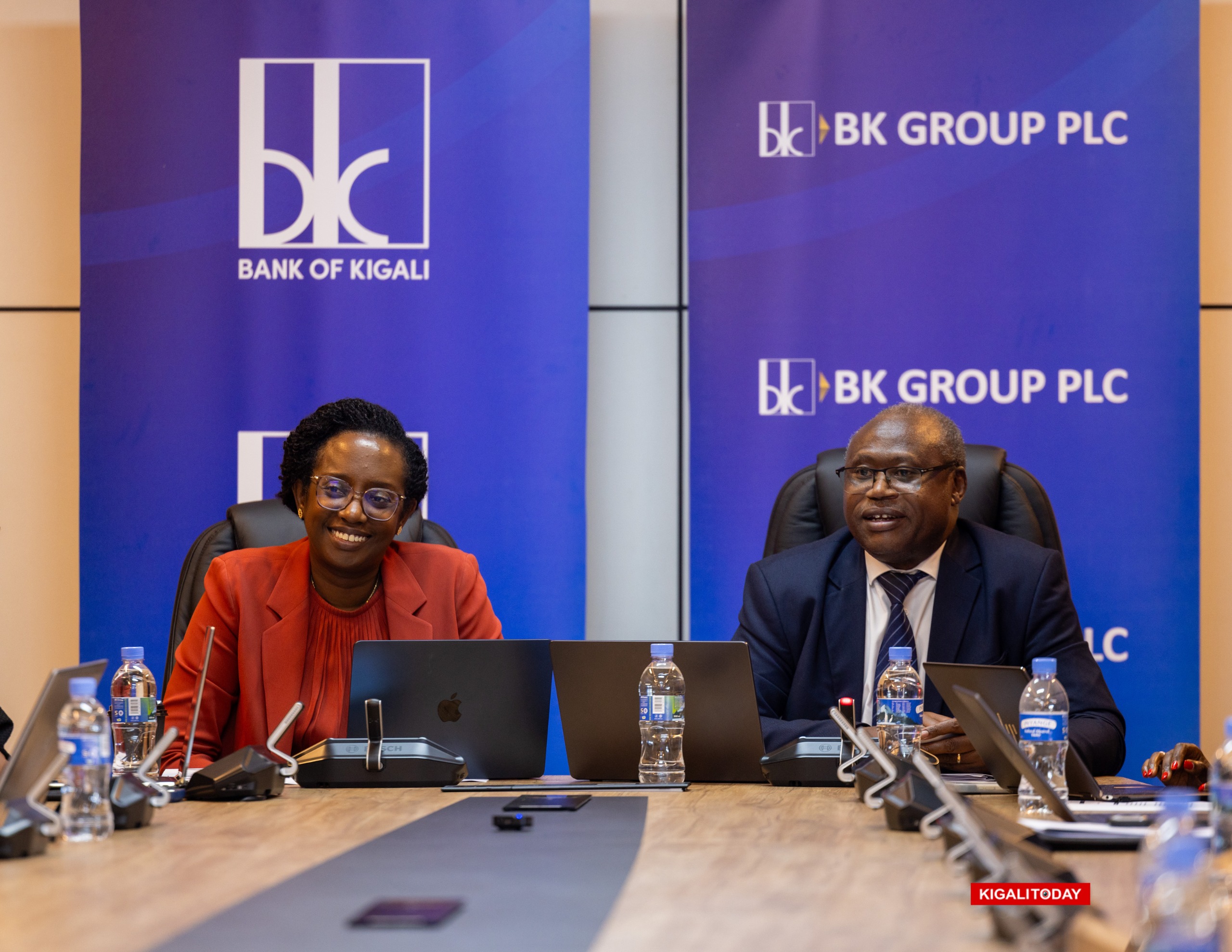
Group CEO Dr Uzziel Ndagijimana and Bank of Kigali CEO Dr Diane Karusisi shared the Group’s financial performance
Whats with BK Open API?
One early example of the Open API in action is Fixa, a platform that connects businesses with workers in sectors like cleaning, security and construction.
Using BK’s system, companies can process payroll directly inside the Fixa app. Workers — including those who bank elsewhere — receive payments faster and with fewer errors.
The benefits extend beyond payroll. E-commerce platforms can confirm payments instantly without redirecting users.
Accounting systems can trigger supplier payments automatically. Delivery and bill-payment apps can integrate transactions without requiring users to open separate banking applications.
For customers who do not hold accounts with Bank of Kigali, the advantage is indirect but meaningful.
Banking becomes less visible — and less intrusive. Money moves where it needs to go, through the platforms people already use for work, shopping or daily services.
Instead of building every service itself, BK is opening its infrastructure to others — a model increasingly common in global markets but still new in Rwanda.
And for Competition?
Developers and businesses can already access the platform through BK’s developer portal, including a testing “sandbox” environment.
For now, the API connects only to Bank of Kigali’s systems, while inter-bank transactions continue to rely on Rwanda’s existing national payment infrastructure.
But as more institutions adopt similar models, the system could evolve into a more interconnected ecosystem.
For Rwanda — one of Africa’s fastest-growing digital economies — the shift is subtle but significant.
Even customers of rival banks are beginning to feel the impact of a more open, collaborative financial system — one integration at a time.

3 comments
i want to develop my destination of future in working hard and developing our country cross in it.
developing my self an$ my country
developing my self and country
Comments are closed.