



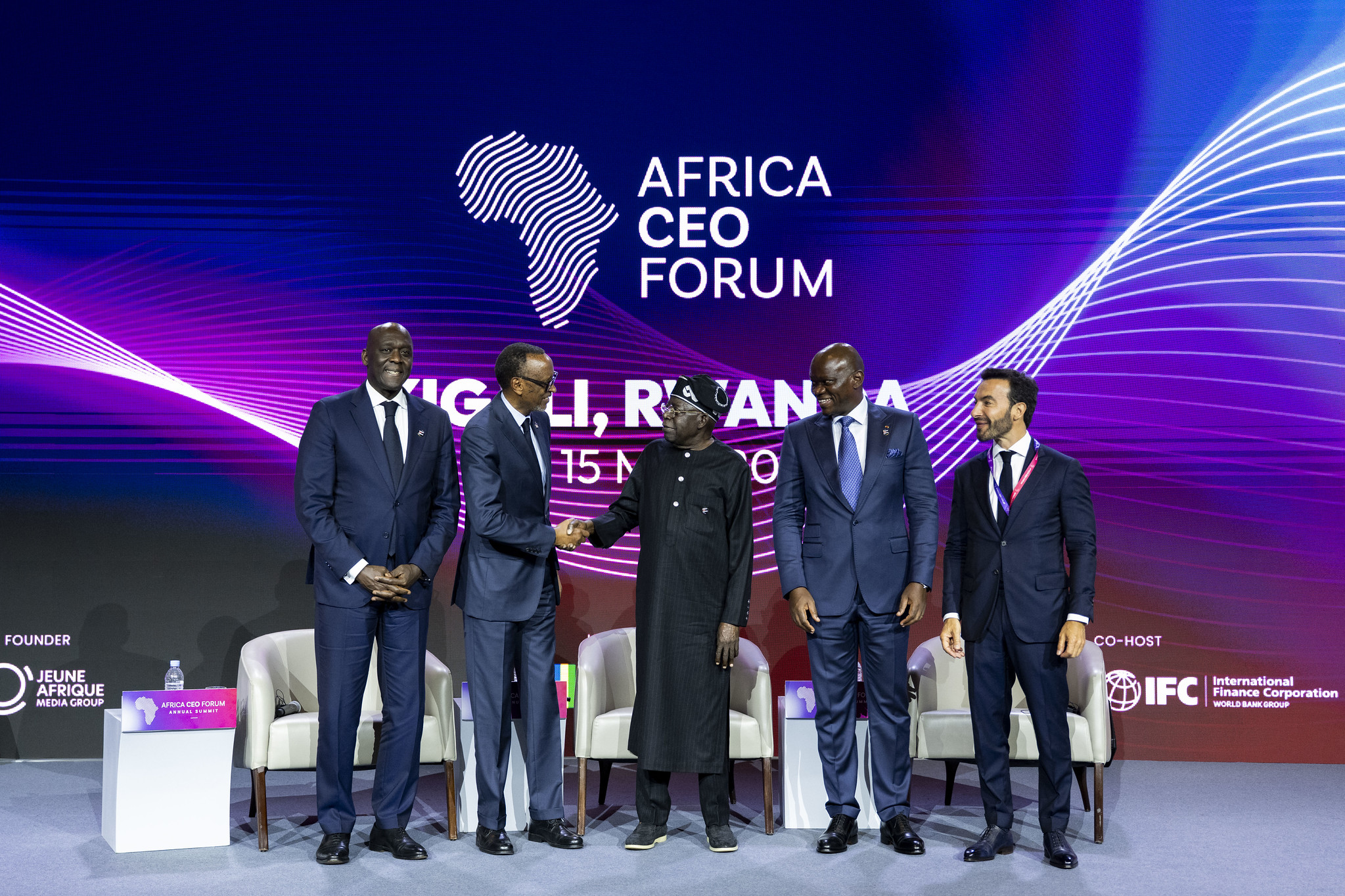
From L-R: Makhtar Diop is the Managing Director of the International Finance Corporation (IFC), President Paul Kagame, Nigerian President Bola Ahmed Tinubu, Gabonese President Brice Oligui Nguema, and CEO of Jeune Afrique Media Group is Amir Ben Yahmed.
KIGALI— It is often said at major international gatherings that the world is living through unprecedented times. Economic uncertainty, geopolitical tensions, and shifting alliances are frequently described as a once-in-a-generation crisis.
But speaking at the Africa CEO Forum in Kigali, President Paul Kagame offered a broader perspective.
Asked by moderator Eleni Giokos whether the global economy had ever faced a crisis as serious as the current one, Kagame argued that history shows humanity has always navigated difficult periods.
Crises Come and Go
“There will always be crises,” Kagame said.
“We have had centuries of different things happening. We have had the slave trade, colonialism, wars, pandemics, and now we are in a different cycle driven by geopolitics, and we have to contend with that.”
It was a characteristic Kagame response — placing current events in historical context and stressing that while crises are inevitable, they are temporary.
More important, he suggested, is how nations respond.
For Kagame, the present moment should serve as a reminder that Africa must stop relying on external prescriptions and begin shaping its own destiny.
“We have had many people contribute ideas and tell us what we need to do,” he said. “But we cannot stay there. We need to learn from this, shape what we are doing for ourselves, and take action.”
He pointed to Africa’s enormous advantages, from natural resources to human capital, and questioned why the continent continues to struggle despite its vast potential.
Rich in Resources, Poor in Leverage
Kagame noted that Africa holds around 60 percent of the world’s solar energy potential and a large share of the critical minerals needed for electric vehicles and the green transition.
Yet, he said, the continent often sells these resources cheaply while others reap the greatest benefits.
“Different powers are fighting over these minerals, but Africa, which has most of them, is silent or losing them cheaply to those who know exactly what they want.”
He also highlighted Africa’s demographic strength.
“In a few years, Africa will have the largest middle class in the world,” he said. “So how can we have these resources and still be wondering how to overcome these challenges?”
Sanctions and the Politics of Power
Kagame also addressed sanctions imposed by the United States on the Rwanda Defence Force (RDF) over allegations related to the conflict in eastern Democratic Republic of Congo.
He described the sanctions as part of a broader pattern in which powerful nations use their influence selectively.
“It’s a situation where the powers that be are holding a whip, beating up whoever they want,” he said.
According to Kagame, sanctions often favour those with greater economic and political leverage, while poorer nations bear the cost.
“There is a lot of cynicism,” he added.
‘We Must Be Able to Say No’
Kagame accused some foreign powers of promoting values such as democracy and human rights while simultaneously exploiting Africa’s resources.
“These powers come here lecturing people about democracy and human rights with one hand, while taking everything people own with the other,” he said.
He urged African leaders, businesses, and citizens to place greater value on themselves and their continent.
“We cannot just wait to be ripped off by somebody who is shrewd enough and has the power,” he said. “We must be able to say no.”
Asked whether Rwanda would yield under sanctions pressure, Kagame responded with confidence.
“I never capitulated in a much worse situation,” he said with a smile.
He acknowledged that sanctions are painful, but argued that compromising on principles would be even more costly.
“It costs more to say yes to the wrong thing.”
Pressure Can Be a Catalyst
Kagame said external pressure should be seen as an opportunity for Africa to reassess its position in the world.
“Africa is being reminded to wake up,” he said. “These pressures are not entirely bad. They force us to look within and do what we need to do.”
He expressed confidence that Africa can succeed if countries work together and act with purpose.
Public and Private Sectors Must Work Together
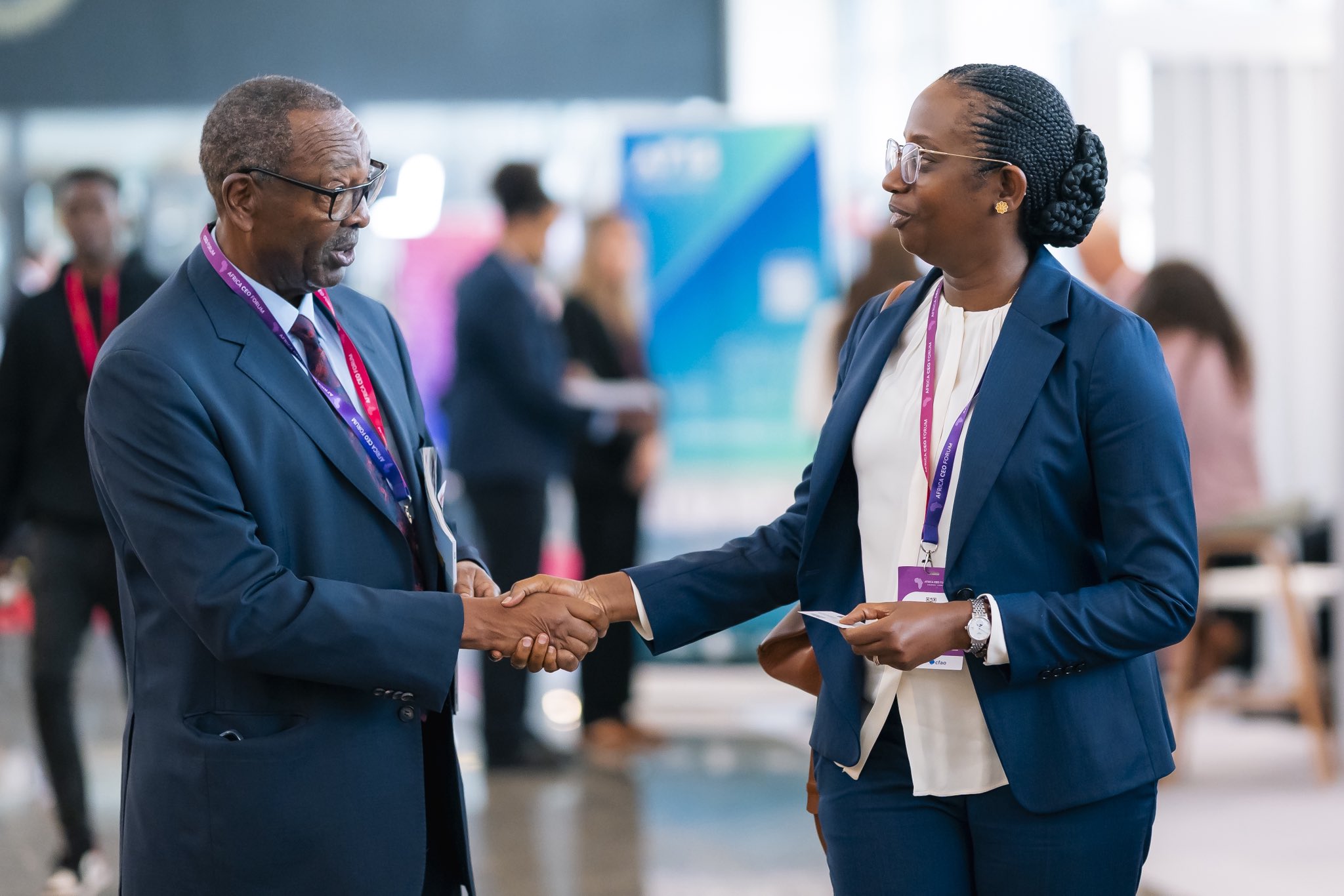
Addressing the forum’s business audience, Kagame praised the private sector for its resilience and innovation.
“The private sector is doing a good job. In fact, it is ahead of the public sector,” he said.
He called for closer cooperation between governments and businesses, urging public institutions to remove barriers and allow entrepreneurs to drive growth.
“Those of us in the public sector need to fine-tune our responsibilities toward allowing the private sector to be the engine that it is and should be.”
Social Media as a Great Equaliser
Kagame also reflected on the role of social media in modern politics.
“I have become immunised to shocks,” he said.
While acknowledging its challenges, he described social media as a force that has democratised communication.
“Everyone can express themselves and be heard,” he said. “It has opened up space for everybody.”
The 2026 Africa CEO Forum drew nearly 3,000 participants from 69 countries, making it one of the largest editions of the event.
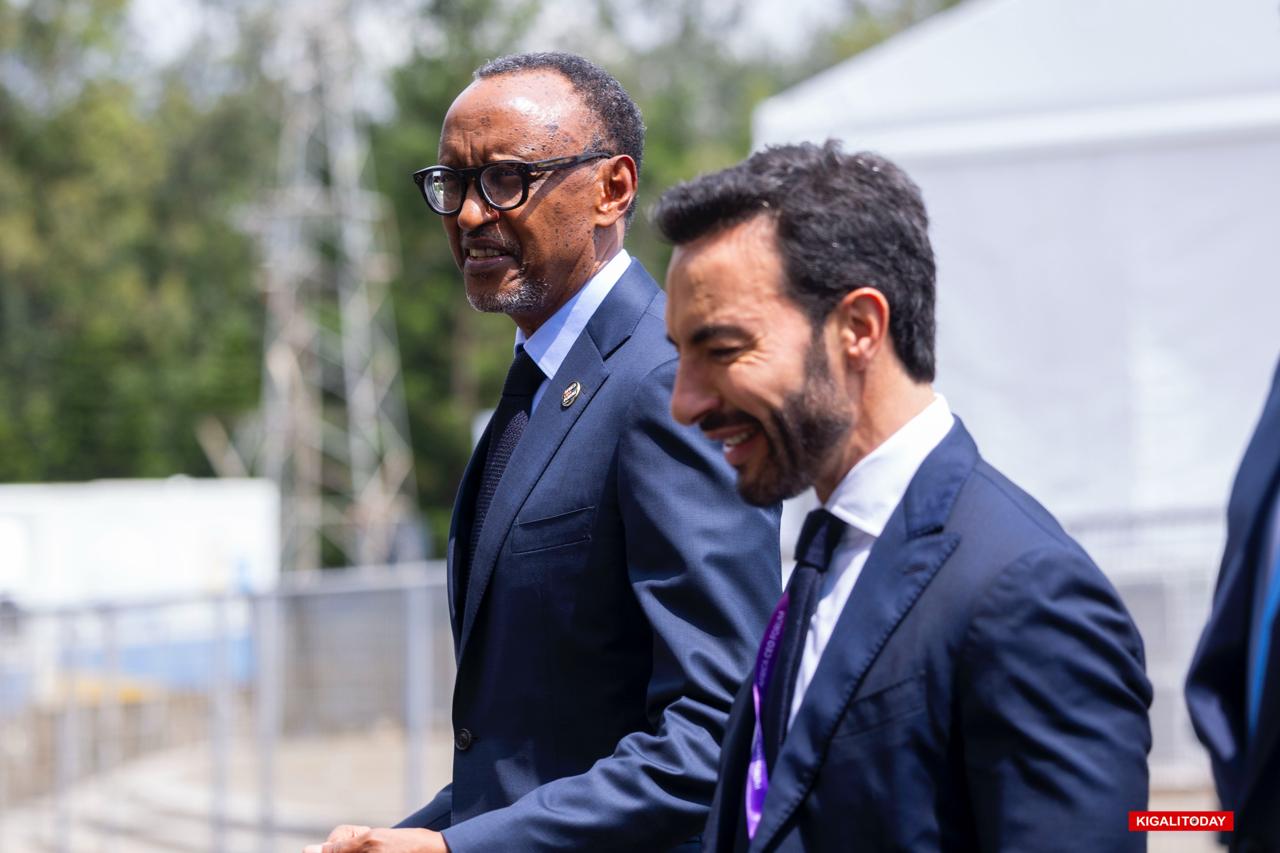
Kagame challenged everyone in the room to contribute to Africa’s transformation.
“Each one of the people in this room and beyond has something to contribute and something to benefit from,” he said.
“The continent has a lot that is not being put to good use, and it is up to us — not people from anywhere else — to raise ourselves to where we should be.”
