


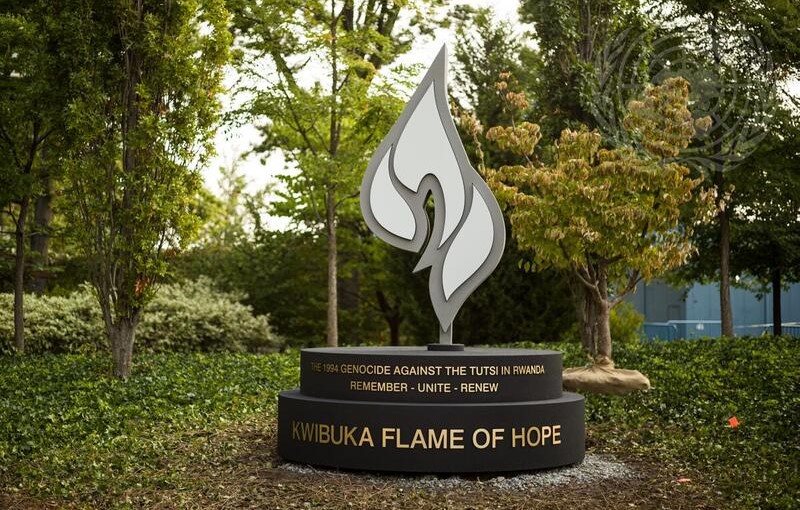
 As Rwanda concludes the 100 days dedicated to commemorating the 1994 Genocide against the Tutsi, the responsibility to remember does not end with the official commemoration period.
The messages shared during these 100 days including unity, reconciliation, forgiveness, resilience, and hope must continue to shape how we live, engage with one another, and confront injustice wherever it exists.
Recently, I listened to a Twitter Space hosted by epidemiologist Mudge Rulf featuring Marie Kresbach Kabera, a survivor of the Genocide against the Tutsi who now lives in Germany after having been adopted by her big sister and her German husband.
Marie was discussing her new book, Steh auf, mein Kind, und geh (“Arise My Child and Go”), a title inspired by the voice she remembers hearing shortly after witnessing the murder of her mother during the genocide.
The twitter space had other speakers who supplemented her story. One of them was her husband Kabera Jean Alain Claude who contributed to the space through talking about ‘’Inkiko gacaca’’ and their role in restoring sanity and unity among Rwandans after the genocide against the Tutsi.
Through her story, Marie offered a powerful reminder of why the world must continue learning about what happened in Rwanda in 1994.
One of the points Marie emphasized was that while global awareness of the genocide has improved over the years, genuine understanding remains limited. Many people know that a genocide took place in Rwanda, but fewer understand that it was not a sudden outbreak of violence.
As Marie explained, the Genocide against the Tutsi was carefully prepared over many years through discrimination, hate speech, propaganda, and the systematic dehumanisation of Tutsi.
Understanding these factors is essential because genocides do not begin with killings; they begin with ideas, narratives, and divisions that are allowed to grow unchecked.
Marie repeatedly highlighted the importance of paying attention to the warning signs. The spread of hatred, discrimination, misinformation, and extremist ideology should never be normalized.
She argued that survivors, especially women and children, have stories that the world needs to hear because their experiences offer lessons that statistics alone cannot convey.
Marie also pointed to the failure of the international community to act quickly enough in 1994, a lesson that remains relevant today as conflicts and hate-driven movements continue to emerge around the world.

Peter Nkurunziza is a communications practitioner and writer based in Kigali.
What struck me most was Marie’s insistence that remembering the Genocide against the Tutsi is not solely Rwanda’s responsibility. More people across Africa and the wider international community need to understand the facts, challenge misinformation, and confront genocide denial and distortion wherever they appear.
As Marie reminded listeners, genocide is a human-made tragedy, not an inevitable one. By learning the truth, defending it, and acting on its lessons, we honour the victims while helping to ensure that such atrocities never happen again.
Now, for a person that was born out of Rwanda, her message resonated with me on a personal level. As someone who grew up in Uganda, I was aware that a genocide had occurred in Rwanda. It was something we briefly learnt about in school, and like many others born out of Rwanda, I knew the basic fact that a tragic event had taken place in 1994.
However, what I was never taught, and what many people outside Rwanda may still not fully understand is that the Genocide against the Tutsi was not a spontaneous conflict or a consequence of war. It was a calculated, organised, and deliberate campaign aimed at completely exterminating the Tutsi population in Rwanda.
It is only through listening to survivors, engaging with historical accounts, and learning the facts that one begins to appreciate the scale of the planning, the depth of the hatred that was cultivated, and the devastating human cost.
This is why continued education and open conversations about the Genocide against the Tutsi remain so important, not only for Rwandans, but for people everywhere who wish to understand how such atrocities happen and how they can be prevented in the future.
There is therefore a pressing need to create more opportunities for people outside Rwanda (starting with our closest neighbours, Uganda, Kenya, Tanzania, Kenya, Burundi, and the whole continent) to learn the facts about the Genocide against the Tutsi, including its correct name, historical context, timelines, and scale.
Widespread access to accurate information through written literature of genocide survivors, recorded testimonies, etc help build a deeper understanding of what actually happened, counters genocide denial and distortion, and makes it more difficult for genocide deniers spread misinformation.
There is therefore a pressing need to create more opportunities for people outside Rwanda to learn the facts about the Genocide against the Tutsi, including its correct name, historical context, timelines, and scale.
Widespread access to accurate information helps build a deeper understanding of what happened, counters genocide denial and distortion, and makes it more difficult for false narratives to take root.
Preserving and sharing the truth is essential not only in honouring the victims and survivors but also in ensuring that the lessons of the genocide continue to inform efforts to prevent such atrocities in the future.
Preserving and sharing the truth is essential not only in honouring the victims and survivors but also in ensuring that the lessons of the genocide continue to inform efforts to prevent such atrocities in the future.
The writer is a Communications Practitioner and Writer based in Kigali.
