


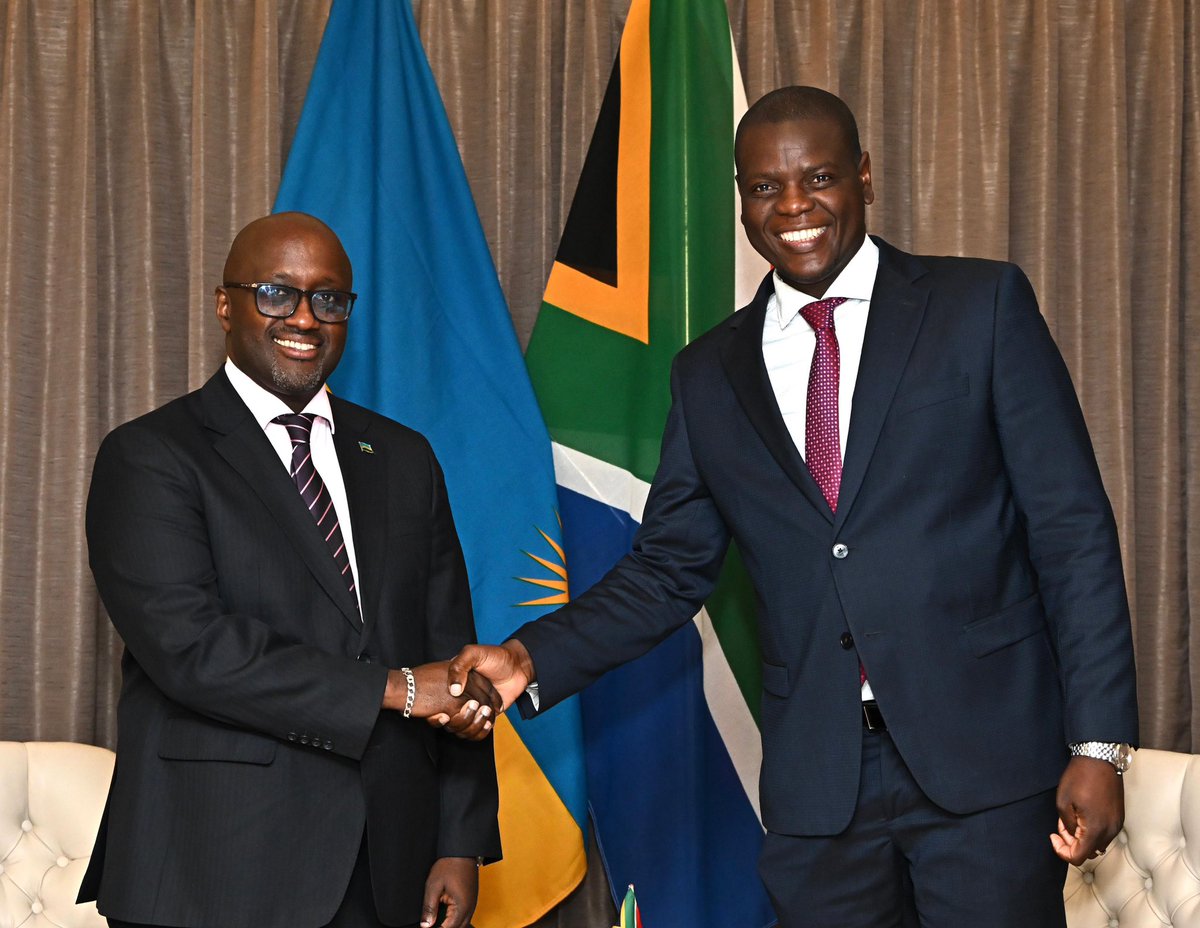
Rwanda’s Foreign Minister Olivier Nduhungirehe met with South Africa’s Minister of International Relations and Cooperation, Ronald Lamola on Wednesday
The recent visit by Rwanda’s Minister of Foreign Affairs, Olivier Nduhungirehe, to South Africa marks a significant moment in the ongoing normalization of relations between two of Africa’s most influential nations.
While many observers have welcomed the diplomatic progress, others, particularly on social media in South Africa, have questioned why South Africa should deepen ties with Rwanda following the deaths of 14 South African soldiers during the conflict in eastern Democratic Republic of Congo (DRC).
These concerns deserve to be heard and examined. However, they should also be viewed within the broader realities of the conflict, the purpose of the military mission involved, and the strategic importance of rebuilding relations between Rwanda and South Africa.
Why Diplomatic Normalization Matters
During his visit, Minister Nduhungirehe met with South Africa’s Minister of International Relations and Cooperation, Ronald Lamola. Their discussions focused on strengthening bilateral relations, expanding economic cooperation, facilitating travel between the two countries, enhancing educational and cultural exchanges, and promoting regional peace and security. Both ministers emphasized the importance of dialogue, mutual respect, and cooperation in addressing regional challenges.
The significance of this visit extends far beyond diplomacy alone. It comes at a time when Africa faces growing geopolitical uncertainty, economic pressures, and security challenges. In such an environment, constructive engagement between Rwanda and South Africa is not merely beneficial—it is essential. As two countries with considerable influence on the continent, their ability to cooperate has implications not only for their citizens but also for regional stability and African integration more broadly.
There is also a broader concern worth considering. While the governments of Rwanda and South Africa are working to rebuild trust and normalize relations after years of strained engagement, a section of public discourse on social media, especially in South Africa, continues to frame every discussion about bilateral relations through the lens of the deaths of South African soldiers in eastern DRC. Public debate is both legitimate and necessary in any democracy. However, when complex regional conflicts are reduced to simplistic accusations, there is a risk of creating confusion about the objectives of diplomatic engagement and diverting attention from the broader benefits that improved relations could bring to both countries.
Diplomatic normalization is rarely a smooth process. It often requires leaders to engage constructively despite disagreements, painful memories, and competing narratives. If every effort at dialogue is immediately overshadowed by renewed accusations and blame, opportunities for cooperation can become more difficult to sustain. This is particularly important at a time when both Kigali and Pretoria appear committed to turning a new page in their relationship and pursuing cooperation in areas of mutual interest.
Understanding the Context of the DRC Conflict
Much of the criticism surrounding the normalization process stems from the deaths of South African soldiers deployed under the Southern African Development Community Mission in the Democratic Republic of Congo (SAMIDRC). The loss of these soldiers was a tragedy, and their sacrifice should be honored. However, several important facts are often overlooked in public discussions.
First, the South African soldiers who lost their lives were not deployed in Rwanda. They were operating in the Democratic Republic of Congo as part of a regional mission established to address the security crisis in eastern Congo. Whatever one’s interpretation of the conflict, the battlefield was located on Congolese territory, not Rwandan territory.
Second, the soldiers were participating in SAMIDRC, a mission deployed in the DRC and tasked with supporting efforts to stabilize the region. The mission was not conducting military operations in Rwanda, nor was it established to defend South African territory. Understanding this distinction is essential when assessing responsibility for events that occurred during the conflict.
This tendency risks oversimplifying a conflict that involves multiple armed groups, regional actors, historical grievances, and decades of instability within eastern Congo itself.
The broader context of the conflict is equally important. Eastern DRC has long been home to dozens of armed groups, including the FDLR, a genocidal group whose members participated in the 1994 Genocide against the Tutsi in Rwanda and later fled to eastern DRC. On the other side, the M23 movement occupies a unique position because it publicly claims to be fighting for the rights, security, and political inclusion of communities it argues have been persecuted and marginalized for many years. Whether one agrees with M23’s methods or political agenda is a separate matter. However, its stated objectives distinguish it from many other armed groups whose motivations are often associated with criminal activities or economic interests.
This reality highlights a broader problem with many discussions surrounding the conflict: the tendency to reduce an extremely complex situation to a simple narrative involving only Rwanda and South Africa. Such an approach overlooks the internal political challenges within the DRC, the historical roots of insecurity in eastern Congo, and the numerous actors that have contributed to instability over the years.
Looking Beyond Blame Toward Regional Cooperation
The difficulties faced by SAMIDRC should also prompt serious reflection. Military missions are ultimately judged by their ability to achieve their strategic objectives. The fact that the mission struggled to alter conditions on the ground and was eventually withdrawn raises legitimate questions about strategy, planning, purpose, and expectations. These are difficult but necessary conversations for policymakers and military planners.
In this context, directing all frustration toward Rwanda may provide a convenient political explanation, but it does not necessarily provide a complete understanding of what happened. When military missions encounter setbacks, there is often a temptation to focus public attention on external actors rather than examining the broader factors that contributed to the outcome. A more balanced assessment would evaluate the full range of political, military, and regional dynamics that shaped the conflict.
None of this diminishes the pain experienced by the families of the fallen soldiers. Yet honoring their memory should not prevent South Africa from pursuing diplomacy where diplomacy serves its national and regional interests.
Indeed, the normalization of relations between Rwanda and South Africa should be viewed as a pragmatic and forward-looking decision. The two countries share important interests in trade, investment, regional security, education, innovation, and continental cooperation. Continued hostility would serve neither country and would do little to address the underlying causes of instability in eastern Congo.
At a time when Africa needs stronger partnerships and more effective regional leadership, the willingness of Kigali and Pretoria to engage constructively should be welcomed. Diplomatic normalization does not require agreement on every issue. Rather, it reflects an understanding that dialogue is often more productive than division.
The visit by Minister Olivier Nduhungirehe and Minister Ronald Lamola therefore represents more than a routine diplomatic engagement. It signals a commitment to moving beyond past tensions and focusing on the future. In an era of uncertainty, that commitment deserves recognition.
