



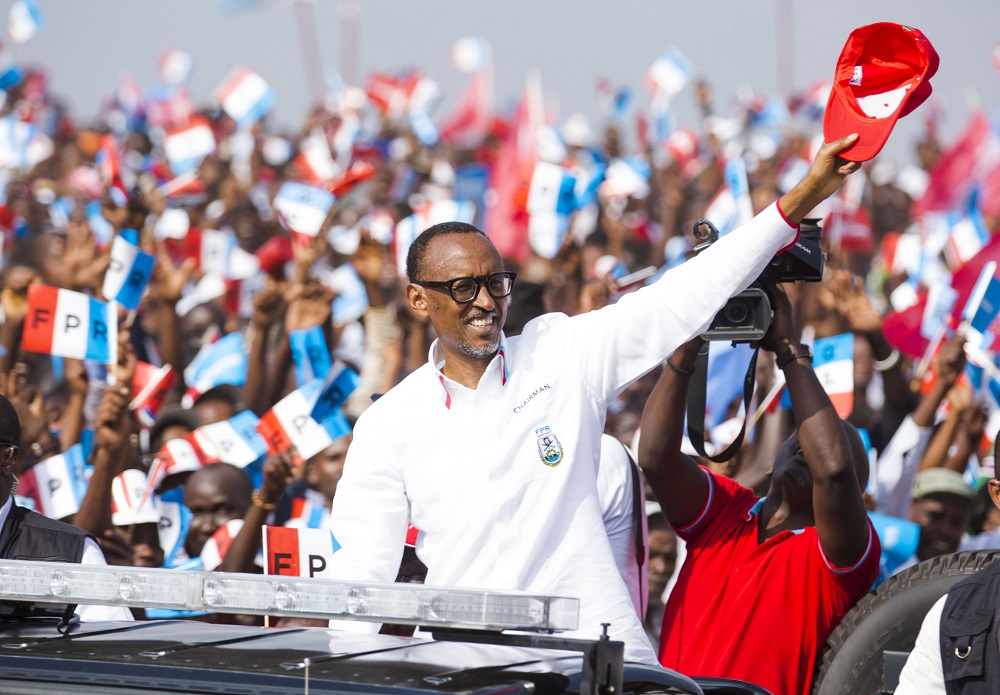
President Kagame on the campaign trail during the July 2024 presidential polls
There is something uniquely enduring about President Paul Kagame’s addresses. Long after he has left the podium, the message his address carries, lingers in the individual minds of his audience. His closing remarks at the RPF (Rwanda Patriotic Front) Bureau Politique Meeting, on 17th July 2026, were no exception. They offered powerful lessons on leadership, responsibility, unity, and the future of the nation.
As with past presidential addresses, overtime the ideas of 17th July are destined to become part of general conversation, raise hitherto unconsidered questions about the day today demands of people’s lives, and for some, become a basis for personal reflection.
Around the country, people habitually return to his words, searching for the ideas that continue to ring loud, long after the applause has faded away, until they are translated into action.
Every speech is less an event and more an invitation to every individual to think, question, and to measure his or her own contribution against the aspirations of the nation.
He summed a profound philosophy in leadership in characteristically simplified terms. “Things will not always be as we want them to be” he told his audience, “there is one sure of making a difference, keep trying. Even when you fail, try again, be stubborn about trying.”
At first glance, the words seemed common place, but the more I reflected on them, the more I realised I had been too beguiled by their simplicity, and lost sight of their profundity.
“Keep trying,” two apparently simple words, but within them was encouragement to persevere in the face of difficulty, a rejection of defeatism, a reminder that no obstacle should ever be accepted as permanent or insurmountable, that instead no stone should be left unturned, until a way is found. It was a reminder that success is seldom the reward of a single attempt, but rather the cumulative result of refusing to stop trying.
In many ways, “Keep trying“ captures the spirit of Rwanda’s own journey- a nation that has repeatedly confronted seemingly insurmountable challenges, not by surrendering to circumstance, but by relentlessly seeking the next possibility, the next solution, and the next opportunity to move forward. If perseverance can become the defining ethic of a people as much as of an individual, then “Keep trying” is more than a memorable phrase; it is an enduring philosophy of leadership, citizenship, and national transformation.
Perhaps no modern Rwandan experience illustrates “keep trying” more vividly than the liberation struggle led by the Rwandan Patriotic Front Inkotanyi. The movement encountered repeated setbacks, from military losses during the early stages of the war, deaths among high ranking military leaders, within days of the start of the start of the military campaign, severe shortages of personnel and resources, political isolation, numerous failed negotiations, and finally the enemy unleashing the Genocide against Tutsi in 1994, as the war raged.
Each setback was grave enough to have brought about the collapse of the struggle. Instead, under the leadership of the then commander of its forces, Paul Kagame, the movement reorganised, reassessed its strategy, and marched on, until Rwanda was liberated and the genocide stopped.
There can be no clearer national expression of “keep trying” than that. Unwavering determination to complete the mission, irrespective of any obstacle.
The beginning of another conversation
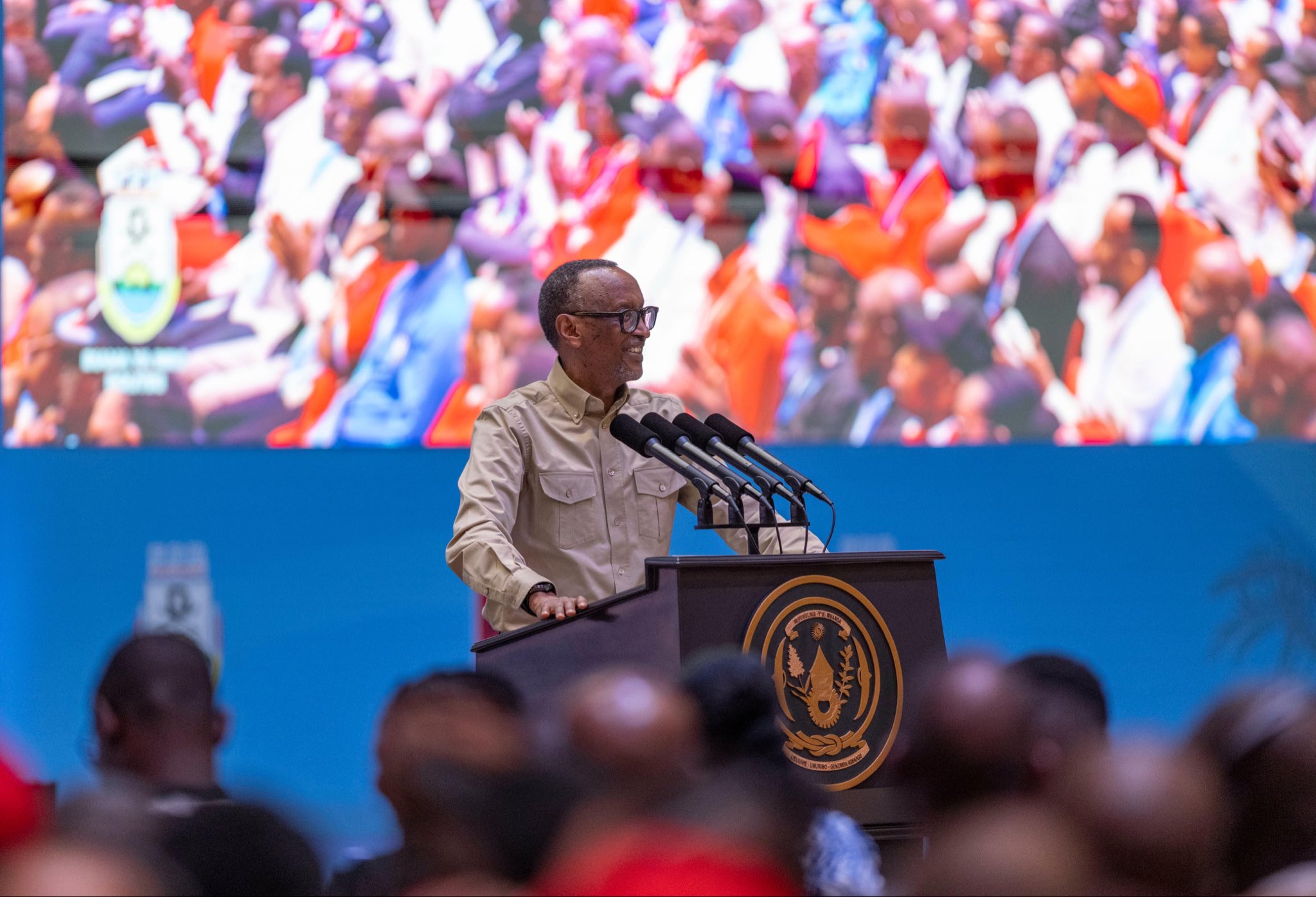
President Paul Kagame speaking at the RPF Congress last week
It has become almost customary for the nation to revisit key messages in President Kagame’s addresses, long after he made them. What was said, what it asks of individual and collective responsibility. These discussions continue to be heard in homes, workplaces, classrooms, and in public spaces, with people reflecting on the speeches’ deeper meaning and the practical implications.
The president touched on a number of ideas during his closing remarks on the 17th July. For most listeners however, two simple words resonated most, “keep trying.”
More than a motivational phrase, it was a philosophy of perseverance—a call to refuse resignation, to continue searching for better solutions, and to exhaust every legitimate possibility until obstacles are overcome. In a nation whose history has repeatedly demonstrated that extraordinary achievements are born from extraordinary resilience, “keep trying” emerged not merely as advice but as an enduring principle of leadership, citizenship, and national transformation.
Beyond optimism: a philosophy of action
In all his addresses, President Kagame emphasizes individual and collective responsibility for change and transformation. “Things will not always be as we want them to be.” The words are a call to banish the comforting illusion that success will come from good intentions alone. They are a reminder that uncertainty is an ever present challenge of leadership.
From identifying the challenge, the President offered a suggestion on how it can be overcome,“there is one sure way of making a difference: keep trying.”
This is neither motivational rhetoric nor blind optimism. It reflects what leadership scholars increasingly describe as adaptive persistence—the willingness to continue learning and adjusting despite repeated obstacles.
Leadership research consistently shows that organizations capable of continuous adaptation outperform those relying on rigid planning alone. Rather than avoiding failure, successful leaders develop systems that transform failure into learning.
Persistence is not repetition

At one of the campaign stops during the 2024 polls, President Kagame had a flu, but that didn’t impact his energy. He put on a musk so that when he arrived, the dust from the thousands of his excites supporters doesn’t worsen the cold. The campaigns went on resulting in a resounding victory
One misunderstanding about perseverance is that it may be taken as simply meaning doing the same thing repeatedly. Research suggests otherwise.
Angela Duckworth’s (2016) work on grit, defines perseverance as sustained passion and effort, directed towards long-term goals rather than stubborn repetition of ineffective actions. More recently, Duckworth has emphasized that grit must be accompanied by learning and adaptation rather than mere endurance.
Similarly, studies examining grit and growth mindset, conclude that persistence becomes most effective when individuals believe that abilities can improve through deliberate effort and feedback rather than fixed traits.
When he says, “even when you fail, try again,” President Kagame, is saying, “when you lose, don’t lose the lesson” as the saying goes. Learn from the mistake and try again, or as the writer, Samuel Beckett, would have it, “ever tried. Ever failed. No matter. Try again. Fail again. Fail better.”
Failure as Information
Many organizations treat failure as evidence of incompetence. High-performing organizations treat failure as information. This distinction explains why innovation ecosystems—from scientific laboratories to entrepreneurial ventures—accept experimentation as an unavoidable component of progress.
Carol Dweck’s ((2006} theory of the growth mindset, argues that individuals who perceive failure as feedback rather than final judgment demonstrate greater resilience, stronger motivation, and higher long-term achievement. Recent empirical studies continue to support the mutually reinforcing relationship between perseverance and growth mindset.
Viewed from this perspective, President Kagame’s message represents an institutional mindset rather than a motivational slogan. A nation, like an individual, advances when setbacks become lessons instead of excuses.
Leadership during uncertainty
Periods of uncertainty expose the true character of leadership. When outcomes are guaranteed, leadership requires administration. When outcomes are uncertain, leadership requires courage.
The appeal to “keep trying“ recognizes that leaders rarely possess complete information before acting. Waiting for perfect certainty often results in paralysis.
Adaptive leadership scholars have long argued that complex challenges cannot be solved through technical expertise alone. They require experimentation, adjustment, collective learning, and persistence over time. The willingness to continue despite imperfect conditions therefore becomes one of leadership’s defining competencies.
The institutional dimension of perseverance
Persistence is often presented as an individual psychological trait.
However, President Kagame’s statement was delivered to political leaders responsible for governing institutions rather than motivating individuals alone. This distinction matters.
Institutions become resilient when they develop cultures where problems are acknowledged honestly, solutions are tested systematically, and failures become opportunities for organizational learning rather than occasions for blame.
In such institutions mistakes are reported instead of concealed; performance is measured through outcomes rather than appearances; adaptation becomes continuous rather than episodic.
Organizational research increasingly identifies these characteristics as central to institutional resilience.
Rwanda’s development experience
Although President Kagame’s statement has universal application, it also reflects Rwanda’s own developmental trajectory. Following the 1994 Genocide against the Tutsi, Rwanda faced institutional collapse, destroyed infrastructure, displaced populations, and profound social trauma.
No single policy reversed these conditions overnight. Progress emerged through repeated cycles of experimentation, evaluation, correction, and renewed effort.
Programs such as decentralization, community-based accountability mechanisms, health reforms, digital transformation, and performance contracts evolved through continuous refinement rather than perfect initial design.
Whether one agrees with every policy choice or not, Rwanda’s development experience illustrates an important principle: lasting transformation rarely occurs through one decisive intervention. It emerges through sustained commitment over decades.
The psychology of hope
Hope is frequently misunderstood as optimism. Psychological research distinguishes the two. Optimism expects positive outcomes. Hope creates pathways toward desired outcomes.
Persistent action sustains hope because every new attempt affirms that change remains possible. Conversely, abandoning effort transforms temporary failure into permanent defeat.
President Kagame’s statement therefore shifts hope from emotion to discipline. Hope becomes something people practice rather than merely feel.
The ethics of persistence
Persistence should not be confused with stubbornness detached from evidence.
Responsible perseverance combines determination with reflection. If President Kagame insists up to the point of encouraging stubbornness about trying, he is referring to commitment to the mission. He is not advocating blind obstinacy.
If a farmer insists on harvesting despite drought, he may change seeds, irrigation methods, planting dates, or farming techniques. He changes how he farms but not why he farms. The mission remains constant. The methods evolve.
This interpretation aligns closely with adaptive leadership theory developed by Ronald Heifetz, who argues that successful leaders preserve their purpose while continuously adapting their strategies to changing realities (Heifetz, 1994).
Why does President Kagame use the terminology “stubborn”?
President Kagame never chooses words accidentally. In this context, “stubborn” is a rhetorical device intended to challenge a deeply rooted human tendency: abandoning effort after repeated disappointment. Most people stop trying not because success is impossible but because discouragement gradually replaces determination.
By saying “Be stubborn about trying, “he shifts stubbornness from being a negative character trait into a positive discipline. Instead of being stubborn about one’s opinions, ego, or mistakes, one becomes stubborn about continuing the journey. This distinction resembles what psychologist Angela Duckworth calls grit—maintaining sustained effort toward long-term goals despite setbacks (Duckworth, 2016).
This means refusing to surrender one’s purpose, including persistence after failure, willingness to learn, resilience under pressure, openness to better solutions, continuous improvement.
This is the stubbornness President Kagame intends to recommend.
Rwanda’s development as an Illustration
President Kagame’s own leadership provides practical examples of this philosophy.
Rwanda’s ambition to become a knowledge-based economy has never fundamentally changed. However, the strategies have evolved continuously.
Examples include agricultural reforms, digital transformation, health financing, performance contracts (Imihigo), decentralization, investment promotion, innovation ecosystems. Each initiative has undergone revisions over time.
The destination remained stable. The pathways evolved.
This is precisely what President Kagame means by being stubborn about trying rather than stubborn about methods. Research shows that resilience is strengthened when individuals interpret failure as temporary and informative rather than permanent and defining (Southwick & Charney, 2018).
People who persist effectively ask: What can I learn?
Those who persist ineffectively ask: How can I prove I was right?
The first attitude generates adaptation.
The second generates rigidity.
A lutta continua!
There is an interesting conceptual exercise. The famous slogan “A luta continua” (“The struggle continues”), popularized during the Mozambican liberation movement by Former President Samora Machel, expresses perseverance through the continuation of struggle.
However, “Keep trying” conveys a somewhat different philosophy. It shifts the emphasis from struggle itself to persistent problem-solving, learning, adaptation, and eventual success. The focus is not on perpetual struggle but on refusing to stop until the objective is achieved. Keep trying until we overcome, perseverance has a destination. Unlike A luta continua, the emphasis is not on endless struggle but on eventual victory.
President Kagame’s appeal to “be stubborn about trying“ should not be interpreted as encouragement to ignore evidence or persist in ineffective action. Continuing to pursue a goal while ignoring new information may become destructive rather than productive.
In this sense, true perseverance is neither passive endurance nor blind obstinacy. It is disciplined determination guided by continuous learning.
Ethical persistence therefore requires three commitments: learning from evidence, adjusting methods when necessary, remaining faithful to long-term purpose.
Conclusion
President Kagame’s appeal to “keep trying” resonates because it expresses a timeless principle rather than a temporary political message. Every generation encounters circumstances that are “not as we want them to be.”
Economic crises, institutional weaknesses, technological disruption, conflict, and personal setbacks are constants of human experience.
What distinguishes successful individuals, organizations, and nations is seldom the absence of failure. It is their response to failure. Persistence, when guided by learning, integrity, and adaptability, becomes more than determination. It becomes a philosophy of leadership.
Ultimately, history tends to reward those who refuse to confuse temporary defeat with permanent impossibility.
As President Kagame reminded his audience, progress is rarely guaranteed—but it remains possible for those who continue to try.
References
Duckworth, A. (2016). Grit: The Power of Passion and Perseverance. Scribner.
Duckworth, A. (2025). How to Create a Successful Mindset: The Science of Passion and Perseverance. Interview with Mel Robbins. Mel Robbins
Duckworth, A., & Quinn, P. (2021). Revisiting the Factor Structure of Grit. Journal of Personality Assessment.
Dweck, C. S. (2006). Mindset: The New Psychology of Success. Random House.
Morales-Navarro, L., Fields, D. A., & Kafai, Y. B. (2024). Understanding Growth Mindset Practices in an Introductory Physical Computing Classroom. arXiv
Park, D., et al. (2022). The Development of Grit and Growth Mindset During Adolescence. PMC
President Paul KAGAME. Closing Remarks at the RPF Bureau Politique Meeting, Kigali, Rwanda, 17 July 2026.
Ambassador Wellars Gasamagera is the immediate-former Secretary-General of the Rwanda Patriotic Front Inkotanyi (RPF Inkotanyi)
