



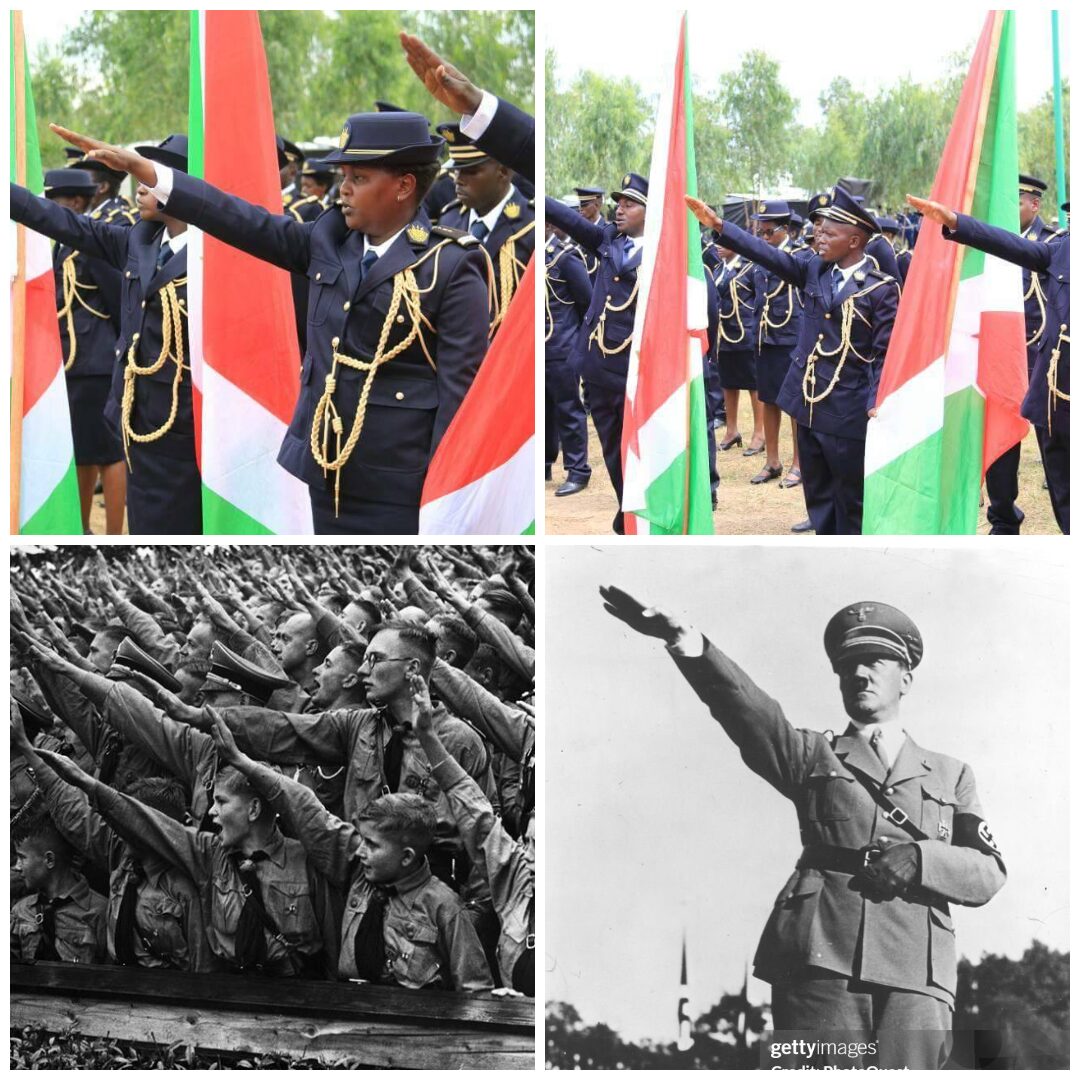
Whether it was 1939, or 2023, the deadly genocide ideology has not died away. Above images show a Police release ceremony in Burundi, with the exact salute as Hitler’s Germany
In recent years, the Great Lakes region has witnessed an alarming and coordinated escalation of targeted ethnic hostility, driven by a revived genocide ideology that targets those identified as Tutsi and anyone labelled as such.
What began as localized hate speech in eastern Congo has metastasized into a state-sanctioned witch-hunt campaign, actively propagated across national borders with the intent to eliminate Tutsis, or those Kinshasa supporters call Nilotiques, from the region.
Under the guise of strategic regional alliances, the political leadership in the Democratic Republic of Congo (DRC) and Burundi, operating in direct collusion with the genocidal FDLR (Forces Démocratiques de Libération du Rwanda), has systematized ethnic scapegoating.
This dangerous coalition leverages historical prejudices, official communication channels, and armed militias to normalize dehumanizing rhetoric, orchestrate widespread violence against Congolese Tutsis while threatening regime change in Rwanda, and undermine the fragile stability established in post-genocide Central Africa.
Adding an intellectual veneer to this genocidal project are figures such as Belgian Filip Reyntjens, who routinely and cynically describe Rwanda as a “minority autocracy,” a term weaponized to imply a Tutsi-dominated state in order to foment ethnic animosity within the country and against it.
Central to this dangerous campaign is an unholy political alliance forged between Burundian President Évariste Ndayishimiye and DRC President Félix Tshisekedi, operating in active connivance with the FDLR, a genocidal armed group founded by the perpetrators of the 1994 Genocide against the Tutsi and figures tied to the genocidal regime in Rwanda, including Fabien Singaye and Jean-Luc Habyarimana.
This coalition has repeatedly signaled its shared agenda through explicit, incendiary declarations. Ndayishimiye has implicitly framed the Tutsi as a “common enemy” that must be confronted, while Tshisekedi has repeatedly framed Congolese Tutsis as having doubtful citizenship.
Adding to these incendiary declarations, Gitega and Kinshasa have granted political legitimacy and operational freedom to the FDLR, following through on their declared regime change agenda and effectively mainstreaming a genocidal militia into regional defense strategies, while turning state institutions into instruments of ethnic persecution.
The physical consequences of this state-sponsored hostility are already devastatingly visible on the ground. In eastern Congo, pastoralist Banyamulenge and Congolese Tutsi communities face relentless, coordinated assaults by the FDLR, operating alongside the Congolese army (FARDC), Burundian forces, and local Wazalendo militias. These joint operations have resulted in public lynching, massacres, systematic looting, destruction of property and livestock, and the forced displacement of hundreds of thousands of civilians into precarious refugee camps across the region.
Concurrently, the FDLR continues to plan military incursions into Rwanda, explicitly seeking to destabilize the nation, reignite ethnic division, and undo three decades of unity, security, and economic progress.
The ideological depth of this threat is further corroborated by chilling testimonies from captured and demobilized FDLR combatants. These fighters consistently reveal the deeply ingrained, indoctrinated FDLR worldview, openly testifying that the group’s primary organizational objective remains launching a full-scale invasion to return to a Rwanda completely cleared of Tutsi presence.
By providing financial support, weaponry, and a shared operational platform to a known genocidal militia, the leadership in the DRC and Burundi is actively fanning the flames of regional destruction. The intentional weaponization of anti-Tutsi rhetoric is no longer a localized security threat; it represents a deliberate, calculated campaign to resurrect a dangerous ideology on a regional scale, culminating in direct interstate confrontation that would inevitably draw in multiple state actors, as it did in the late 1990s.
The international community, particularly regional blocs such as the EAC and SADC, cannot afford to remain silent while state actors openly partner with genocidal forces. Ignoring these clear warning signs risks allowing history to repeat itself across the Great Lakes.
