



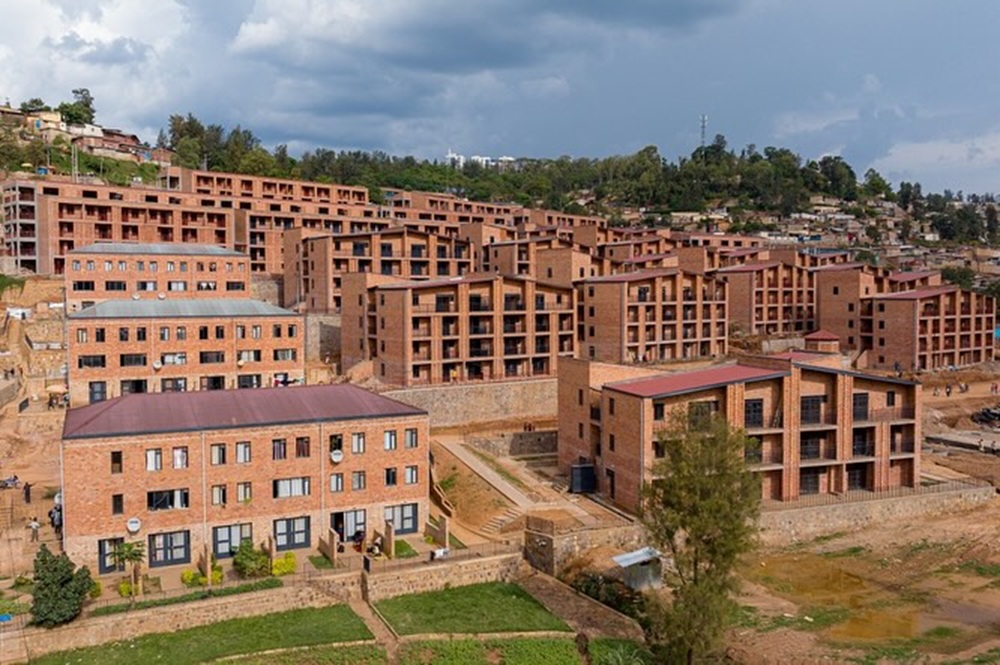
These are 688 housing units constructed under Mpazi Rehousing Model in Gitega Sector, Nyarugenge District, as part of its Govt strategy to upgrade informal settlements.
President Paul Kagame has acknowledged that housing in Kigali has become increasingly expensive for ordinary Rwandans, particularly young people, but said the challenge is a consequence of rapid growth and does not mean Rwanda’s economic gains are benefiting only a small section of society.
Responding to a question at a press conference on August 24 about whether Kigali risks becoming unaffordable to most Rwandans, Kagame said the government was working to address the problem but could not promise that the city’s challenges would disappear.
“I can’t tell anybody the lies that, yeah, I have a solution. That next year when you come back, you’ll find I have sort of the this problem… no, I will be telling lies,” Kagame said.
He said Kigali’s rapid expansion, population growth and rising demand were inevitably creating new pressures that the government had to continuously manage.
“The city is growing, the population is growing, the demands are growing of everybody. We are trying to cope,” he said.
Growth Not at the Expense of Others
Kagame argued that the housing challenge should be viewed alongside the broader improvement in living conditions across Rwanda over the past 15 years.
He said economic growth had not been concentrated in Kigali or among a narrow group of Rwandans, but had produced improvements across the country.
“Wherever, whichever part of the corner of this country you go to, you find improvement for ordinary people,” he said.
Kagame went further, arguing that Rwanda’s economic expansion has been relatively evenly distributed.
“The country is growing, and it is growing, not some people growing at the expense of others. I think you find that growth is really more or less evenly distributed across the country, better than you will find any other country. I would even say that,” he said.
He acknowledged that this did not mean Rwanda had solved all its economic and social problems.
“There are problems. There are many problems to deal with. We just have to deal with them and keep going,” Kagame said.
Housing Remains a Challenge
Kagame acknowledged that housing and real estate prices remain beyond the reach of many Rwandans.
“You are talking about real estate. It’s not even that. There are many more things. Yes, yes, they are very expensive for modern Rwandans,” he said.
But he argued that the government had made significant progress in improving the welfare of ordinary citizens, including outside the capital.
“At least you are aware the last, like the last 15 years, we have resolved that problem for the most, the majority of Rwandans across the country, not just the city,” he said.
His comments suggest that the government sees Kigali’s housing affordability problem partly as a consequence of the same economic and urban growth it is seeking to promote.
Kagame said there was no point pretending that Rwanda—or any rapidly developing city—could reach a stage where all problems disappear.
“If there is any moment you come and find we have no problem, or you go around and not see any problem,” he said.
The challenge, he added, is to ensure that Rwanda continues making progress while addressing the problems created by that growth.
