



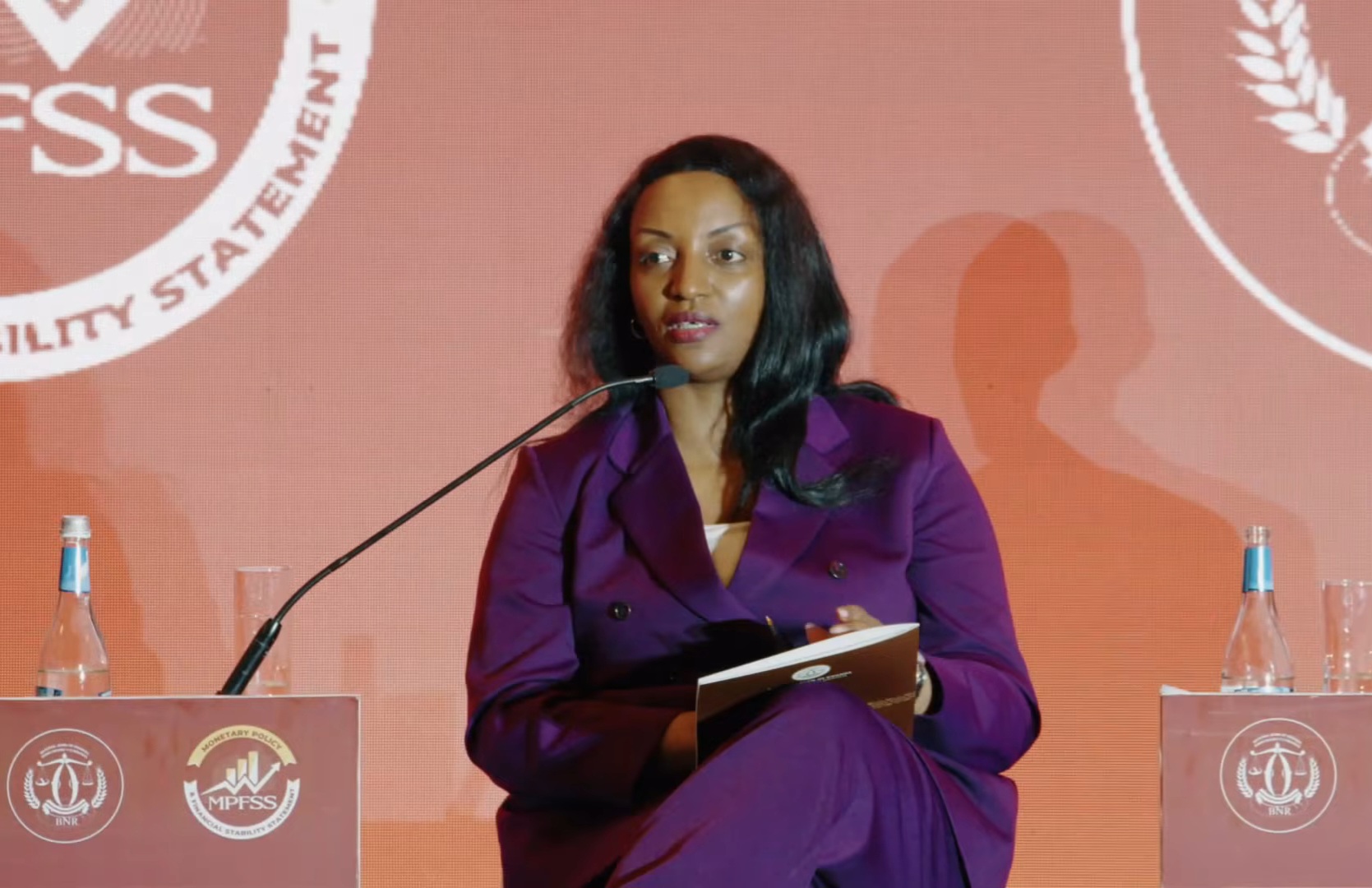
Central Bank Governor Soraya Hakuziyaremye speaking on Thursday
KIGALI — Rwanda’s pension contributions rose by 51.7% to Rwf457 billion in the year to June 2026, as reforms to the pension system combine with stronger investment performance and improvements in the management of pension funds.
National Bank of Rwanda Governor Soraya Hakuziyaremye announced the figures Thursday, October 8, 2026, while presenting the Monetary Policy and Financial Stability Statement to stakeholders.
Pension contributions increased from Rwf301 billion in June 2025 to Rwf457 billion in June 2026, according to the statement. Pension benefits paid also increased by 35.7% to Rwf101 billion, from Rwf75 billion a year earlier.
Contributions to Ejo Heza, Rwanda’s long-term savings scheme, also rose by 30% to Rwf14 billion from Rwf11 billion over the same period.
More than mandatory contributions
The increase in pension contributions follows major changes to Rwanda’s pension system that increased the mandatory contribution rate from 6% to 12% of gross salary from January 2025.
The contribution is shared equally between employers and employees.
The contribution base was also expanded, meaning more components of workers’ earnings are taken into account when calculating pension contributions.
But according to Bernard Nsengiyumva, Executive Director of the BNR Financial Stability Directorate, the growth in the pension sector is not only a result of mandatory contributions.
Speaking during a panel discussion after the Governor’s presentation, Nsengiyumva identified three other factors behind the growth.
They are the implementation of safe investment strategies, income generated from investments, and reviews of information technology systems and operations to improve services to members.
The investment component is particularly important because pension contributions are invested to generate additional income for the system.
The stronger performance is also reflected in the wider financial position of the pension sector.
The central bank presentation shows that pension assets stood at Rwf3.2 trillion in June 2026, an increase of 38%. Total financial-sector assets reached Rwf17.5 trillion, up 22.8% year-on-year.
Minimum pension rises

The improved performance has also been accompanied by higher pension benefits.
Nsengiyumva said the minimum pension benefit has increased from about Rwf13,000 to around Rwf33,000.
The increase is intended to provide greater financial support to pensioners during retirement.
The central bank’s figures show that total pension benefits paid rose from Rwf75 billion in June 2025 to Rwf101 billion in June 2026, a 35.7% increase.
The changes come as Rwanda gradually increases the amount workers and employers put into the pension system.
The contribution rate is scheduled to rise further in the coming years, reaching 20% by 2030.
RSSB expands investment portfolio
The latest pension figures also come shortly after the Rwanda Social Security Board (RSSB) took full ownership of three major Rwandan companies in a series of transactions completed in August and September.
RSSB acquired the remaining shares in Inyange Industries and Ruliba Clays, giving it full ownership of both companies. It also acquired BK General Insurance for Rwf31.7 billion.
Before the transactions, RSSB already held 40% of Inyange and 50% of Ruliba. It bought the remaining shares from Crystal Ventures Limited.
The acquisitions came as RSSB’s assets under management reached about Rwf3.9 trillion at the end of June 2026, according to RSSB management. The institution has described the transactions as part of a new five-year strategy focused on extracting greater value from existing assets and pursuing sustainable, long-term, risk-adjusted returns for its members.
The transactions therefore give RSSB a larger direct investment footprint in the food-processing, construction-materials and insurance sectors.
Wider financial sector remains resilient

The pension growth comes against a broader expansion of Rwanda’s financial sector.
The central bank said the financial system remains resilient, supported by strong capital and liquidity positions, while payment systems remain stable and reliable. It also said financial institutions are continuing their digital transformation while strengthening cybersecurity.
Digital payments have also expanded rapidly.
The value of retail payments reached Rwf27.8 trillion between January and June 2026, up 36% from Rwf20.4 trillion in the same period of 2025. The central bank attributed the acceleration partly to the rollout of eKash.
By September 2026, eKash had 10.3 million active accounts and 28.9 million transactions, with an average success rate of 97.8% since its rollout.
Regional central banks benchmark Rwanda
The presentation also brought together financial-sector players from Rwanda and central banks from across Africa and beyond.
Hakuziyaremye said delegations from the central banks of Sweden, Uganda, Egypt, Kenya, Zambia, Tanzania, Somalia and South Sudan were attending the session.
She said the delegations were in Rwanda for benchmarking, alongside players from the banking, insurance and pension industries.
The participation of the foreign central banks comes as Rwanda showcases developments in its financial sector, including pension management, digital payments, financial stability and the use of technology in financial services.
For the pension system, the latest figures point to a combination of higher mandatory contributions, stronger investment income, changes in investment strategy and improvements in the systems used to serve members.
The increase in benefits means the reform is also beginning to show on the other side of the system, with more money being paid to retirees as the pension fund grows.
