



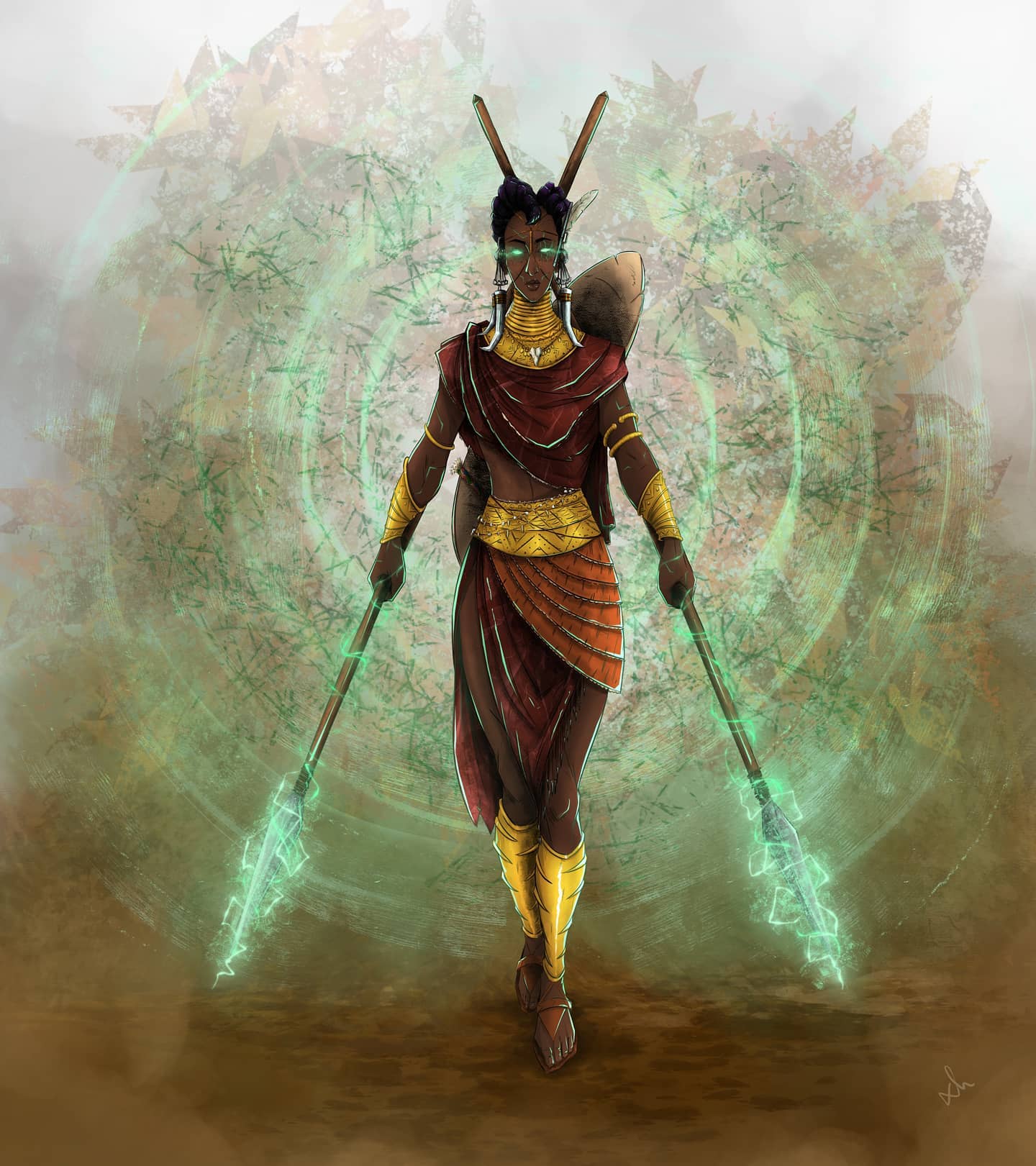
The legendary Virgin Nyabingi, originally known in Kinyarwanda as Princess Nyabyinshi, is a revered historical and spiritual figure across Rwanda, Uganda, and Tanzania. Known as the “Conqueror of Nations,” she evolved from a 16th-century warrior princess into a powerful goddess of abundance, justice, and absolute defiance against colonial oppression.
To understand Rastafari, we must begin in Jamaica, but the story does not belong to Jamaica alone.
Jamaica is a Caribbean island shaped by African displacement, slavery and British colonialism. By the early twentieth century, Black Jamaicans were searching for spiritual dignity and African historical memory. Ethiopianism and Marcus Garvey’s Pan African thought became powerful influences.
Then, on 2 November 1930, Ras Tafari Makonnen was crowned Emperor Haile Selassie I of Ethiopia. For some Jamaicans, the coronation appeared to fulfil biblical prophecy. Rastafari emerged from this environment during the 1930s.
But there is a much older African thread.
Nyabingi existed before Rastafari
Historical research places Nyabingi traditions among the Kiga/Bakiga and Banyarwanda of Kigezi in southwestern Uganda and northern Rwanda, with a history extending roughly two centuries. Nyabingi was understood as a powerful female spiritual presence, associated with protection, fertility, healing and authority. The tradition was mediated by bagirwa, spiritual practitioners who could enter trance and communicate with Nyabingi.
Its history also became political. Muhumuza, one of the best-known Nyabingi figures, became associated with resistance to political and colonial authority in the Great Lakes region. Her story belongs to the complicated history of Rwanda, Uganda and the borderlands between them.
Then the name travelled.
When Rastafari emerged in Jamaica, Nyabinghi was adopted and transformed within the movement. It became associated with the House of Nyabinghi, one of Rastafari’s major traditions. But we should not confuse the two histories: Jamaican Nyabinghi is not simply the unchanged continuation of the older Rwandan-Ugandan tradition. Something more extraordinary happened next.
Nyabinghi became rhythm.
Rastafari developed Nyabinghi drumming for worship, chanting, reasoning and communal gathering. The bass establishes the deep foundation; the fundeh maintains the repeating pulse; the kete or repeater improvises above them. One holds the ground, one sustains continuity, one speaks freely.
There is almost a philosophy hidden inside the rhythm:
Individual expression becomes possible because community provides the foundation.
Then Jamaica created another revolution.
Reggae was not invented by Rastafari. Jamaican popular music evolved from mento, ska and rocksteady, incorporating African-derived traditions, Caribbean forms and North American rhythm and blues. By the late 1960s, reggae had emerged. Rastafari, however, profoundly shaped its spiritual and political vocabulary.
Reggae became a vehicle for speaking about Babylon, Zion, Africa, injustice, resistance, love and God. Bob Marley, Peter Tosh, Bunny Wailer, Burning Spear and countless others carried those ideas beyond Jamaica. UNESCO now recognizes Jamaican reggae as Intangible Cultural Heritage, noting its social, political, spiritual and intellectual dimensions.
And suddenly, the journey becomes astonishing:
Rwanda and Uganda → Nyabingi → Jamaica → Rastafari → Nyabinghi rhythm → reggae → the world.
A spiritual tradition from the Great Lakes entered a Jamaican movement, became ritual percussion, influenced a global musical language and returned to Africa as something the world recognized as Jamaican. That is more than cultural history. It is a lesson in how civilisation works. Ideas migrate. Cultures borrow. Symbols change meaning. Music carries memory farther than textbooks sometimes can.
Rastafari therefore cannot be understood merely through dreadlocks, reggae or religion. It became a way of reasoning about life, oppression, nature, God, community and liberation. Its influence travelled far beyond its relatively small formal membership because culture does not require a majority to become powerful.
For East Africa, there is an uncomfortable question here. How many things born in our communities have travelled outward, been transformed elsewhere, commercialized, intellectualized and returned to us as foreign creations?
Perhaps the greatest irony is that we may have been listening to reggae for decades without recognising that somewhere inside its rhythm is a distant echo of our own Great Lakes history. The drum crossed the ocean. The memory survived. And eventually, the world danced to it.
James Kaliisa is Co Founder & CTO of Nexus Inc., a Rwandan deep tech company building sovereign artificial intelligence infrastructure and digital systems for Africa.
