


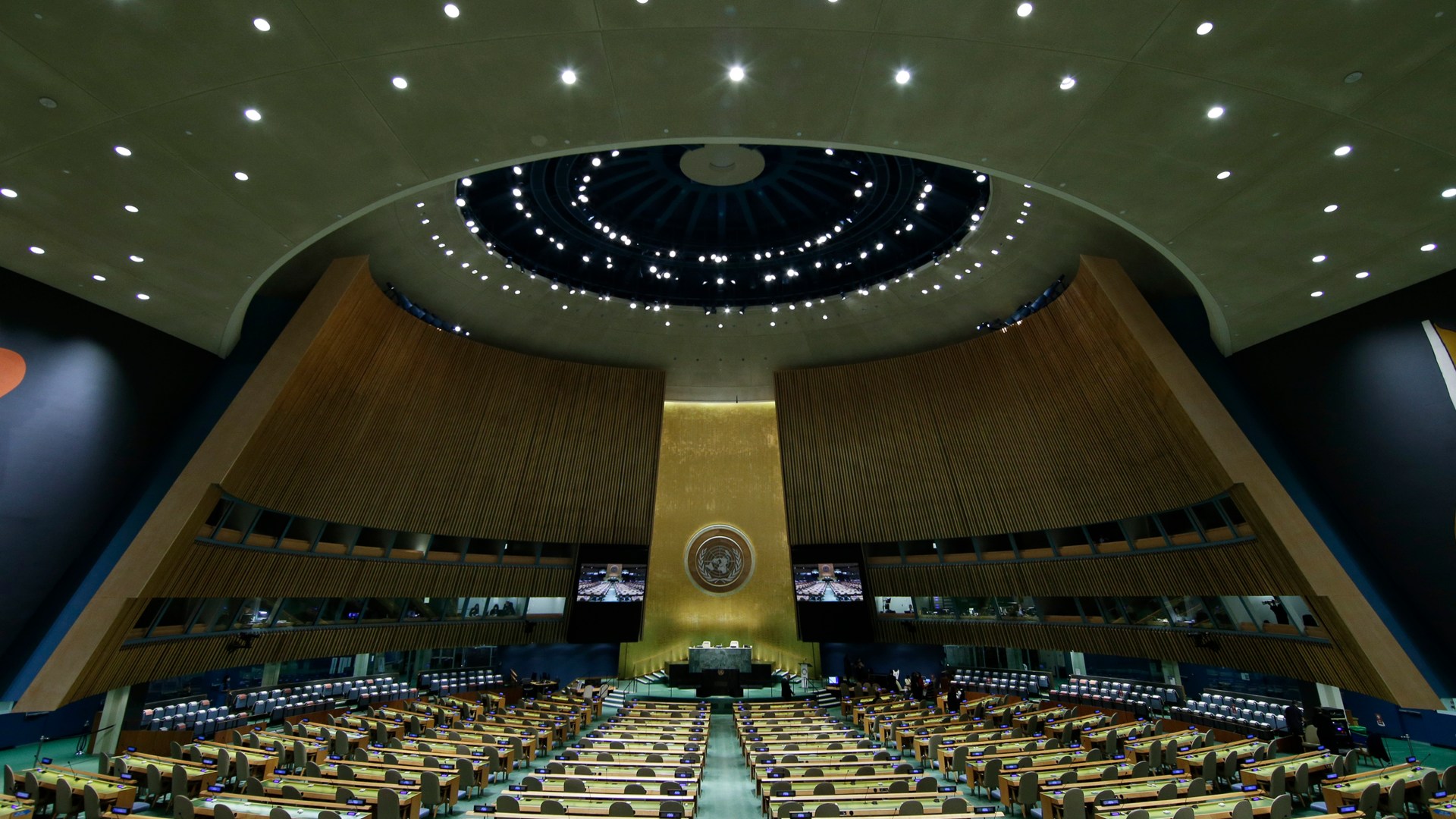
NEW YORK — The world’s most powerful leaders gather in New York for the high-level General Debate of the 81st United Nations General Assembly, under a theme that sounds less like a slogan than a warning: “Restoring trust, managing transformation: a United Nations that delivers for all.”
Before the speeches begin, the United Nations faces an uncomfortable question: How can an organisation credibly lead the world towards peace when some of the powers entrusted with protecting international peace are themselves parties to major conflicts?
This is the contradiction at the heart of today’s international order.
The United Nations was created after the Second World War to prevent another global calamity. At the center of its security architecture sit five permanent members of the Security Council the United States, Russia, China, France and the United Kingdom whose special responsibilities are matched by an extraordinary privilege, the veto.
Two of those permanent powers, Russia and the United States, are now directly involved in major armed conflicts Russia with Ukraine and the United States in the conflict with Iran.
The circumstances are not identical, nor should their competing legal arguments be casually equated. Yet together they expose a profound contradiction between the UN’s peacekeeping mandate and the conduct of states entrusted with exceptional authority.
When the guardians become participants
Russia’s full-scale war with Ukraine has made this contradiction particularly stark.
In 2022, the General Assembly voted 141 to 5 to demand that Russia end its use of force and withdraw its troops from Ukraine. Yet Russia remains a permanent member of the Security Council, with the power to veto substantive Council action.
The dilemma is obvious: the body charged with maintaining international peace can be severely constrained when one of its most powerful members is itself a party to war.
The United States presents another dimension of the same problem.
On 28 February 2026, Washington launched military strikes against Iran and invoked the right of self-defence under Article 51 of the UN Charter. Iran has rejected that justification. The UN Secretary-General condemned the US-Israeli strikes and subsequently condemned Iranian attacks across the region, warning that the escalation threatened international peace and security.
The legal arguments remain contested. They should be judged according to international law and evidence, not political allegiance.
But the larger question is unavoidable: If international rules are to command respect, can they remain credible when their application appears weakest precisely where power is greatest?
This is not simply a problem of Russia or the United States. It is a structural problem.
And at the centre of that structural problem is the veto.
Under the UN Charter, substantive Security Council decisions require nine affirmative votes, including the concurring votes of the permanent members. In practice, this means that any one of the five permanent members can prevent the Council from adopting a substantive resolution, even when the majority of Council members support it.
The veto was designed to ensure that the major powers remained invested in the international security system. But it also creates an extraordinary imbalance: five states possess a power that the rest of the UN membership does not.
The question, therefore, is not simply whether the veto should exist. It is whether such exceptional power can remain legitimate without equally exceptional responsibility and accountability.
Africa does not watch great-power politics from a distance
For decades, African countries have lived with the consequences of decisions made in distant capitals. Wars and geopolitical rivalries elsewhere reach Africa through food and energy prices, disrupted trade, refugee flows, arms markets and diplomatic pressure.
The continent therefore has a direct stake in how powerful states exercise military and diplomatic power.
Yet Africa has little permanent influence over the institution making some of the most consequential decisions on international peace and security.
That brings us to the second question: Why does Africa still not have a permanent seat on the Security Council?
Africa’s demand is about power, not prestige
For more than two decades, African governments have demanded permanent representation on the Security Council. Through the Ezulwini Consensus and Sirte Declaration, the African Union has called for at least two permanent African seats with full prerogatives, including the veto for as long as the veto exists, alongside five additional non-permanent seats.
When the Security Council was created in 1945, most of Africa was still under colonial rule. African states therefore had little opportunity to participate as sovereign equals in designing the institution that would later make decisions affecting their security.
Today, Africa has 54 UN member states and represents roughly 28 per cent of the organisation’s membership. African crises also feature prominently on the Security Council’s agenda.
Yet the continent remains without a permanent voice.
UN Secretary-General António Guterres has repeatedly argued that this imbalance is no longer defensible. At the African Union summit in February, he declared that the absence of permanent African seats was “indefensible” and insisted: “This is 2026 — not 1946.”
Africa’s demand is therefore not merely for a prestigious chair in New York.
It is a demand for a greater say over decisions whose consequences Africans often have to live with.
But representation alone would not automatically translate into power. Africa’s 54 states have different interests, alliances and foreign-policy priorities. A permanent seat occupied by one African country could become the seat of that country rather than the institutional voice of the continent.
For the seat to become genuinely consequential, Africa would need stronger continental coordination, greater diplomatic cohesion and the economic and strategic capacity to support its positions.
The question before UNGA 81
The deeper issue confronting UNGA 81 is larger than Ukraine, Iran or Africa’s permanent-seat campaign.It is about the credibility of the international system itself.
If sovereignty matters for Ukraine, it must matter elsewhere.
If territorial integrity matters for one state, it must matter for another.
If international law binds weaker countries, it must bind powerful ones too. And if permanent members are entrusted with greater responsibility for maintaining peace, that privilege should carry greater accountability, not greater exemption from scrutiny.
The UN’s own theme this year is about restoring trust.
Trust will not be restored through speeches alone. It will be restored when rules are applied consistently, power does not place countries beyond accountability, and institutions created in 1945 are prepared to reflect the realities of 2026.
That is why Africa’s demand for a permanent seat matters.
It is not simply about putting an African flag beside the flags of the five permanent members.
It is about whether the international order is willing to distribute responsibility more fairly and whether those entrusted with extraordinary power are prepared to accept extraordinary responsibility.
The deeper question is whether the international community can reform the system without reproducing the inequalities that made reform necessary in the first place. As leaders take the podium in New York this week, they will speak about peace.
The harder task is to make the institution they represent worthy of believing in.
Africa is asking for a seat at the table.But perhaps the more important question is this:
Will the world finally change the table?
The author, Sylivanus M. Karemera is Station Manager, KT Radio 96.7FM, which is under Kigali Today Ltd
