



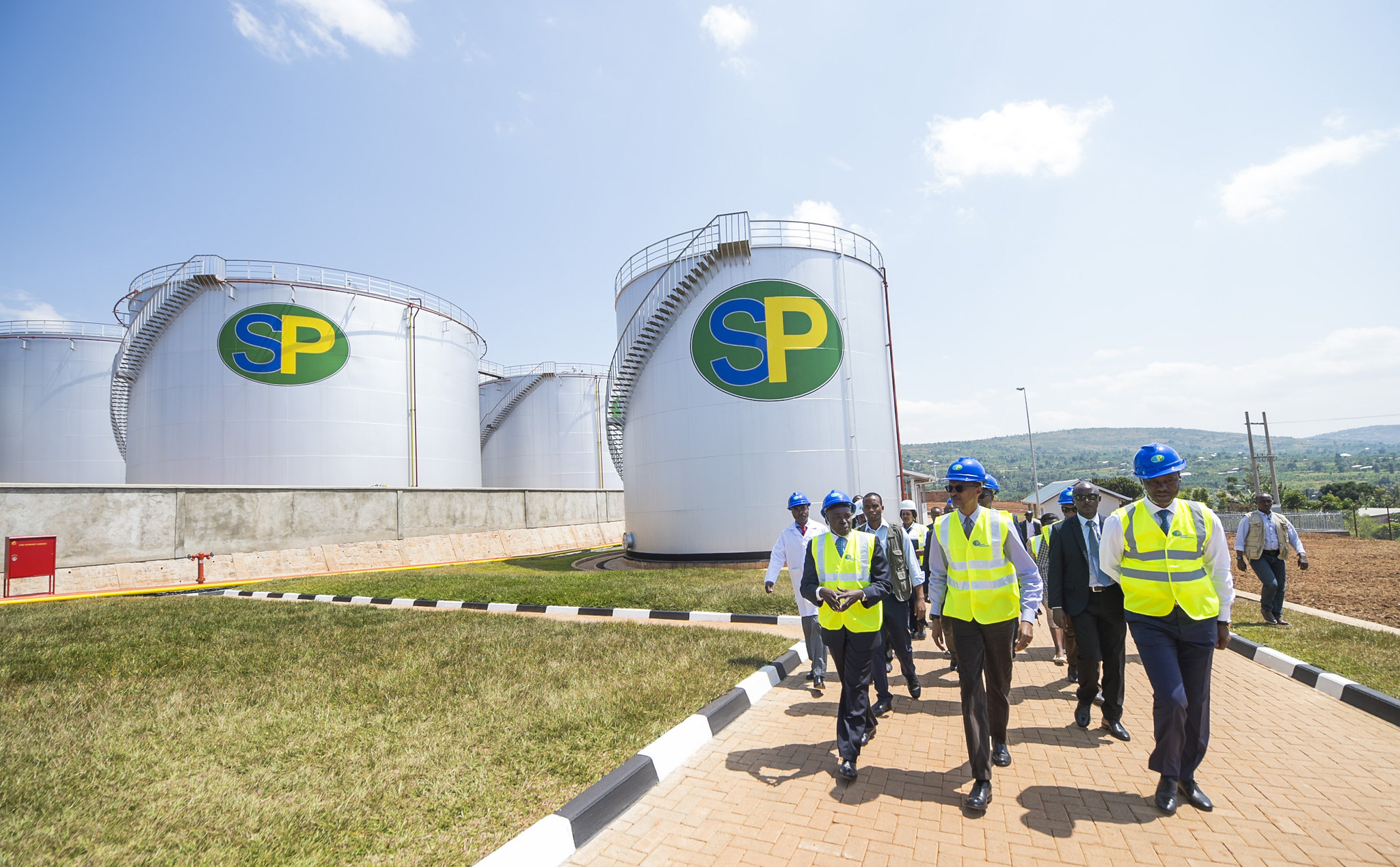
Inauguration by President Paul Kagame of the SP Rusororo Fuel Depot | Gasabo District, 11 June 2016. It is one of the country’s strategic storage facilities
MOMBASA — Rwanda has received its first government-backed shipment of refined petroleum products through Kenya, marking the operational launch of a new fuel import route designed to strengthen the country’s energy security and reduce dependence on a single supply corridor.
The 40,000-metric-tonne cargo, carried by the vessel MT Sea Wolf, arrived at the Kenya Pipeline Company’s Kipevu Oil Terminal 2 (KOT2) in Mombasa on Tuesday.
The shipment is the first under a new framework that allows Rwanda to independently source bulk refined petroleum products while using Kenya’s port, pipeline and storage infrastructure to move the fuel towards Rwanda through the Northern Corridor.
The milestone was marked in Mombasa by Kenya’s Cabinet Secretary for Energy and Petroleum, James Opiyo Wandayi, and Rwanda’s Minister of State in the Ministry of Infrastructure, Armand Zingiro.
“This is a proud milestone for Kenya and for our partnership with Rwanda,” Wandayi said. “The arrival of this maiden cargo through Kipevu is the practical result of nearly three years of close collaboration between our two governments.”
The new arrangement is based on agreements signed by Rwanda and Kenya on June 29, 2026.
The framework includes a Memorandum of Understanding between the two governments, a Tripartite Agreement involving the governments and Rwanda National Energy Company (RNEC), and a Transport and Storage Agreement between RNEC and Kenya Pipeline Company.
The agreements provide Rwanda access to Kenya’s petroleum infrastructure for transportation, storage, scheduling and handling of its fuel imports.
Rwanda’s Minister of State Armand Zingiro said the new route would provide the country with a more reliable way of importing petroleum products needed by the economy.
“Today’s ceremony marks the culmination of a shared vision between Rwanda and Kenya to strengthen our energy security through regional cooperation,” Zingiro said.
A new strategy for fuel security
The arrival of the cargo follows a broader shift in Rwanda’s petroleum import strategy.
Rwanda is a landlocked country that imports all of its refined petroleum products, making the reliability and cost of transport routes critical to fuel supply.
For years, petroleum products have reached Rwanda primarily through the Central Corridor from Tanzania and the Northern Corridor from Kenya through Uganda.
But disruptions in global energy markets and volatility in oil prices earlier this year exposed the risks associated with relying heavily on existing supply arrangements.
KT Press reported in July that Rwanda was responding by establishing two government-backed fuel corridors — through Kenya and Tanzania — giving the country greater control over procurement, transportation and storage.
The Tanzania route became operational in July when the first 40,000-tonne government-backed fuel shipment arrived at the Port of Tanga under an agreement between RNEC and Gulf Bulk Petroleum Tanzania.
The Kenya route now joins that system.
The two arrangements are intended to complement rather than replace Rwanda’s existing supply network. KT Press reported that the Central Corridor through Dar es Salaam remains the country’s principal gateway for general cargo, with more than 70 percent of imports continuing to pass through Tanzania.
500 million litres a year
The Kenya agreement is expected to significantly increase the volume of petroleum products moving through the Northern Corridor.
Under the framework, Rwanda’s petroleum imports through Kenya are projected to rise from roughly 42,000–50,000 cubic metres in 2025 to more than 500,000 cubic metres annually, equivalent to about 500 million litres.
Kenya has also agreed to give Rwanda greater flexibility in managing its fuel stocks by extending the storage period for Rwanda-bound petroleum products in Kenya Pipeline Company facilities from 35 days to as much as 90 days during an initial two-year period.
The longer storage window is intended to allow Rwanda to build strategic stocks and manage imports more flexibly during periods of price volatility or disruption.
RNEC has also been registered in Kenya and licensed by the Energy and Petroleum Regulatory Authority to import, export and wholesale petroleum products, completing the regulatory framework for the new arrangement.
Diversifying beyond one corridor
The move comes as Rwanda seeks to make its fuel supply chain more resilient.
In May, KT Press reported that Rwanda’s dependence on imported fuel leaves it particularly exposed to international energy shocks, since most refined products ultimately originate from markets outside East Africa and are transported through regional ports and corridors.
The government subsequently moved to establish dedicated arrangements through both Kenya and Tanzania.
The new system gives Rwanda access to Mombasa and Tanga in addition to the existing Dar es Salaam route, creating more options for securing fuel when global prices, shipping conditions or regional logistics are disrupted.
The two governments say the Kenya arrangement will also strengthen regional integration by making greater use of existing infrastructure along the Northern Corridor.
For Kenya, the agreement provides an opportunity to increase the use of its port, pipeline and storage infrastructure and deepen trade with Rwanda and other landlocked markets in the region.
For Rwanda, the immediate objective is to ensure that fuel remains available even when one route or source becomes constrained.
The arrival of the MT Sea Wolf therefore marks more than the delivery of another fuel shipment. It puts into operation a new component of Rwanda’s long-term strategy to diversify how the country buys, transports and stores the petroleum products on which its economy depends.
