



Rwanda today and the capacity to anticipate
As Rwanda just marked the beginning of the successful struggle to liberate the nation from the grip of genocidal forces, we always wonder how enough should the sacrifice of the liberators who paid the highest price for liberation of the people and national rebirth be honored today.
Rwanda today stands at a different point in the historical trajectory of her developmental journey. The country is no longer principally confronted with the emergency of physical reconstruction that characterized the years immediately following the genocide against the Tutsi. The central challenge has progressively shifted from rebuilding a society that had been devastated to transforming that society into a productive, innovative and knowledge-based economy capable of generating opportunities for a growing population.
The highest evolution of revolutionary leadership occurs when a culture of struggle is transformed into a culture of relentless problem-solving. Rwanda’s experience illustrates this transition. The courage, discipline, sacrifice, solidarity and strategic patience associated with revolutionary mobilization have progressively been redirected from political survival toward reconstruction, development and innovation. The battlefield has moved from defeating adversaries to overcoming poverty, weak institutions, inadequate infrastructure, unemployment, low productivity and technological vulnerability.
Rwanda’s experience therefore raises a broader question for contemporary societies: how can the discipline that enables a society to survive crisis be converted into the capacity to anticipate and solve problems that are yet to emerge but are certain to. An analysis of Rwanda’s revolutionary, transformational leadership, as it guides the nation through the challenges of an uncertain, complex global environment, may point to at least some of the answers.
From liberation to problem-solving
Revolutionary movements are normally shaped by exceptional conditions: insecurity, injustice, political exclusion or existential threat. Their effectiveness depends on courage, ideological conviction, discipline, sacrifice, solidarity, strategic patience and collective action.
Development on the other hand, presents a fundamentally different challenge. There is no final victory. Roads must be maintained, schools must provide learning, energy to drive productivity must be produced, health systems must be established and economic growth must be maintained for all these services, creation of employment, opportunity, and much more. The logic of liberation must evolve into the logic of continuous transformation.
Rwanda’s trajectory can be understood through four successive transformations: liberation, survival and reconstruction, development, and innovation. Each stage preserves elements of the previous one while changing the object of collective effort. The “enemy” consequently becomes poverty, insecurity, social fragmentation, institutional weakness, inadequate infrastructure, unemployment, poor health and educational deficits. The soldier’s battlefield is complemented by the classroom, farm, hospital, laboratory, enterprise and public institution. Patriotism fuels the citizens’ contribution to solving national challenges.
From reconstruction to measurable
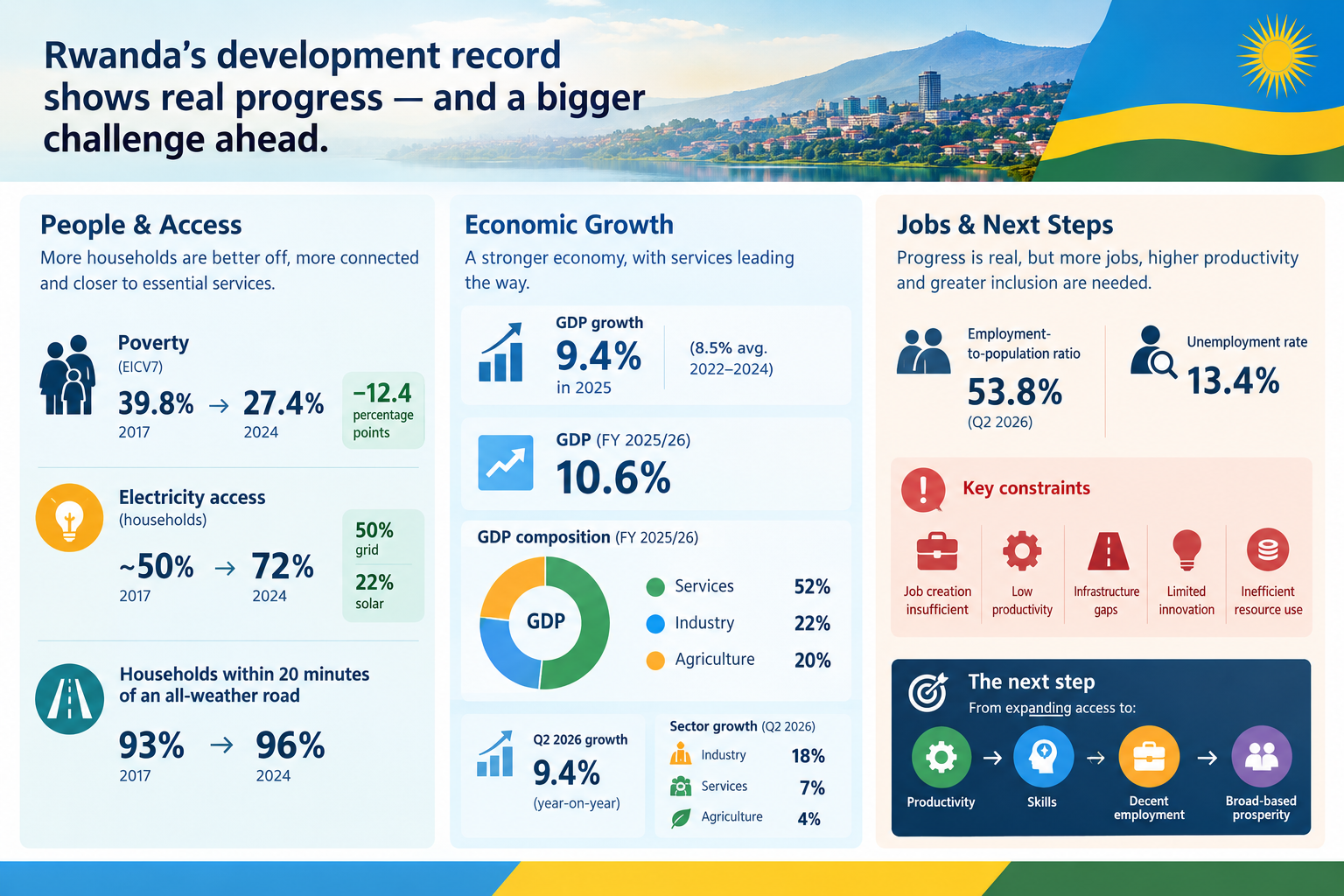
Rwanda’s development record records major changes, it also reveals more challenges. The latest EICV7 household survey shows poverty falling from 39.8% in 2017 to 27.4% in 2024, a reduction of 12.4 percentage points. Electricity access reached 72% of households in 2024, compared with roughly half that level in 2017; 50% were connected to the grid and 22% used solar systems. Moreover, 96% of households were within 20 minutes of an all-weather road, compared with 93% in 2017.
The economic expansion has continued. Rwanda’s GDP grew 9.4% in 2025, after average growth of 8.5% during 2022–2024. More recent national accounts show that GDP increased by 10.6% in fiscal year 2025/26, with services accounting for 52% of GDP, industry 22% and agriculture 20%. In the second quarter of 2026, GDP grew another 9.4% year-on-year, with industry expanding by 18%, services by 7% and agriculture by 4%.
These figures demonstrate progress but also bring new development challenges into sharp relief. According to the World Bank, job creation remains inadequate, productivity relatively low, innovation limited and inefficient allocation of resources constraining efforts to ensure inclusivity of growth. Rwanda’s employment-to-population ratio was 53.8% in Q2 2026, while unemployment stood at 13.4%. The challenge has therefore shifted: from expanding access to converting access into productivity, skills, decent employment and broad-based prosperity.
From the developmental state to the developmental society
This shift suggests a further evolution in Rwanda’s development model: from a developmental state toward a developmental society. The state remains essential for strategy, coordination, infrastructure and institution-building, but it cannot solve every problem. Sustainable problem-solving capacity must increasingly come from universities, research institutions, private enterprises, communities, schools, civil society and technology ecosystems. The teacher, farmer, engineer, researcher, entrepreneur and civil servant become not merely beneficiaries of development but producers of solutions.
The salient question is whether institutions generate learning, productivity, inclusion and accountable problem-solving. Rwanda’s model has never pretended to be universal. The focus has but been on a constant quest for solutions adapted to its context and needs.
The next frontier is innovation. Rwanda’s next phase cannot be defined simply as a continuation of reconstruction. It requires a transition from a developmental state that mobilizes resources and builds institutions to a developmental society in which knowledge, creativity and problem-solving capacity are distributed throughout society. Universities, researchers, entrepreneurs, farmers, engineers, teachers, communities, civil servants and young innovators must increasingly become producers of solutions rather than only recipients of policies.
Rwanda’s Digital Acceleration Program, supported by a $200 million World Bank/AIIB programme, is expanding broadband, digital public services and support for technology enterprises. By late 2025, 22 start-ups had received funding across areas including health technology, mobility, agriculture, fintech and artificial intelligence.
Globally, artificial intelligence is reinforcing the need to move from importing solutions to adapting, creating and eventually exporting them. The World Bank identifies connectivity, computing capacity, data and skills as foundational requirements for inclusive AI adoption.
From resilience to anticipation
The greatest transition is therefore from resilience after crisis to innovative anticipation of crises. Resilience enables societies to recover from shocks; innovation enables them to anticipate, absorb and transform emerging challenges. Climate change, pandemics, demographic pressure, technological disruption and geopolitical instability require a continuous capability to identify problems, understand complexity, mobilize knowledge, experiment, measure results, learn from failure and scale what works.
For the transformation of revolutionary discipline into developmental learning therefore, a particular cycle must be maintained, where issues are identified early, analyzed, and a course for their solutions charted. There must continue to be a clear understanding of the present context of any challenges, measuring the results of implemented solutions, continuously improving and learning from them, the better to anticipate future ones.
This cycle also provides a practical bridge between the four stages of Rwanda’s trajectory. Liberation requires courage and sacrifice, reconstruction requires urgency and institution-building, development requires planning, productivity and service delivery, while innovation requires creativity, science, experimentation and adaptability.
The implication extends beyond Rwanda. The central leadership question of the contemporary world is no longer simply whether a society can mobilize people against a common adversary. It is whether it can mobilize knowledge and collective capability against continuously changing problems.
A different meaning of struggle
If yesterday, the language of the struggle was…A luta continua… it must include aiming at continuous transformation of society. The historical achievement of revolutionary leadership is not to preserve the conditions of permanent struggle, but to transform the discipline, solidarity, courage and strategic patience developed under exceptional circumstances into a permanent capacity for solving ordinary and extraordinary challenges.
Rwanda’s modern experience suggests that the meaning of struggle can evolve. The country’s trajectory illustrates this transformation. Yesterday’s struggle was principally about survival and liberation; reconstruction transformed it into institution-building; development redirected it toward poverty eradication and economic transformation; and the next stage must direct it toward innovation, productivity and the capacity to anticipate challenges yet to come.
The fundamental transition is seeing problems as the enemy, from political victory to continuous improvement, from reconstruction to transformation, from infrastructure access to greater productivity, from resilience after crisis to innovation that anticipates crises, and from importing solutions to creating them. The developmental state must increasingly become a developmental society, in which citizens and institutions possess the capacity to generate solutions.
Rwanda’s transformation is therefore far from complete. It is a continuous process, not an event. New challenges can arise from every success. More roads, mean more traffic, expanded education opportunities raise expectations for quality employment, digitization and digitalization demand new skills and cybersecurity challenges, economic growth creates demand for higher productivity, inclusion and technological sophistication. Climate change, demographic change, pandemics and geopolitical instability continually introduce problems that cannot be solved with yesterday’s instruments. Development is consequently not a destination but a permanent process of solving the problems produced by yesterday’s achievements.
This proposition extends well beyond Rwanda. Around the world, governments and societies are confronting problems that require different solutions: climate change, artificial intelligence, demographic ageing, youth unemployment, pandemics, inequality, technological disruption, energy insecurity, migration and geopolitical uncertainty. These challenges require neither permanent mobilization against an adversary nor confidence that one final reform will solve everything. They require societies capable of learning continuously.
The decisive resource of the twenty-first century is therefore not mobilization alone, but collective problem solving capacity. A society becomes resilient not simply when it can survive a shock, but when it can learn from that shock and it becomes innovative when it can anticipate a problem before the shock occurs. It becomes transformative when that capacity for learning and anticipation is embedded in its institutions, enterprises, universities, communities and citizens.
The leadership question of the contemporary world must consequently be reformulated. It is no longer sufficient to ask whether leaders can mobilize populations around a common struggle. The deeper question is whether they can build societies capable of mobilizing knowledge, institutions, creativity and collective responsibility around problems whose contours are still emerging.
This gives a new meaning to revolutionary leadership. Its highest expression is not an endless revolution against an enemy, but the conversion of revolutionary energy into a culture of continuous advancement. The spirit that once enabled people to endure sacrifice for liberation can become the spirit that motivates them to learn, experiment, create, adapt and solve.
The ultimate test of revolutionary leadership is therefore not whether it can preserve the spirit of struggle indefinitely, but whether it can transform that spirit into a disciplined national capacity to solve prevalent problems, including those that have not yet emerged. That is the movement from struggle to solutions—and from inherited resilience to the deliberate creation of the future.
Senator Amb. Wellars Gasamagera is the immediate-former Secretary-General of the Rwanda Patriotic Front Inkotanyi (RPF Inkotanyi). He is a Senator is Rwanda’s Senate
