



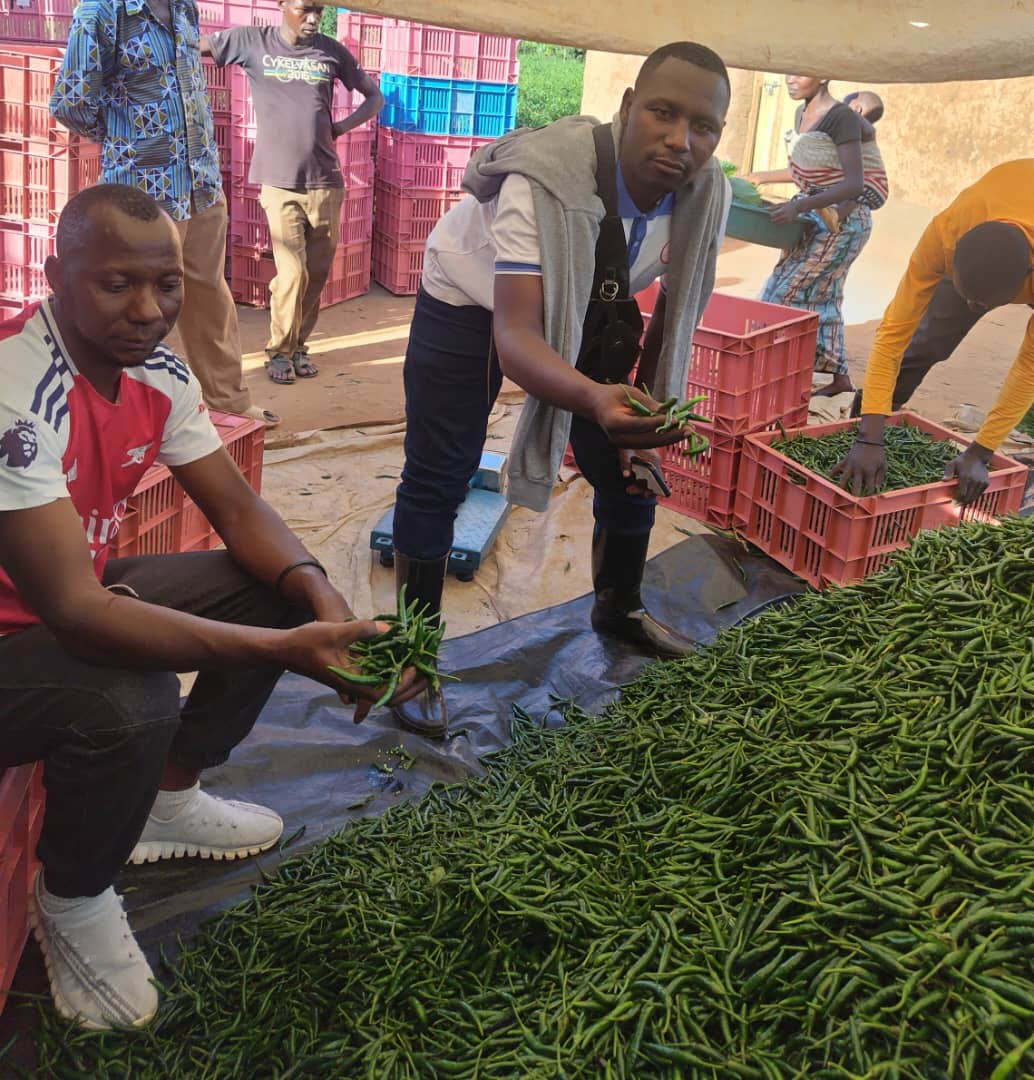
Farmer Umwami Jean d’Amour ukorera produces pepper in Gatsibo sector, Gatsibo district, eastern Rwanda. Like many farmers, some of their produce is collected by wholesale buyers, who export it to China, largely benefiting from the tariff-free regime
At the Forum on China–Africa Cooperation (FOCAC) Ministerial Meeting in Changsha in June 2025, China announced zero-tariff treatment covering 100 percent of tariff lines for all 53 African countries that have diplomatic ties with China, as reflected in the Changsha Declaration.
This built on the December 2024 extension to 33 African Least Developed Countries, which was followed by a 15.2% year-on-year increase in China’s imports from African LDCs by March 2025.
The initiative represents a major opportunity for deeper Africa–China economic cooperation. Expanded Chinese market access can support African efforts to diversify exports, promote value addition, strengthen industrial capacity, and advance mutual economic benefits.
Different from AGOA
Enacted in 2000 for approximately 40 sub-Saharan nations, the US African Growth and Opportunity Act (AGOA) produced some results. In 2024, more than US$8 billion in African exports entered the United States under AGOA preferences.
But AGOA’s core flaw was political contingency: it required periodic re-authorization, carried governance conditions, and lapsed entirely in September 2025.
It was only restored for one year retroactively, bundled into a fiscal appropriations package signed by President Trump on February 3, 2026, with AGOA’s long-term future beyond December 2026 remaining uncertain.
The lesson is unambiguous: a trade preference with no binding legal permanence is a fragile instrument. Moreover, only 18 of 40 eligible AGOA nations ever developed national utilization strategies, a failure of African governments as much as of the program’s design.
Drawing on structural transformation theory and South–South cooperation perspectives, this analysis examines the opportunities presented by China–Africa preferential trade relations under China’s zero-tariff initiative.
Structural transformation theory highlights the need for African economies to move beyond peripheral positions in global value chains through industrial upgrading and value addition.
In addition, the South–South cooperation perspective frame China–Africa relations around mutual development, solidarity, non-hegemonic partnership, and shared economic advancement.
Guiding benchmarks
Adopting a qualitative policy-analysis approach, and combining comparative institutional analysis, trade-data analysis, and interpretive policy review, the initiative strengthens Africa-China foreign policy shifts.
It draws on verified trade statistics and policy materials from GAC, UNCTAD, SAIS-CARI, AERC, FOCAC, USTR, the World Bank, and AfDB. Comparative analysis of preferential frameworks, including AGOA, unpacks the far-reaching effects of industrialization, export diversification, and development in structurally unequal economies.
From Structural Transformation and South–South cooperation perspectives, China’s zero-tariff initiative offers opportunities for African industrialization and value addition.
However, infrastructure deficits, weak manufacturing capacity, logistics bottlenecks, limited energy access, and fragmented markets remain significant constraints to Africa’s global value-chain integration.
Three Conditions for Transformative Impact
Setting binding multilateral instruments
The Changsha Declaration frames China’s zero-tariff commitment as a readiness to negotiate and sign an economic partnership framework; China and the African Union must convert this commitment into a legally binding multilateral instrument with fixed preferences, dispute resolution mechanisms, modalities for sustainable communication, and review processes that require mutual consent to amendments.
Invest in Supply-Side Capacity
“Without supply-side capacity, zero tariffs are doors without a road leading to them.” China’s zero-tariff initiative can generate greater developmental benefits for Africa when combined with coordinated production, industrial relocation, and technology transfer rather than trade expansion alone.
Africa could benefit from relocating low- and medium-skill manufacturing, particularly in textiles, agro-processing, assembly, and light manufacturing.
As researchers indicate, market access can support export diversification and employment when accompanied by infrastructure investment, vocational training, and manufacturing capacity.
Thus, the long-term value of zero tariffs depends on strengthening Africa’s industrial transformation.
Coordinate with the AfCFTA
The African Continental Free Trade Area (AfCFTA) can create a 1.4-billion-person market capable of supporting regional value chains.
China’s zero-tariff initiative should therefore be coordinated with AfCFTA through rules of origin that reward intra-African value addition and regional manufacturing. China can support implementation through digital infrastructure, e-commerce, customs digitization, cross-border payments, and trade facilitation.
These measures are particularly important because SMEs face high transaction costs, fragmented customs systems, and weak digital logistics networks.
Linking AfCFTA platforms with Chinese markets can reduce these barriers, improve African export competitiveness, and create more efficient supply chains while expanding opportunities for Chinese technology, logistics, and digital infrastructure.
China’s zero-tariff initiative offers an important opportunity to deepen Africa–China economic cooperation and expand African access to the global market. However, market access alone cannot guarantee industrial transformation.
Experience from AGOA and the EU’s Everything But Arms initiative (EBA) shows that trade preferences require productive capacity, infrastructure, investment, and strong institutions with bargaining power.
African governments must strengthen industrial strategies, invest in infrastructure and skills, promote value addition, and improve continental coordination. Africa–China relations should advance structural transformation, technological learning, and productive employment.
By combining zero tariffs with investment, technology transfer, and stronger African productive capacity, both sides can promote shared prosperity and a more balanced economic partnership.
The author is a lecturer at the University of Rwanda, a commentator on international affairs. He can be reached at ruhumurizaanselme4@gmail.com
