

President Félix Tshisekedi’s latest remarks on the FDLR raise serious questions about the DRC’s commitment to the Washington Peace Agreement.
During an exchange with the Congolese diaspora in Russia on October 30, Tshisekedi said his government is regrouping FDLR members in Kitona, apparently preparing to transfer them to another country.
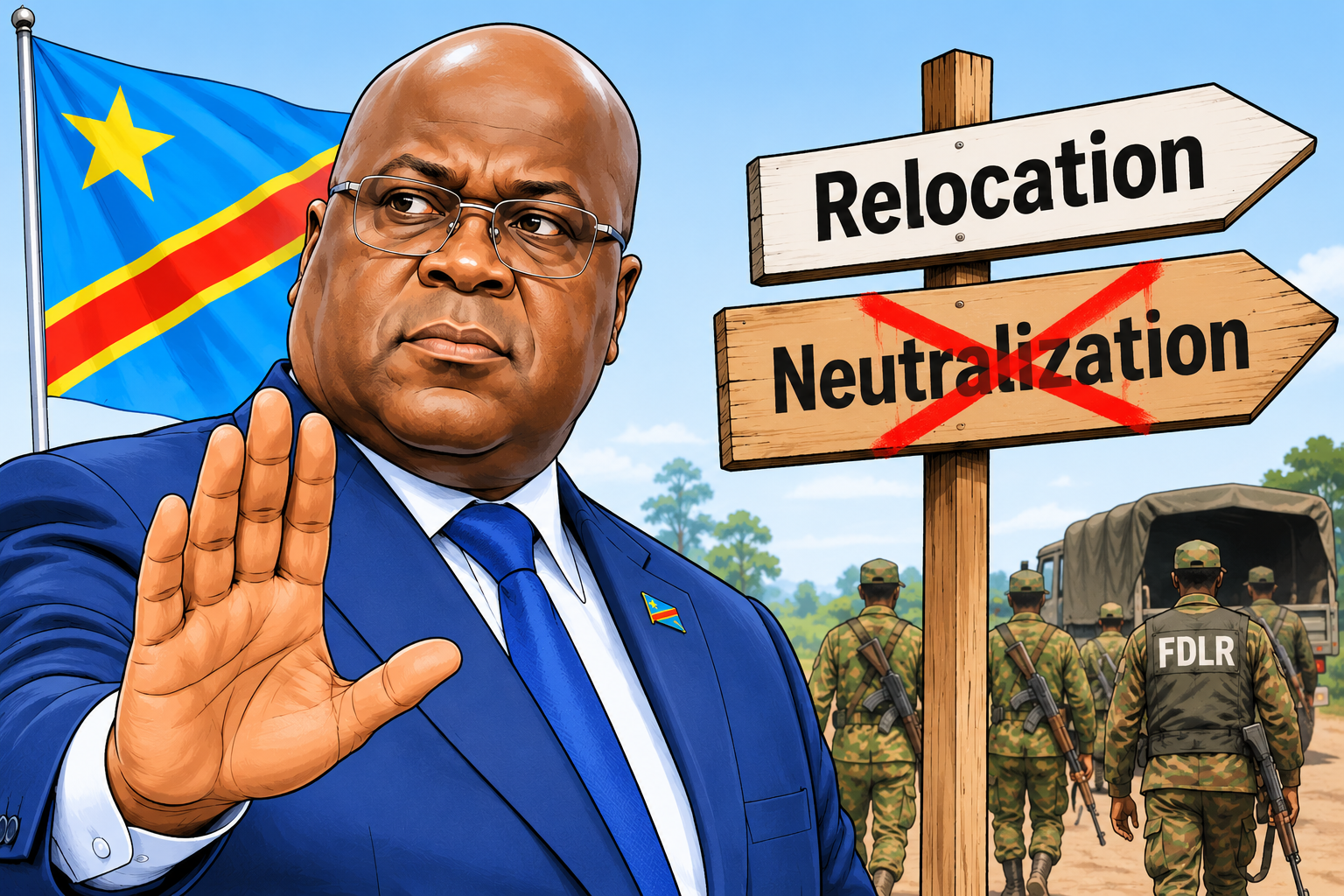
This raises a fundamental question, why is Kinshasa negotiating the relocation of the FDLR instead of fulfilling its commitment to neutralize the group?
The Washington Peace Agreement is not a relocation arrangement. It requires concrete security measures to address the threat the FDLR poses. Moving some of its members from one location to another, or transferring them to another country’s territory, does not dismantle the organization, eliminate its military capabilities, or address its genocidal ideology. It merely shifts the problem elsewhere.
The contradictions within the Congolese leadership make the situation even more troubling.
Just two days before Tshisekedi’s remarks, Foreign Minister Thérèse Kayikwamba Wagner told RT that the DRC could not neutralize the FDLR because its members were operating in territories controlled by M23.
Government spokesperson Patrick Muyaya has repeatedly offered similar explanations whenever Kinshasa is questioned about its failure to act.
Yet the president is now telling the world that his government has regrouped FDLR members in Kitona.
So which version should the international community believe? If the FDLR are inaccessible because they operate in M23-controlled territories, how has Kinshasa managed to regroup them in Kitona? And if the government can assemble them in a designated location, what prevents it from proceeding with their disarmament and neutralization?
The FDLR cannot disappear from government statements on Monday, be reported in FRN-controlled areas on Tuesday, reappear in Kitona on Wednesday, and suddenly become another country’s responsibility on Thursday. Kinshasa owes the international community a consistent explanation.
Perhaps the biggest contradiction lies in Tshisekedi’s own political narrative. He repeatedly accuses Rwanda of using the FDLR as a pretext for its security concerns and involvement in eastern DRC. He has even complained that the United States is pressuring his government to neutralize the group.
But if the FDLR is merely a pretext, as Tshisekedi claims, why resist the very action that would remove that pretext? How does one relocate a pretext, and why complain about international pressure to dismantle an armed group you already committed in writing to neutralizing?
The FDLR is not an imaginary organization. Its origins, genocidal ideology, and continued activities in eastern DRC are well-documented. Neutralizing it is not a favor to Rwanda; it is a security obligation and an essential step toward lasting regional stability.
The United States played a central role in facilitating the Washington Agreement. Its credibility now depends on ensuring that commitments made by the signatories translate into measurable action.
Tshisekedi cannot sign an agreement requiring FDLR neutralization, complain about pressure to implement it, and then present relocation as an alternative.
Washington must demand answers; How many, if any, FDLR members are in Kitona? Have they been disarmed? What happens to their command structures and military networks? Under what framework does Kinshasa intend to transfer them abroad?
The question is no longer what Kinshasa is expected to do, but whether it has the political will to do it. And how long will Washington continue turning a blind eye to this failure?
