

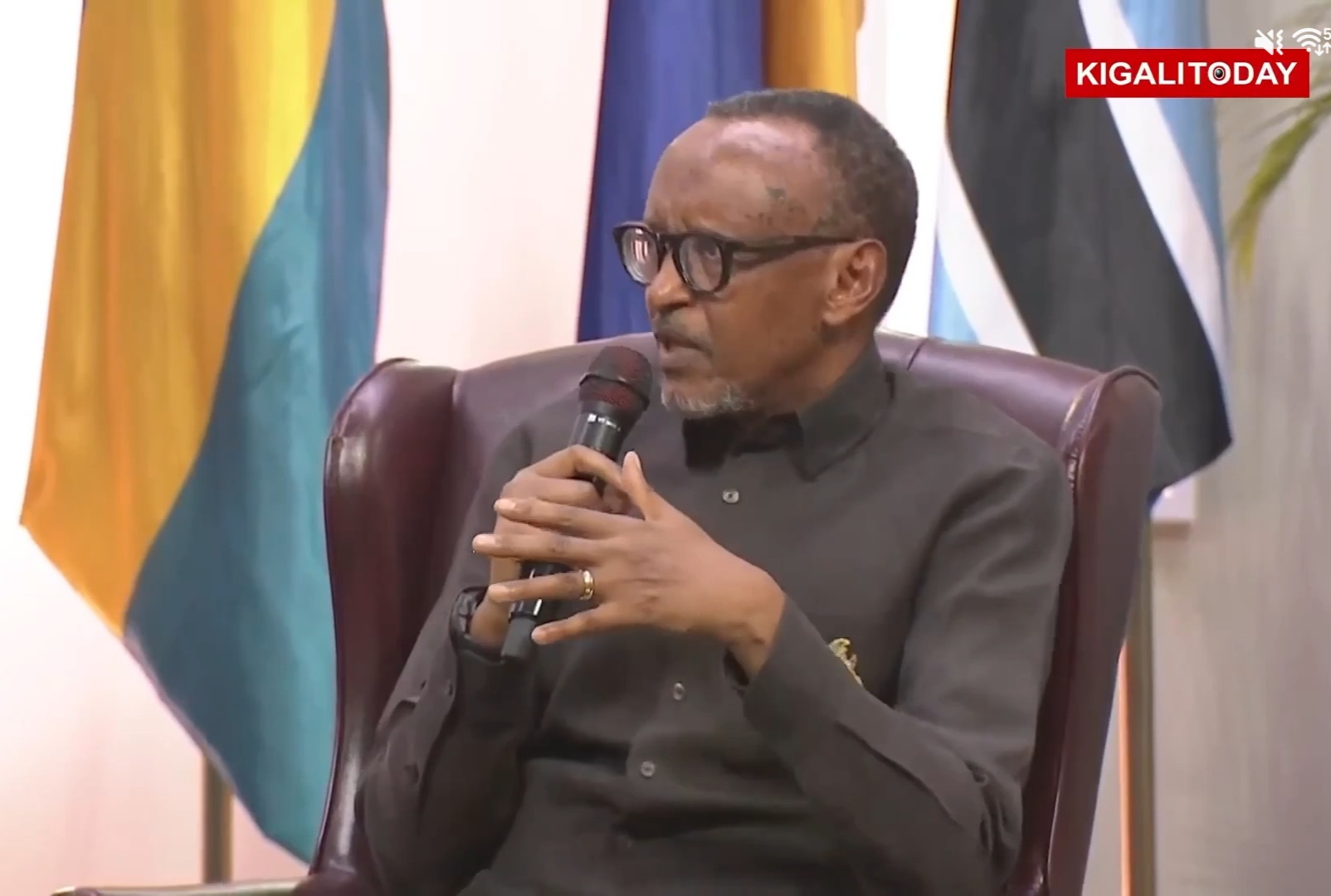
President Kagame Paul speaking during the panel session
ST JOHN’S, ANTIGUA AND BARBUDA – President Paul Kagame says international investors need to rethink their perception of developing economies, arguing that investment risks are not exclusive to poorer countries and should not keep capital away from viable projects.
Speaking at a Commonwealth leaders’ panel in Antigua and Barbuda on Monday, November 2, Kagame said the belief that investments in the Global South carry greater risks than those in the Global North has persisted for too long.
“There is a perception out there that the developing countries […] in making these investments, there are higher risks for the investments in the south than in the north,” he said.
“But it is not true. There are risks everywhere for any investments you want to make.”
Kagame said governments and investors should focus on managing those risks through cooperation and by making resources available to projects with sound commercial prospects.
He said the Commonwealth could help change the way international investors view developing economies, particularly countries that need foreign capital to create jobs, equip young people with skills and expand their economies.
The Rwandan leader returned to the question of investment later in the discussion, when the moderator, Professor Justin Robinson, asked how a small Commonwealth country could attract financing for profitable projects in renewable energy, digital platforms and agro-processing.
Kagame said the size of a country should not determine whether a viable project gets financing. Governments and private investors, he said, should work together to close funding and infrastructure gaps that prevent good projects from taking off.
He also pointed to regional market integration as a way of making investments in smaller economies more attractive.
“It’s not just a small project in a small country, but rather a viable project in a growing market beyond the place where it is,” he said.
He added that governments must put in place policies and strong institutions that connect the public and private sectors.
The moderator used Rwanda as an example of a country that has overcome some of the disadvantages associated with geography. He noted that the country has no coastline or oil resources but recorded 9.4% economic growth in 2025.
Kagame’s remarks come as many developing countries compete for investment while facing higher borrowing costs, limited access to international capital markets and perceptions of political and economic risk.
His message was that investors should assess the commercial prospects of individual projects rather than dismissing opportunities because of the countries in which they are located.
The panel also featured Jamaican Prime Minister Andrew Holness and Samoa’s Deputy Prime Minister Mulipola Anaroso Ismilio.
Holness focused on the cost of government bureaucracy, saying inefficient institutions can hold back development even when financing is available. He called for governments to use technology and artificial intelligence to improve public service delivery.
Ismilio, meanwhile, highlighted the importance of trust, relationships and collective responsibility among Commonwealth countries.
The discussion formed part of the 2026 Commonwealth Heads of Government Meeting in Antigua and Barbuda, November 1 – 4, 2026.
