



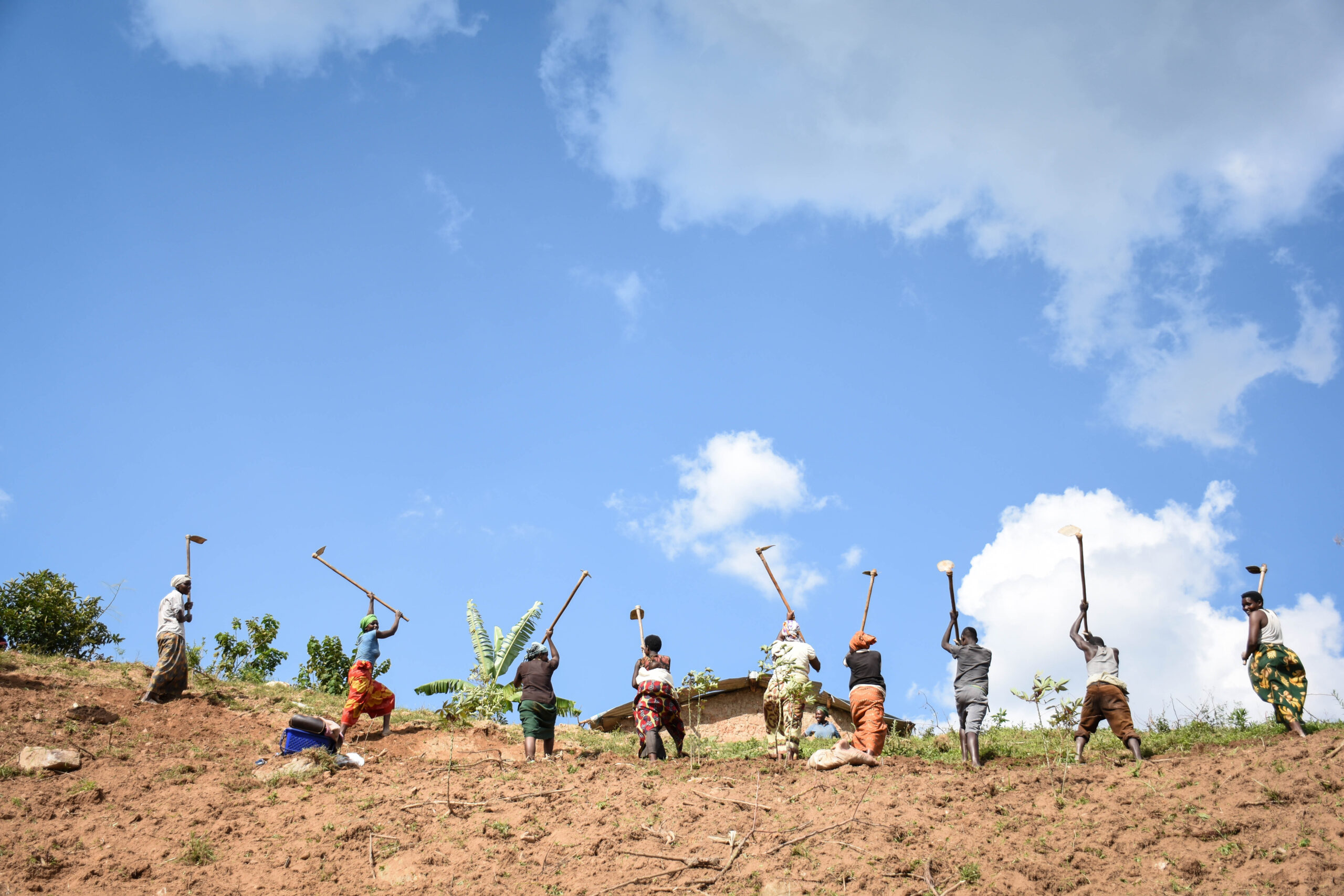
Farmers cultivating their land. Smallholder farmers across Africa are among the most productive agricultural actors globally. Like Delifa highlighted here, they want fair rights to their own land and a stable platform to grow their livelihoods.
Across East Africa, I have stood in fields with young farmers whose voices carry the quiet urgency of untapped potential. In rural Kenya, Malawi, Zambia, and Rwanda, when I ask what stands between farmers and lasting growth, one answer comes up again and again as the first barrier: land. Specifically, access to secure, formally recognized and investable land, an essential foundation that enables farmers to fully benefit from the range of support available to them, from financing to technology, and to invest confidently in their future.
In agriculture, land isn’t just the ground beneath our feet. It’s interchangeable with resilience, productivity, and increased incomes. Yet, for most farmers on this continent, access to land remains precarious at best.
Why Secure Land Rights Matter for Productivity
In sub-Saharan Africa, only about of rural land is formally registered with legal documentation, leaving the vast majority in customary systems that, while locally binding, often provide weak assurances of tenure security. Up to 26% of rural landholders worry about losing their land in the next five years, according to World Bank analysis, a stark measure of ongoing insecurity.
The implications are real and measurable. We have seen that smallholder farmers with secure tenure can produce significantly more. Farmers with long-term rights to their land often see yields rise by over a ton per hectare compared with their neighbours.
Far too many farmers we work with at One Acre Fund are unable to make long-term decisions because they do not have land ownership security. In a recent conversation I had with Faith Musinde, a young agripreneur in western Kenya, she shared, “I hesitate to plant fruit or timber trees because I am not confident if I will still control the land when they bear fruit”. Across East Africa, youth — a demographic bulge and the world’s future food producers — are less likely than their parents to obtain land outside of inheritance, leaving them with little equity or choice.
Women Steward the Land Without Equal Rights
Women sustain African agriculture. In sub-Saharan Africa, women represent a majority of the agricultural workforce — FAO estimates suggest 60-80% — yet they own far less land than men.
This mismatch isn’t just unfair; it’s costly. When women have secure land rights, evidence shows that investment increases, yields improve, and communities benefit. Yet, deeply rooted norms and incomplete legal implementation mean women frequently only hold secondary rights, if any at all.
Progress is happening. Across sub-Saharan Africa, governments are strengthening land security through land registration and digitization in Kenya, joint spousal land ownership laws in Rwanda, and emerging youth-focused allocation and leasing reforms in Zambia. Organizations also have a role to play in advancing these efforts. At One Acre Fund, our Kwiharika initiative in Rwanda helps families formally allocate land to youth, while in other countries, we are testing models that partner with local leaders to promote inclusive land access.
Security Spurs Investment, Growth, and Resilience
There is clear economic logic to tenure reform. When farmers know they won’t be displaced, they invest in soil health, trees, irrigation, or in cash crops. Research on tenure across Africa and elsewhere consistently links secure rights with increased investment and reduced production risk.
From a policy perspective, land tenure is not a niche concern. It’s a linchpin for everything from food security to climate resilience, credit access, and rural economic transformation. It underpins multiple Sustainable Development Goals, including poverty reduction (SDG1), gender equality (SDG5), and sustainable land use (SDG15).
But it rarely gets the sustained political and technical attention it deserves.
It’s Time for Land to Be a Policy Priority
Policymakers must elevate land tenure from a peripheral policy issue to a central agricultural strategy. This requires strengthening registration systems that protect both documented and customary rights while working with local community leadership so that reform respects community structures, and vice versa. Such an approach can help ensure women and youth have enforceable rights to inherit, own, and transact land. This should also be paired with linking land policy to credit and climate strategies so that tenure security unlocks broader investment in climate-smart agriculture.
Regional farmer organizations are already stepping into this space. The East African Farmers Federation (EAFF), which represents millions of farmers across the region, has been elevating land tenure issues in national and regional policy forums. Through its county and national chapters, it has created platforms where farmers can raise concerns about inheritance systems, registration bottlenecks, and youth access to land. Our recently formalized partnership with EAFF seeks to better understand and address the major risks smallholders face, from climate shocks and market access to the foundational challenge of secure land tenure. This kind of organised, farmer-driven collaboration is essential. Sustainable land reform will not come from policy rooms alone; it must be shaped by the farmers who live with its consequences every day.
Farmers themselves speak to the importance of secure land access: “I was renting fields and sometimes would struggle to raise the money to pay my rent. So, having my own field is a dream come true. I also hope that from selling the maize which I have now planted, I will raise enough capital to set up a grocery store,” Delifa Chimtambala, Malawi Farmer.
Smallholder farmers across Africa are among the most productive agricultural actors globally. Like Delifa, they want fair rights to their own land and a stable platform to grow their livelihoods. Across the continent, they are innovating, adapting to climate stress, and building markets. But no matter how good the seed, or how climate-smart the practice, without secure access to land, farmers remain constrained by uncertainty.
To grow Africa’s agricultural future, we have to make land the primary input, not an afterthought.
Yael Hartmann is Senior Director of Government Relations and Policy at One Acre Fund

1 comment
Kadıköy 7/24 Su Kaçağı Tespiti Termal kamera ile yapılan Kadıköy su kaçağı tespiti çok başarılıydı. https://dealers-rater.com/
Comments are closed.