



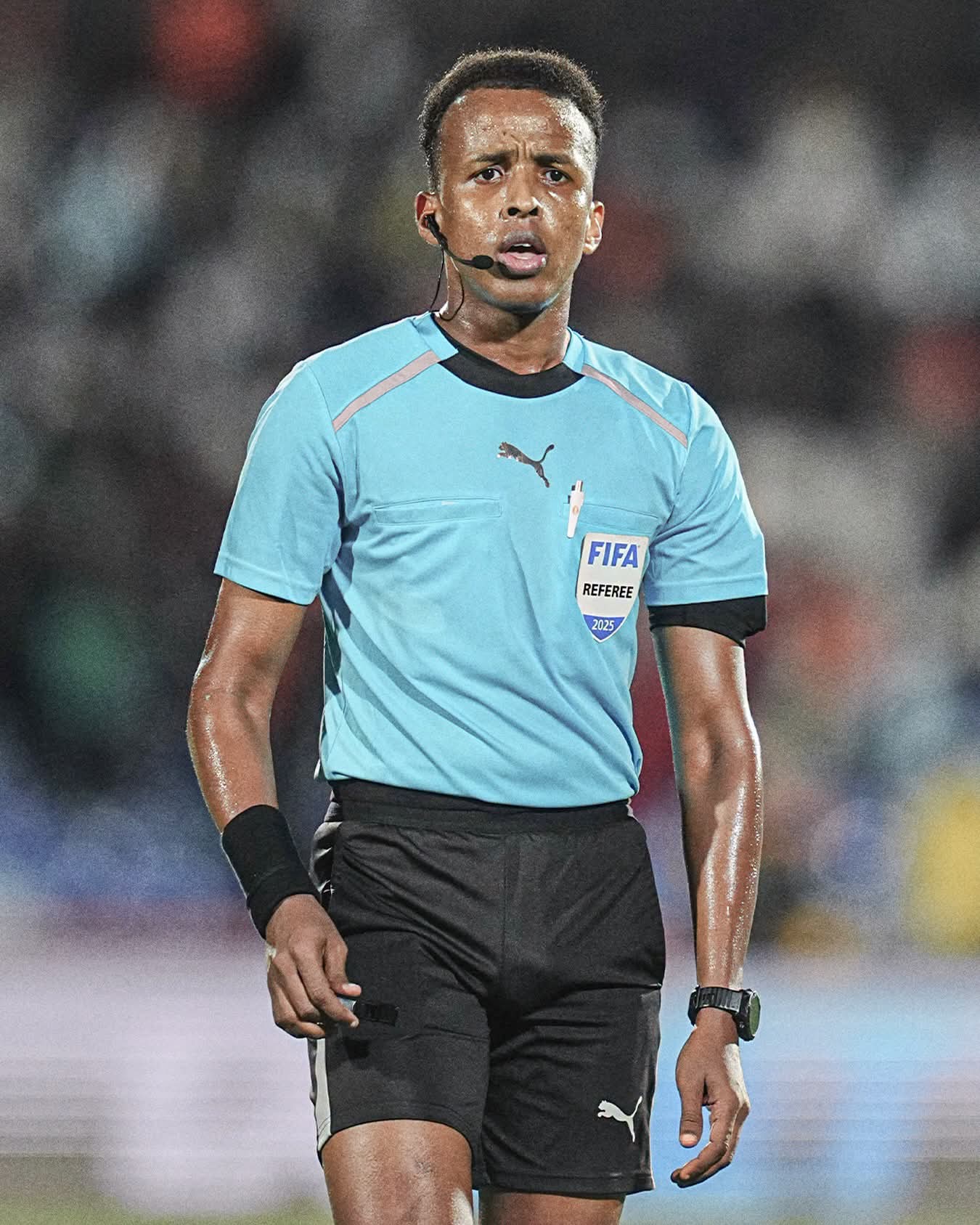
Omar Abdulkadir Artan
The FIFA World Cup has always been more than a football tournament. It is a global gathering that brings together people from different nations, cultures, and backgrounds in a celebration of sport. At its best, it represents the ideals of unity, inclusion, and international cooperation.
That is why the case of Omar Abdulkadir Artan has attracted attention far beyond the football community.
Artan, who was named CAF Referee of the Year in 2025, made history by becoming the first Somali referee appointed to officiate at a FIFA World Cup. His selection was a milestone not only for Somalia but also for African football, demonstrating how the game continues to create opportunities across regions that have long sought greater representation on the world stage.
However, that achievement was overshadowed when Artan was denied entry into the United States upon arrival in Miami, preventing him from participating in the tournament.
The decision immediately sparked controversy. FIFA confirmed that Artan would not be part of the World Cup officiating team following the U.S. government’s action.
While FIFA does not control the immigration policies of host nations, the outcome was clear: a referee officially selected for the world’s biggest football competition would not be allowed to take part.
U.S. authorities later stated that the decision was based on security and vetting concerns.
Reports indicate that officials cited alleged associations with individuals suspected of links to terrorist organizations.
Artan has strongly denied those allegations, and no detailed evidence has been made public.
This distinction is important.
Public debate should be based on verified facts rather than assumptions. It would be inaccurate to state as fact that Artan was denied entry solely because of his nationality or Somali origin. At the same time, it is equally reasonable to ask whether sufficient transparency has been provided regarding a decision that affected an individual chosen by FIFA to perform an official role at a global sporting event.
Regardless of where one stands on the immigration decision itself, the incident highlights a broader challenge facing the World Cup and other major international competitions.
A tournament that welcomes participants from every corner of the world inevitably depends on host nations being able to balance legitimate security concerns with the need to ensure fair and accessible participation.
When athletes, officials, journalists, or supporters are unable to attend because of immigration barriers, questions naturally arise about how inclusive such events truly are.
Those concerns are not limited to Artan’s case. For months, discussions have taken place about visa processing, travel restrictions, and access for supporters from various countries seeking to attend World Cup matches in the United States.
While every sovereign nation has the right to enforce its immigration laws, the hosting of a global tournament also carries unique responsibilities.
The success of a World Cup is measured not only by what happens on the pitch but also by the extent to which the event fulfills its promise of bringing the world together.
To his credit, Artan has responded with professionalism and dignity.
Rather than engaging in public confrontation, he has thanked FIFA and CAF for their support and expressed his determination to continue his refereeing career. His reaction reflects the resilience expected of those who reach the highest levels of international sport.
Whatever the final judgment on the U.S. government’s decision, one fact remains clear: Omar Artan has already made history.
Becoming the first Somali referee appointed to a World Cup is an achievement that cannot be erased. His journey remains a source of inspiration for young Somalis and Africans who aspire to reach the highest levels of global sport.
The larger lesson from this episode extends beyond one individual. It raises important questions about transparency, consistency, and accessibility in international competitions.
As the World Cup continues to grow as a truly global event, organizers and host nations alike must work to ensure that legitimate security requirements are balanced with the principles of fairness and inclusion that make the tournament meaningful to billions around the world.
Football’s greatest stage should remain exactly that: a stage where the world comes together, not one where questions about access and participation overshadow the game itself.
