



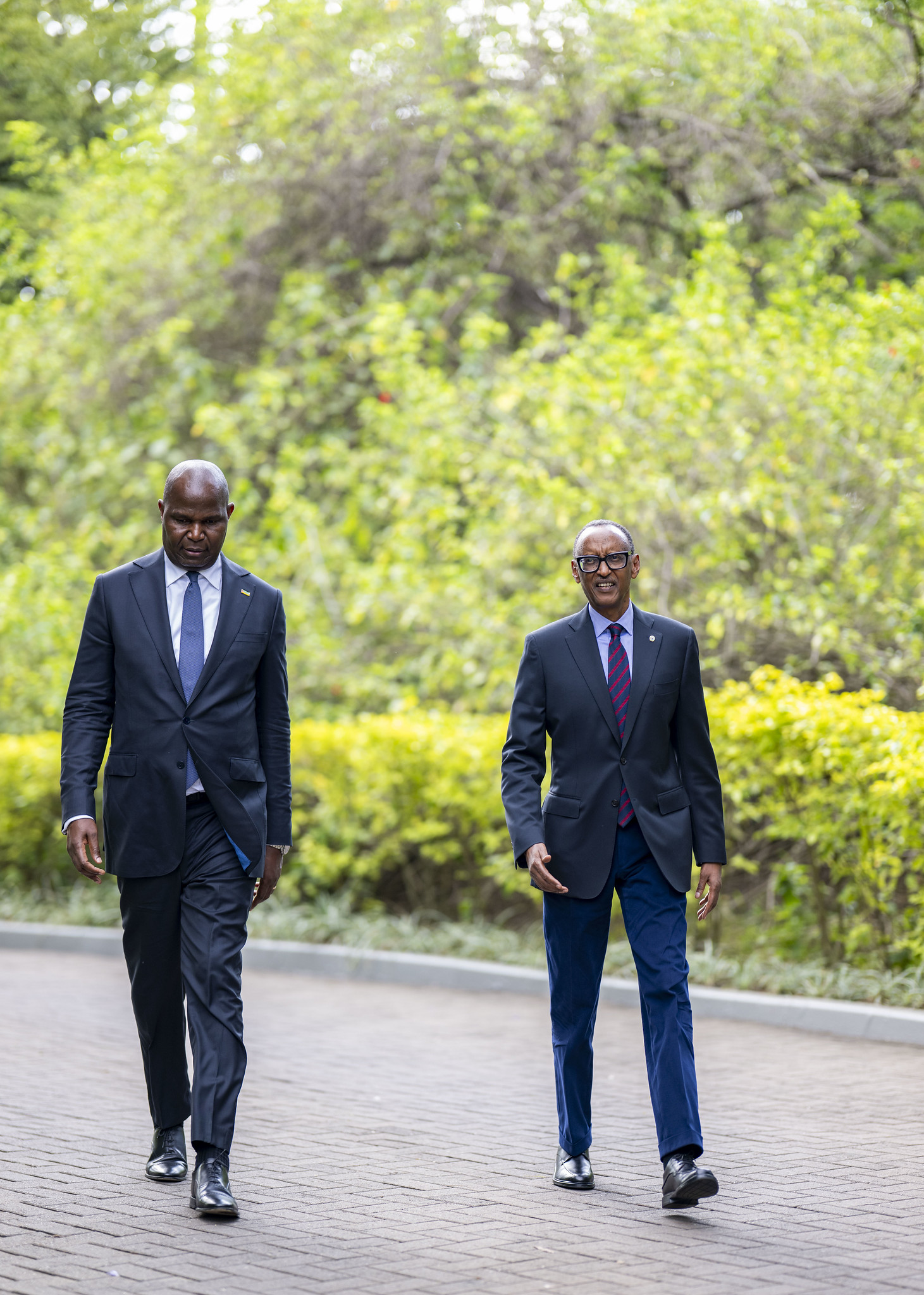
President Kagame welcomes Mozambique President Daniel Francisco Chapo who was in Kigali, 27 August 2025, for a working visit
Recently, reports by French media outlet Africa Intelligence suggesting that Mozambique may be looking for new security partners to replace Rwandan troops have fuelled speculation regarding the future of the defence agreement between Maputo and Kigali.
However, recent events, the current geopolitical rifts, and a close examination of the operational realities on the ground suggest that far from fracturing, the military alliance will remain strong for the foreseeable future.
First, there is no denying that Maputo values Rwanda’s contribution to the stabilization of its northern province of Cabo Delgado. That much was made clear when certain actors within the European Union bloc sought to withdraw their financial support for the intervention sending the message to Kigali that the work and sacrifice of its soldiers were meaningless.
Maputo stepped in, ensuring continued support and proving that President Daniel Chapo meant every word of his statement made in Kigali.
“Your sons and daughters have shed blood on our soil so that our people may have peace again. For that, Mozambique will always be grateful,” Chapo said.
There is also no denying that the people of Cabo Delgado appreciate Rwandan troops, a feeling they have expressed more than once, even during peaceful gatherings. In other words, Rwanda’s deployments have political and popular support in Mozambique.
Second, the strategic necessity of the Rwanda Security Forces (RSF) deployment extends far beyond the borders of East and Southern Africa, positioning it as a critical focal point of contemporary global geopolitics.
Indeed, the global geopolitical turmoil stemming from the wars in Eastern Europe and the Middle East means that the TotalEnergies and ExxonMobil gas projects are now more important than ever for their home countries’ energy sectors.
For Western powers, the long-term stability of northern Mozambique represents a strict geopolitical red line. And guess who ensures stability?
Today, the RSF stand as the singular, indispensable bulwark preventing northern Mozambique from the vicious Islamist insurgency that had been wreaking havoc for about five years.
For Washington and its allies, the alternative to Rwanda’s deployments is a terrifying prospect. The collapse of local security frameworks could potentially invite the encroachment of foreign mercenary groups whose interests may radically diverge from those of the Western alliance.
If, for instance, the choice is between having Russian state-backed security companies as Mozambique’s partners and waiving sanctions on the RDF forces in that country, the U.S. choice will be obvious.
Within this high-stakes environment, the reality in the gas-rich province of Cabo Delgado is stark: there is simply no viable, immediate alternative to the RDF. This reality became undeniable following the official withdrawal of the Southern African Development Community Mission in Mozambique (SAMIM).
While the SADC regional mission made commendable efforts to stabilize the region, its departure ultimately exposed deep structural limitations within traditional, multi-state regional frameworks.
Plagued by chronic funding constraints, debilitating logistical delays, and a pronounced lack of unified command agility, SAMIM struggled to mount the rapid, decisive operations required to suppress a highly fluid guerrilla enemy.
These factors partly explain why Rwanda’s bilateral intervention succeeded where a regional intervention could not.
In the specific sectors where Rwandan troops were deployed, terrorists were systematically purged from their strongholds in less than a month. Those who survived the initial onslaught were forced to abandon their fortified bases and seek safe haven elsewhere.
To maintain this hard-won momentum and secure expanded territories, the Rwandan contingent has since scaled up significantly, growing to nearly 5,000 personnel operating across five volatile districts in northern Mozambique.
Their highly coordinated tactical efforts have successfully disrupted militant supply routes, most notably along the strategic Indian Ocean coastline. By choking off these maritime lanes, the RDF effectively denied the insurgents vital access to external logistical support and heavy weaponry, forcing the remaining cells into increasingly isolated forest hideouts.
Crucially, the RDF’s role in Mozambique has extended far beyond active combat operations and the routine training of the country’s local armed forces.
Recognizing that military force alone cannot defeat an insurgency, Rwandan personnel have blended hard security with social development to build deep communal trust.
Their civil-military operations have facilitated the safe, dignified return of over 300,000 internally displaced persons to their homes.
Furthermore, Rwandan forces have reopened vital sea and airports to restart the local economy, while actively engaging in daily community outreach activities, such as delivering essential health services and conducting local school clean-ups.
By successfully combining sharp tactical expertise with humanitarian and development initiatives, the Rwandan military has established a powerful new benchmark for peacekeeping on the continent. This cannot be replaced that easily.
To be sure, Mozambique remains a sovereign country, free to choose to broaden its security partnerships. But there is simply no indication that more partnerships mean that Maputo is seeking an alternative to Kigali, as suggested by Africa Intelligence.
In fact, the political mood in the country, the geopolitics of the moment, and the operational realities all suggest that the alliance between the two sister countries is unshakable.
