



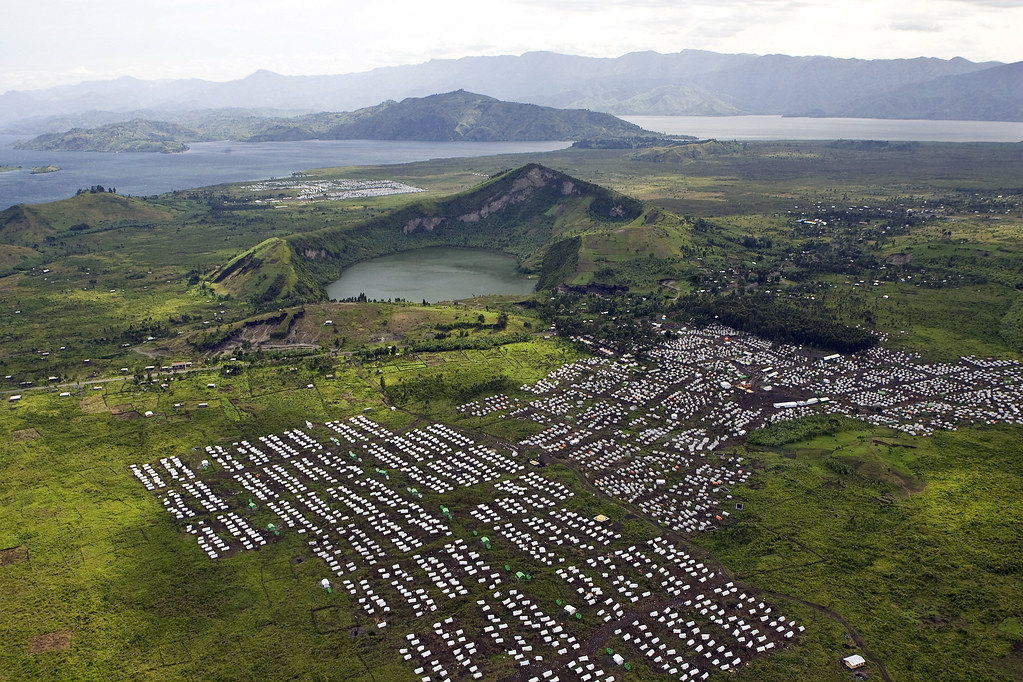
Aerial view of an IDP camp in eastern DR Congo,. Many of such sites are no longer there
In 2007, a journalist meets a Congolese refugee in Kiziba Camp, Karongi District in Western Rwanda, who vows to gift him a cow “once we return home.”
Yesterday’s news of more than one million Congolese IDPs returning to their homes brought that promise—and the man’s haunting story—rushing back.
It was with a trembling hand that I scrolled through the news on my phone on Sunday, August 10. My eyes caught a headline that pulled me in and froze me in my seat:
“Over 1 Million IDPs Return Home After M23–AFC Takeover in Eastern Congo.”
I read the piece slowly, feeling each word like a stone pressed against my chest. They were going home. The men, women, and children who have had the real cruel test of life. I have met Congolese refugees over the years in refugee camps in Rwanda—some of them as far back as my early days as a young reporter.
I should have felt only joy. But the truth is, as I read that piece, a part of me was silently asking: Could he be among them? Did he finally make it home? Unfortunately, not sure.
The “he” in my mind was a man I met in 2007 in Kiziba Refugee Camp in Karongi District, Western Rwanda. He wasn’t just another interviewee. He was a mirror of my own history. And the memory of that day has never left me.
Born to a Story I Already Knew
I am the child of refugee parents. My late father, as a 16-year-old boy, had fled Rwanda in 1958 after his family home was set ablaze. He would spend three decades in exile in Uganda before returning in 1994 after the Genocide against the Tutsi.
That means that by the time I started working as a journalist in 2005, the word “refugee” was not just something I covered—it was something I understood in my bones. I knew the smell of longing for a homeland, through the sound of stories told around smoky cooking fires about “back home,” the weight of growing up knowing your parents belonged to a place you had never seen.
So, when my reporting took me to Kiziba Camp in Karongi District and Nyabiheke Camp in Gatsibo District, I was not stepping into a foreign world. I was walking into the shadows of my own childhood.
Kiziba, 2007
Back then, Kiziba was a place where the mountains met the sky, but the air carried the heavy smell of scarcity. The camp sat on a hilltop overlooking Lake Kivu, its rows of makeshift shelters stubbornly clinging to the red soil. It had been established in 1996, in the aftermath of one of the most tragic refugee exoduses in modern African history.
I had covered stories of refugees before—food ration cuts, health crises—but on that morning in 2007, I was assigned to cover an event in the camp organized by the Africa Humanitarian Act (AHA) – an NGO that was delivering expansive health services at the camp. I woke before dawn in Bwishyura Sector, laced up my shoes, and started the 12-kilometre journey to Kiziba to cover the event.
By midday, my assignment was done. But something pulled me toward a small street market that had sprung up inside the camp—a place where people sold what little they had in hopes of surviving another day.
It was there that I saw him.
The Man with the Mats
He looked to be around 50, though the deep lines in his face could have been carved by decades of loss. He sat on the ground beside a neat pile of small mats, his three daughters—no older than 12—sitting beside him.
When our eyes met, he smiled and said, “Banza ugure imikeka yanjye.” “First, buy my mats.”
“How much?” I asked.
“One thousand francs each,” he replied.
I reached for my wallet, but before pulling out the money, I did what journalists do—I asked about his life.
The conversation started simply: where he was from, how long he had been in the camp. But as he spoke, the words became heavier, and his voice slowed.
He told me about the day in 1996 when his village in North Kivu was burned to the ground. How he ran with his wife and eight children through the night, listening to the sound of gunfire behind them. How, in the chaos, they saw friends and neighbours fall.
He told me about crossing into Rwanda, thinking they had found safety, only to face a new kind of suffering—ration cards that never stretched enough, sickness that claimed the weak, and the slow erosion of dignity when year after year passed with no sign of going home.
I listened, and somewhere between his words, I felt my own father’s story replaying itself.
The Tears I Couldn’t Hold Back
I am not a reporter who cries in the field. We are taught to keep a professional distance. But that afternoon, standing in the dust of Kiziba, my notebook dangling uselessly in my hand, I felt my throat tighten and my eyes burn.
I thought of my father at 16, running from a burning home. I thought of my mother in Uganda, raising children in a land that was not hers. And I thought of this man—raising eight children in a place where even hope seemed rationed.
I had only Rwf20,000 in my pocket that day. Without thinking too much, I handed it to him. “This is for your business,” I said. “Maybe it can help you buy more mats to sell.”
It was meant to be a small gesture. But the moment the money touched his hand, his face crumpled. Tears streamed down his cheeks.
“Please,” he said, “let me come and thank you with my family.” I felt nervous, but I was determined to receive a suffering family inside my small home in Bwishyura.
The Visit and the Promise
A few days later, he came. All of them—his wife and eight children—from Kiziba to my small home in Bwishyura. They carried no gifts, only smiles and words. We shared lunch that day. We returned to those wailing stories but with hope.
“We have nothing to give you now,” he told me, “but when we return home, we will give you a cow.”
A cow. In our culture, it’s more than livestock—it’s a symbol of friendship, gratitude, and enduring connection. His promise was not about repayment; it was about honour.
I never forgot it.
The Years That Followed
In the years that followed, I continued to cover refugee stories. I visited Kiziba many times, and Nyabiheke too. I wrote about food ration issues, young men struggling with idleness, and women making crafts to survive. I interviewed aid workers and government officials.
But I never saw this man and his family again. Life moved on, assignments changed, and I was posted to different beats. Yet, whenever I thought of Kiziba, I thought of that man, his mats, his tears, and his promise.
Yesterday’s News
And now, here we are—August 2025.
The news says more than a million Congolese refugees have returned back into their homes from different camps. The M23/AFC alliance has taken control of large swaths of territory in North and South Kivu, opening a window for return.
How about those in the refugee camps in Rwanda and neighbouring countries? I can picture the scenes: long convoys of trucks carrying mattresses and bundles, mothers balancing cooking pots on their heads, young men pushing wheelbarrows piled high with everything they own.
Can he and his family be among them? Can he now stand on the soil he left in 1996, breathing in the smell of home after 29 years in exile?
What This Return Means
For many of us who have lived the refugee story, going home is more than a physical journey—it is a return to dignity. It is a reclaiming of a name, a land, and a history.
But I also know that return is never simple. The villages they left may no longer exist. Their neighbours may be strangers. The trauma they carry cannot be unpacked in a single day.
And yet, the sight of people crossing back is something I cannot ignore. It will feel like watching history bend back toward justice, even if imperfectly.
The Promise That Still Stands
I may never know if the man with the mats kept his promise. Perhaps the years have worn it away, or perhaps it is still there, waiting for the day our paths cross again.
But in my heart, I believe he remembers. Because I remember.
Yesterday’s news was not just a headline for me. It was the sound of footsteps on a road that began decades ago, a road my own father once walked, a road lined with both grief and hope.
And perhaps, somewhere in the hills of North Kivu, a 68-year-old man can, once again, be looking at his herd, thinking, It’s time to find that journalist and give him the cow I promised.
Until then, I will hold on to the memory—not for the sake of a cow, but for what it represents: the endurance of human dignity, even in the harshest of exiles.
The Writer is the Editor-in-chief of Kigali Today Ltd, the parent company of KT Radio 96.7FM (plus for 4 other provincial channels), KT Press and KigaliToday.com

1 comment
Thank you for sharing this deeply moving story. Your words carry both the pain and hope of so many who have lived through exile. It is a reminder of resilience, dignity, and the bonds that survive time and distance.
Comments are closed.