





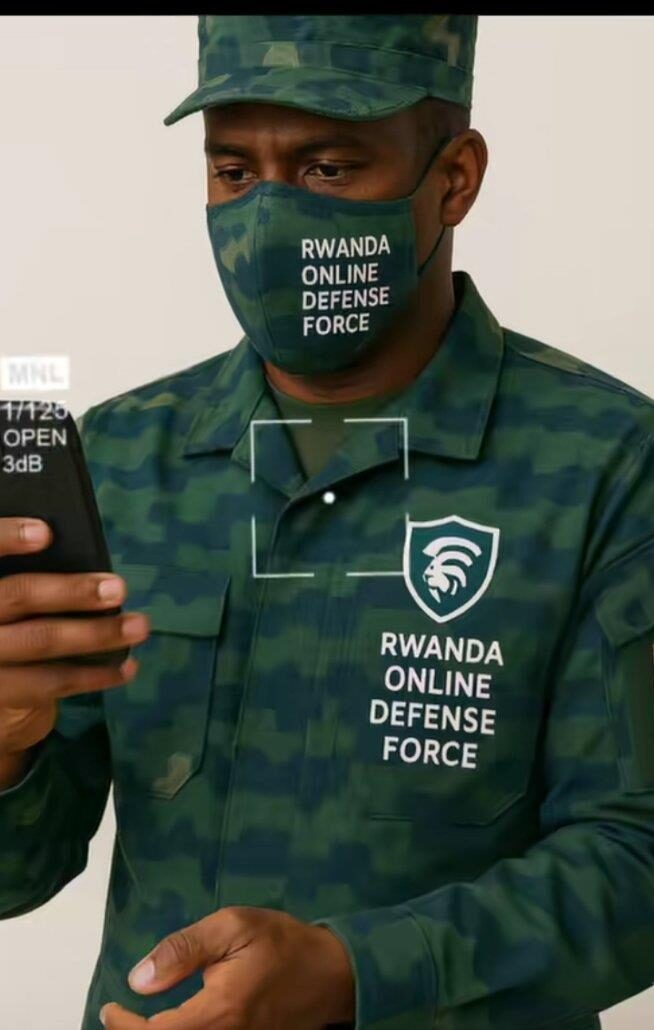
This graphic avatar has been widely shared by Rwandan social media users as comfortable response to online attack
“With the grace of God I can now announce that the accounts denying the 1994 genocide are no longer accessible,” wrote one jubilant user on TikTok a few weeks ago. The post was from @ajeuse2, real names Ajay Jean Niyomufasha, a young Rwandan whose online activism has been directed at countering the resurgence of genocide denialist rhetoric on social media.
His target was clear: accounts run by individuals such as Sylvia Mukankiko and Josephine Nyiratunga, both based in Europe. They are accused of using TikTok to distort Rwanda’s history and question the 1994 Genocide against the Tutsi.
Niyomufasha was not acting alone. He is part of a very vibrant and growing network of young Rwandans who see online spaces as the new frontline in the struggle to defend memory and truth. He celebrated TikTok, YouTube and Facebook’s decision to suspend those accounts, framing it as a victory not just for himself, but for Rwanda as a whole. For him, silencing denialists was both a patriotic duty and a moral triumph over what he described as people who attack Rwanda for personal gain.
For a short while, the targeted women disappeared from the platforms. But the silence did not last long. Rumors swirled online that Mukankiko had been killed, a narrative deliberately circulated within diaspora circles. These kinds of false death announcements are not unusual—they are a well-worn tactic used to stir confusion, fear, and sympathy. What happened with Mukankiko was a textbook case of how denialist communities manufacture drama to keep their audiences engaged.
A Fierce New Generation
Among the most striking faces in this digital war is that of Umuhoza Gentille, who goes by the social media name La Belle. With an unflinching stare into the camera, rarely smiling, she has become known for her direct confrontations with denialist figures like Mukankiko and Nyiratunga.
Her strategy is simple but powerful. Instead of dwelling on what denialists claim, she counters by showcasing what Rwanda has achieved. In one of her widely circulated videos, she dismissed Nyiratunga with the line: “I wasn’t yet born in 1994, but I am educated enough to know the history of Rwanda far better than those who distort it.”
For those unfamiliar with Rwanda, Umuhoza may appear at first like any other content creator. She discusses lifestyle, culture, and social issues in her videos. But underneath the surface lies a deep frustration with the persistent attempts to discredit her country and erase the memory of its victims. She does not identify as a political activist, but her firm stance against denial suggests she has reached her limit with the constant online distortions.
A Growing Threat
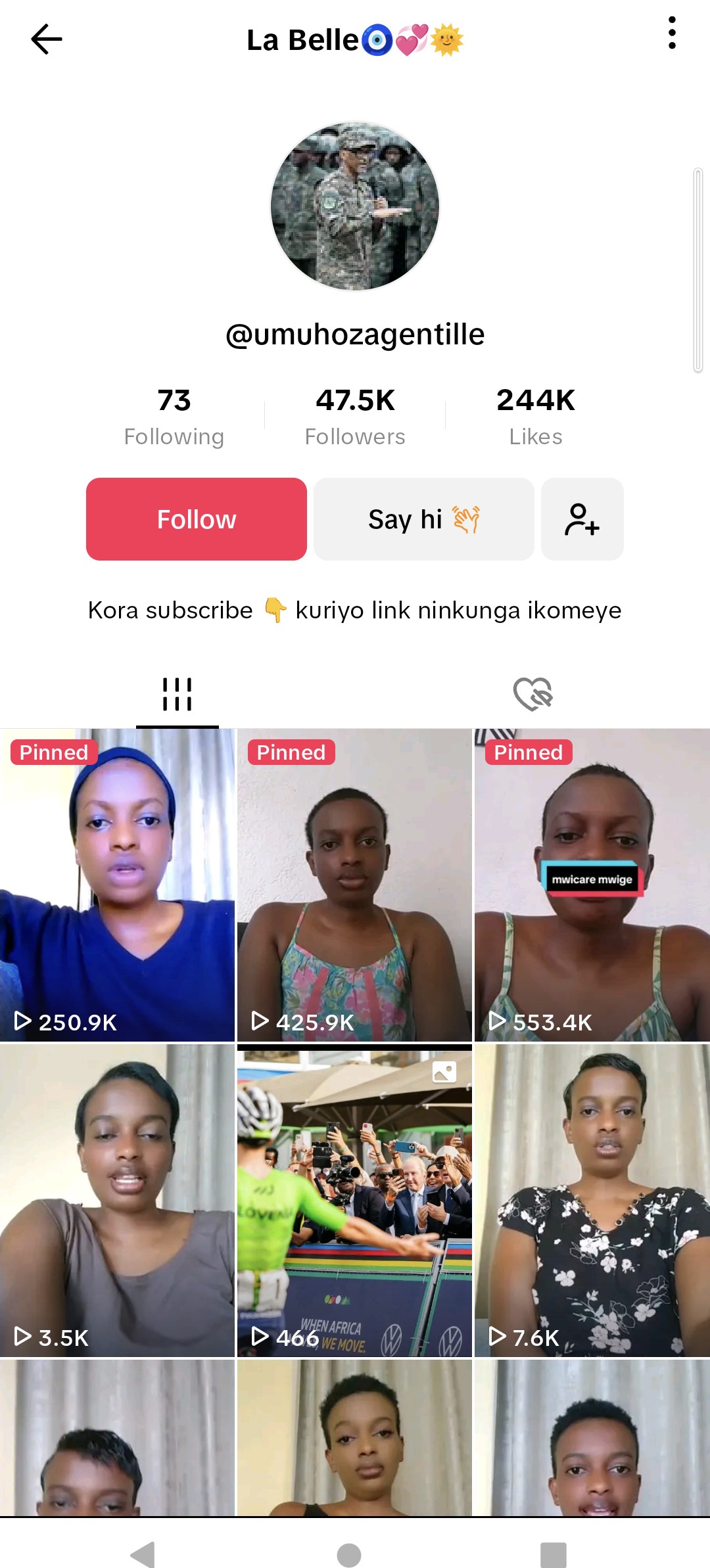
Umukaza Gentile’s profile picture is President Kagame in full military attire. She is proudly out there, unlike some who hide behind online anonymity
What Rwanda faces is not just scattered individuals spreading false information. It is a coordinated and persistent campaign of genocide denial and negation, amplified by the anonymity and reach of the internet. This is not an abstract concern. It is a problem that the Rwandan Senate itself has studied in detail.
In 2019, the Senate published a 149-page report documenting the persistence of genocide denial abroad. The report was blunt in its warning: denial remains one of the greatest threats to survivors’ dignity, to Rwanda’s national unity, and to the integrity of historical truth itself.
The study showed how denialist tactics have evolved. In the immediate aftermath of the genocide, denial was often crude and overt, rejecting the very idea that a genocide took place. Over time, the strategies became more subtle, packaged as political commentary or academic debate. Today, the digital sphere has become the central battlefield where these narratives thrive.
Denialists commonly push three main arguments. Some claim the massacres were not genocide but a tragic by-product of civil war. Others cling to the discredited notion of a “double genocide,” insisting both Hutu and Tutsi were equally targeted.
A third recurring tactic is to dispute the death toll, casting doubt on the well-established figure of over one million Tutsi killed. In more recent years, some have taken to manipulating language, deliberately using the vague term “Rwandan genocide” instead of naming it correctly as the Genocide against the Tutsi.
Live spaces are a common occurrence on both sides of the narrative divide
The Architects of Denial
The Senate report did not shy away from naming names. It pointed to European and American writers such as Bernard Lugan, Pierre Péan, and André Guichaoua, as well as Canadian author Robin Philpot, all of whom have been accused of spreading misleading accounts that undermine the historical record. Within the exiled diaspora, figures like Thomas Nahimana and Joseph Matata were highlighted as particularly active in fueling denialist propaganda.
These individuals do not act alone. Militia groups such as the Democratic Forces for the Liberation of Rwanda (FDLR), and political groups like the Rwandan National Congress (RNC), have provided institutional support, giving denialist narratives political cover and organizational resources.
The Digital Amplifier
Perhaps the most alarming revelation is the degree to which these narratives have migrated online, finding in the internet a fast, borderless, and often unregulated tool. The Senate documented dozens of websites functioning as hubs for denialist content. On the surface, these sites often pose as opposition news outlets or political blogs. In reality, they recycle old lies, disguise them as fresh “research,” and spread them to unsuspecting audiences.
Social media has multiplied the reach of these voices exponentially. Olivier Nyirubugara and Gaspard Musabyimana are among the most cited figures, using Facebook, Twitter (now X), and YouTube to circulate revisionist messages. Their posts find eager audiences in diaspora communities, especially during the sensitive commemoration season between April and July, when Rwanda mourns its dead. Carefully coordinated hashtags and online campaigns are launched at these moments to sow doubt, confuse the global audience, and disrupt remembrance.
American and European-owned platforms unwittingly provide safe ground for such activities. Branding themselves as “alternative media,” denialist outlets attract audiences already predisposed to distrust official narratives. Streaming platforms, too, play a major role. One of the most infamous examples remains the 2014 BBC documentary Rwanda’s Untold Story, which was criticized internationally for downplaying the genocide and giving a platform to known denialists. Clips from that production remain accessible online, continuing to poison the discourse and mislead those unfamiliar with Rwanda’s history.
The strategies used by denialists follow clear patterns. They question the death toll, relativize the genocide by suggesting both sides were equally guilty, or attempt to shift the blame to the Rwandan Patriotic Front (RPF), claiming the killings were merely a reaction to the assassination of President Habyarimana. Many hide behind the shield of free speech, arguing that what they publish is “political opinion” or “academic debate” rather than dangerous hate speech. Survivors and officials who speak out are often directly targeted in comment sections, accused of lying, manipulating history, or exploiting the genocide for political gain.

On TikTok, there is @ajeuse2, real names Ajay Jean Niyomufasha
A Networked Campaign
These are not isolated efforts. Denialist narratives are sustained through coordinated networks. Groups such as the so-called “Government of Rwanda in Exile (GREX),” the FDLR, and the RNC maintain websites, publish articles, and organize their followers around a shared agenda. Individual bloggers echo the same lines, while sympathetic Western journalists and academics provide an added layer of legitimacy.
This is what makes the denial campaign particularly insidious: it is no longer the work of fringe voices. It is a systematic and politically motivated project with its own networks, talking points, and amplification mechanisms.
The Democratic Republic of Congo (DRC) has emerged as the latest arena where this agenda is being promoted. Researcher Jonathan R. Beloff recently wrote in the Journal of the International Association of Genocide Scholars that Rwanda’s foreign policy is increasingly shaped by the perceived threat of genocide denial.
In his article “Combating Genocide Denial through Rwanda’s Foreign Policy,” Beloff argued that Rwanda views denial not merely as historical revisionism but as an active threat to its ontological security—its very sense of self and survival as a state. He noted that the government, guided by the principles of agaciro (self-reliance and dignity) and haunted by the fear of international abandonment, considers denial an existential danger to the unifying project of Ndi Umunyarwanda (“I am Rwandan”).
The Online Brigade
It is in this context that young Rwandans like Niyomufasha and Umuhoza have found themselves labeled as part of what some now call the “Rwanda Online Brigade.” The name is meant as an insult, a way of dismissing them as government puppets or propagandists. But those being targeted are unafraid. Many proudly post their photos, draped in the national colors, defiantly declaring that they will not be silenced or intimidated.
What is striking about this group is its character. They are overwhelmingly young. Many are highly educated. Unlike much of the diaspora, they are fluent in Kinyarwanda, a rare trait among second-generation Rwandans abroad. Most importantly, they do not hide behind anonymity. They put their names, faces, and voices on the line in a digital environment where harassment is almost guaranteed.
And they are prepared to fight fire with fire. When denialists spew hate, they respond in kind, using the same platforms, the same language, and the same energy. To their critics, this makes them militants. To their supporters, they are guardians of memory, standing in defense of truth in a hostile digital landscape.
The False Accusation of Paid Positivity
The sheer scale of this positive storytelling, however, has sparked its own backlash. The spontaneous, massive outpouring of content—from young people filming with their phones, to diaspora communities proudly sharing achievements, to visitors documenting their experiences—has created a vibrant online chorus that often drowns out the propaganda. For many observers, this has been a striking reminder of how ordinary people, without formal coordination, can become the strongest ambassadors of their country.
Faced with this reality, the Government’s critics have been forced to adopt a new attack line. They now claim that the government is secretly financing the creation of positive content, paying vloggers, influencers, and everyday citizens to speak well of the country. The accusation has gained traction in some corners of conventional media, where skepticism about Rwanda’s success stories is already entrenched.
Yet the claim struggles to withstand scrutiny. The diversity of voices, the spontaneity of the postings, and the sheer informality of much of the content all point to one conclusion: this is not a manufactured campaign, but a genuine expression of lived experience and national pride.
In many ways, the accusation reveals more about the critics than it does about Rwanda. Unable to explain why so many people, inside and outside the country, are eager to share positive stories, they resort to dismissing it as state propaganda. Yet the truth is more compelling: Rwanda’s story of recovery and transformation resonates so strongly that it compels ordinary people to tell it. What emerges is a digital counterweight to hatred—an uncoordinated but powerful force of optimism that thrives precisely because it is authentic.
The New Wave of Lethal Propaganda
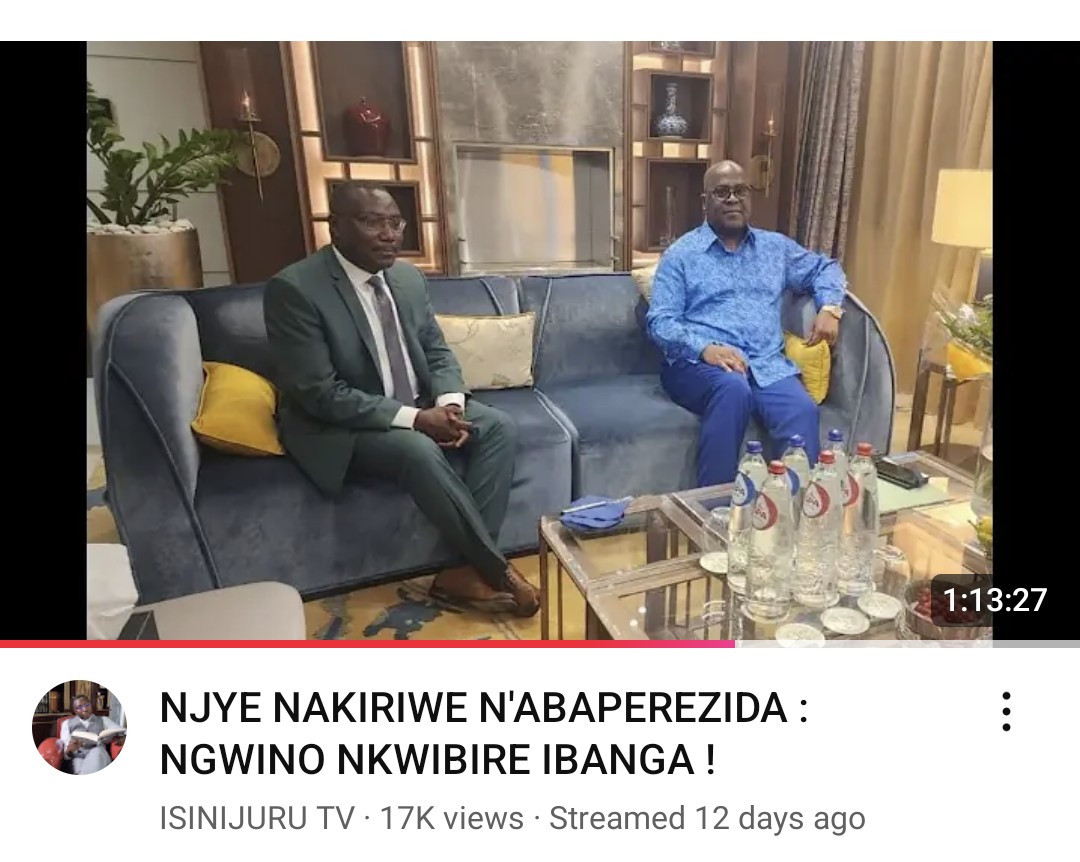
This is a screenshot of YouTube channel for Fr. Thomas Nahimana, who brandishes himself as President of the Rwandan Government in Exile (GREX). The thumbnail is picture of him meeting DRC President Tshisekedi, who has vowed to invade Rwanda and topple Government of President Kagame
In the past two years, the nature of propaganda against the country and the Government has taken on a far more lethal form. What once existed as scattered opinion pieces or sporadic online attacks has now evolved into a relentless daily campaign. Opposition groups like the Rwanda National Congress (RNC) host live Twitter Spaces almost every evening, attracting audiences and weaponizing discussion platforms to recycle old grievances under the cover of debate.
On TikTok, figures such as Nyiratunga and Mukankiko run daily live shows, weaving hatred and distortion into casual conversations that appeal especially to impressionable audiences.
Meanwhile, YouTube has become a central battlefield, where channels like Kazigabanabenirage, Isinijuru, Nanze Kubaho Ntariho, and many others stream continuous broadcasts filled with toxic narratives. One of these spread a false information that President Kagame had died in 2020, a rumour that nearly held, had the President not come out at a public even.
What makes this new wave even more dangerous is the regional reinforcement it has recently acquired. Congolese YouTube channels now amplify these toxic narratives, pushing the idea that the FDLR no longer exists and twisting history to portray “Tutsi” as a people intent on enslaving so-called “Bantu” communities.
This calculated rhetoric clouds the real causes of the ongoing instability in eastern Congo and deliberately stirs ethnic animosity across borders. Over the past year, Burundian actors have also joined the pool, adding another layer of intensity to this hostile information ecosystem.
Together, these streams of propaganda reach audiences of more than 300,000 people every single day—an alarming figure that underscores the scale and persistence of the assault.
In contrast, Rwanda’s direct counter-response to this tide of disinformation remains limited. The vast majority of content emerging from within the country is not defensive, but instead celebratory. Travel vloggers dominate platforms with stunning visuals of Rwanda’s mountains, wildlife, and bustling cities, often monetizing their passion while showcasing a country in transformation.
Influencers and entertainers fill YouTube, TikTok, X, Facebook, and Instagram, with celebrity interviews, lifestyle pieces, and light-hearted cultural features.
National milestones, such as the recently concluded UCI Road World Championships, are amplified and shared across digital spaces, painting a picture of progress, hospitality, and pride. The underlying message of this storytelling is simple but powerful: there is so much good happening in Rwanda, it is better to embrace it than waste time spreading hatred.
Its battlefield is global, its weapons are words and images, and its outcome will determine whether truth or falsehood prevails in the collective memory of Rwanda and the world.
And for young people like Niyomufasha and Umuhoza, it is a battle for the soul of their country—a refusal to let lies, denial, and revisionism write over the memory of a million dead.
