



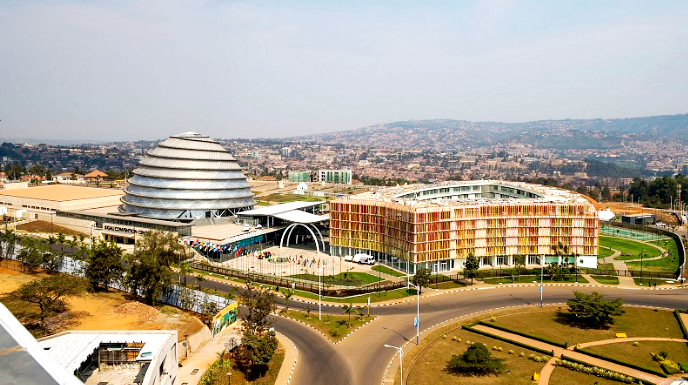
Kigali Convention Center round about is under car-free zone
Rwanda has received strong backing from major international development partners in its bid to graduate from the United Nations’ Least Developed Countries (LDC) category by 2027, with more than $105 million committed to support the transition.
The World Bank, International Fund for Agricultural Development (IFAD), African Development Bank (AfDB), United Nations Development Programme (UNDP), World Health Organization (WHO), UNICEF, and other partners affirmed their support during a recent UN–Government of Rwanda Joint Steering Committee meeting. The partners agreed that Rwanda has a credible and achievable pathway to graduation, citing steady progress across key development indicators.
Under United Nations rules, LDCs are assessed every three years by the UN Committee for Development Policy (CDP) using three criteria: Gross National Income (GNI) per capita, the Human Assets Index (HAI)—which measures health, nutrition, and education—and the Economic and Environmental Vulnerability Index (EVI), which captures exposure to shocks such as climate risks and export concentration.
To qualify for graduation, a country must meet at least two of the three thresholds in two consecutive reviews. Rwanda is scheduled for its next review in 2027 and is expected to be formally considered for graduation at that time.
According to the Government of Rwanda–UN Joint Steering Committee, the country already meets—or is close to meeting—the required thresholds. Rwanda is in the same review cohort as Uganda and Tanzania, placing it among a small group of African countries on a credible graduation trajectory. Other African nations that have successfully graduated include Botswana, Cabo Verde, and São Tomé and Príncipe.
What Rwanda Must Do to Graduate Successfully:
While partners expressed confidence in Rwanda’s prospects, they also outlined key actions required to ensure a sustainable and resilient transition.
First, Rwanda must sustain inclusive income growth, as reflected in GNI per capita. This will require maintaining steady economic expansion while scaling up productive sectors such as agro-processing, manufacturing, information and communication technology (ICT), services, and tourism with higher value addition. Strengthening private sector competitiveness and expanding exports will be critical, with partners cautioning against growth that is overly narrow or dependent on external aid.
Second, continued investment in human capital is essential to strengthen the Human Assets Index. This includes improving the quality of education beyond enrollment figures and ensuring skills development aligns with labor market needs. Sustained investments in health and nutrition—particularly for children and mothers—remain central to making graduation socially inclusive and durable.
Third, reducing economic and environmental vulnerability remains one of Rwanda’s most pressing long-term challenges. Priority areas include promoting climate-resilient agriculture, strengthening disaster risk management in response to floods and droughts, diversifying exports to reduce reliance on a limited number of commodities, and enhancing domestic revenue mobilization.
Finally, partners emphasized the importance of carefully managing the post-graduation transition. While graduation can enhance Rwanda’s international standing, boost investor confidence, and expand policy autonomy, it also brings the gradual loss of preferential trade access, concessional financing, and special UN support measures.
To mitigate these risks, Rwanda is encouraged to implement a smooth transition strategy that includes negotiating extended access to selected LDC benefits, strengthening domestic institutions, and aligning the graduation process with national development frameworks such as Vision 2050 and the National Strategy for Transformation (NST).
With sustained reforms and coordinated support, development partners say Rwanda is well positioned to make the transition from LDC status by 2027—marking a significant milestone in the country’s development journey.