


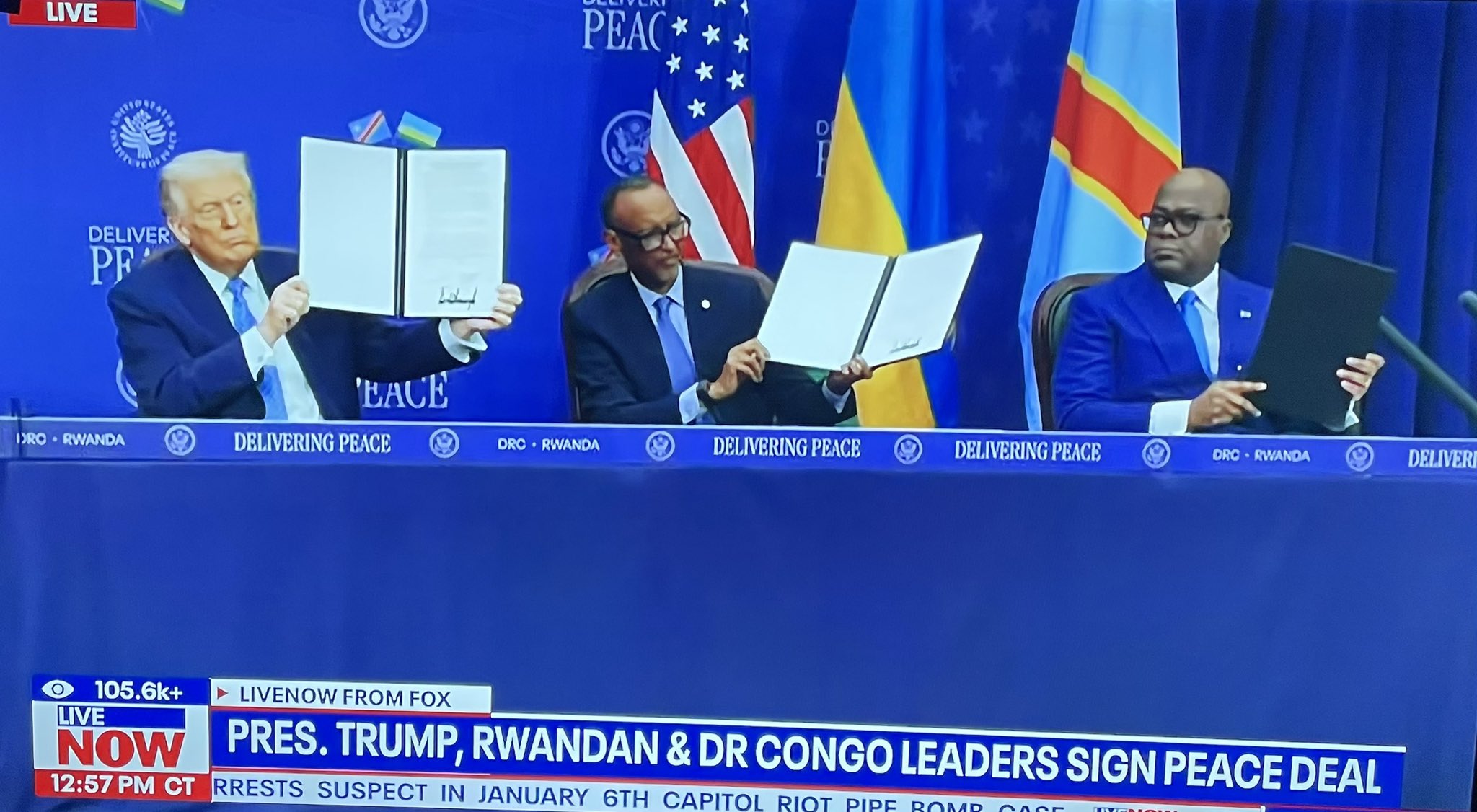
The Presidents of the Republic of Rwanda, Paul Kagame, and the Democratic Republic of Congo’s Félix Tshisekedi joined U.S. President Donald Trump in signing a landmark DRC-Rwanda Peace Agreement that had failed for over 30 years.
The Washington Accord signing ceremony was held inside the White House in Washington, D.C., on December 4, 2025, following trilateral meetings which the U.S. government has managed to negotiate ahead of the signing.
The Accord is also a result of the initial signings of the ‘Declaration of Principles’ on April 25, 2025, and the comprehensive ‘Washington Accord’ on June 27, 2025, prompted by the U.S. government but hit delays and snags along the way.
Why DRC–Rwanda Peace Agreement Took Decades:
The failure of previous agreements, such as the 2002 Pretoria Agreement, centered on a lack of trust and a failure to implement reciprocal commitments:
Rwanda’s Security Concern: The DRC failed to disarm and repatriate the FDLR (Democratic Forces for the Liberation of Rwanda) militia, a group composed of perpetrators of the 1994 Genocide, who continued to operate from Eastern DRC. Rwanda viewed this as an existential threat.
DRC’s Sovereignty Concern: Rwanda was accused of supporting armed proxy groups (like the M23 rebels) in the Eastern DRC, compromising Congolese sovereignty and fueling instability.
Fresh Start with Key Commitments:
The final agreement is designed to be an enforceable exchange of security guarantees, building on the Harmonized Plan (CONOPS) developed during the Angolan-led Luanda Process:
DRC’s Commitment: To neutralize the FDLR and stop all state support for other non-state armed groups.
Rwanda’s Commitment: To implement the phased disengagement of its forces and cease all support for proxy groups in the DRC.
Joint Mechanism: The establishment of a Joint Security Coordination Mechanism to verify compliance on the ground.
Economic Integration: The agreement includes an economic component, the Regional Economic Integration Framework (REIF), aimed at stabilizing border areas through shared investment and secure supply chains, particularly for critical minerals.
“This is a very important day,” Trump said as he recounted how many decades it has taken to reach the deal. “It is an amazing day, a great day for Africa, a great day for the world. And these two beautiful countries have so much to be proud of,” he noted.
Trump thanked the two leaders and to an extent said it may mean so much because we are here in this brand new building – the Trump Peace Center, which he said cost a lot.
He, however, said that the signing begins a new chapter between DR Congo and Rwanda and stated that this was because the two leaders are courageous and great men.
“They (President Paul Kagame and Félix Tshisekedi) are amazing and had stories to tell me that were incredible. And really fascinating in many ways – both sad and beautiful, and today makes them beautiful,”
Trump also recognized key players in the lead to the agreement including Burundian, Angolan, Kenyan presidents, Uganda, the Qatar government representatives, UAE, the African Union (AU), and especially one – Marco Rubio, the United States Secretary of State, plus Massad Boulos – U.S. Senior Advisor for Arab and African Affairs among others who did all the negotiations.
Recounting how many millions have died (more than 10 million lives) in the over 30-year-old conflict, Trump said that the U.S. Government has succeeded in ending such atrocities, where others have failed.
He noted that this is the eighth war or conflict the US government has succeeded in resolving in less than a year.
Explaining the accord in brief, Trump said that both Rwanda and DR Congo have spent a lot of time in conflict and now they will spend more years loving and working along each other.
While previous agreements failed, Trump also revealed that he is confident the accord will be upheld between the two states, and with the US signing more deals in mineral extraction, every side will make money.
In his remarks, President Paul Kagame began with words of thanks to fellow Heads of State, especially Qatar – the negotiator and President Trump, and stated that their presence indicates an effort to succeed.
Kagame said that countless efforts and agreements have been in place but in vain to resolve the conflict. However, Trump’s approach was dynamic, not taking sides and focused on the future, not the past.
“More importantly, President Trump’s approach is programmatic. The process has not become an end in itself. All these elements filtered down to his dedicated team,” he said, singling out with special appreciation to negotiators – Marco Rubio and Massad Boulos.
“We would not be here today without their efforts and as a result, we have the clearest and most viable path forward that we have ever had,” he said.
Kagame stated that the accord is supposed to succeed and if it fails, it will not be the responsibility of President Trump but that of Africans.
Even when there are anticipated ups and downs in materializing the accord, Kagame said that there is no doubt Rwanda will fail it.
“(The) Rwanda I know will not be found wanting. I can assure you of that. Our only objective is and has always been for our country to be safe and secure after having endured so much tragedy. We now want to look forward in confident expectation of a prosperous and stable future,” Kagame concluded.
In his remarks, Félix Tshisekedi said that after the signing of the accord, he felt deep gratitude for his people and clear hope for the future.
He thanked President Trump and the American people for the critical role played in bringing both countries to a peace deal and noted that this ends an era of mistrust and fighting and starts a new era of an all-shared friendship, prosperity.
“The Democratic Republic of Congo takes this solemn commitment to implement with sincerity all our obligations that stem from this agreement,” he said.
“We will do this with seriousness, rigorousness, and constant care for peace and security for our populations, for the unity and integration of our territory,” he added and hoped that Rwanda will do likewise.