




KIGALI – As Rwanda deepens its ambition to become a knowledge-based economy, the conversation around technology in education has shifted to pace, scale and sustainability.
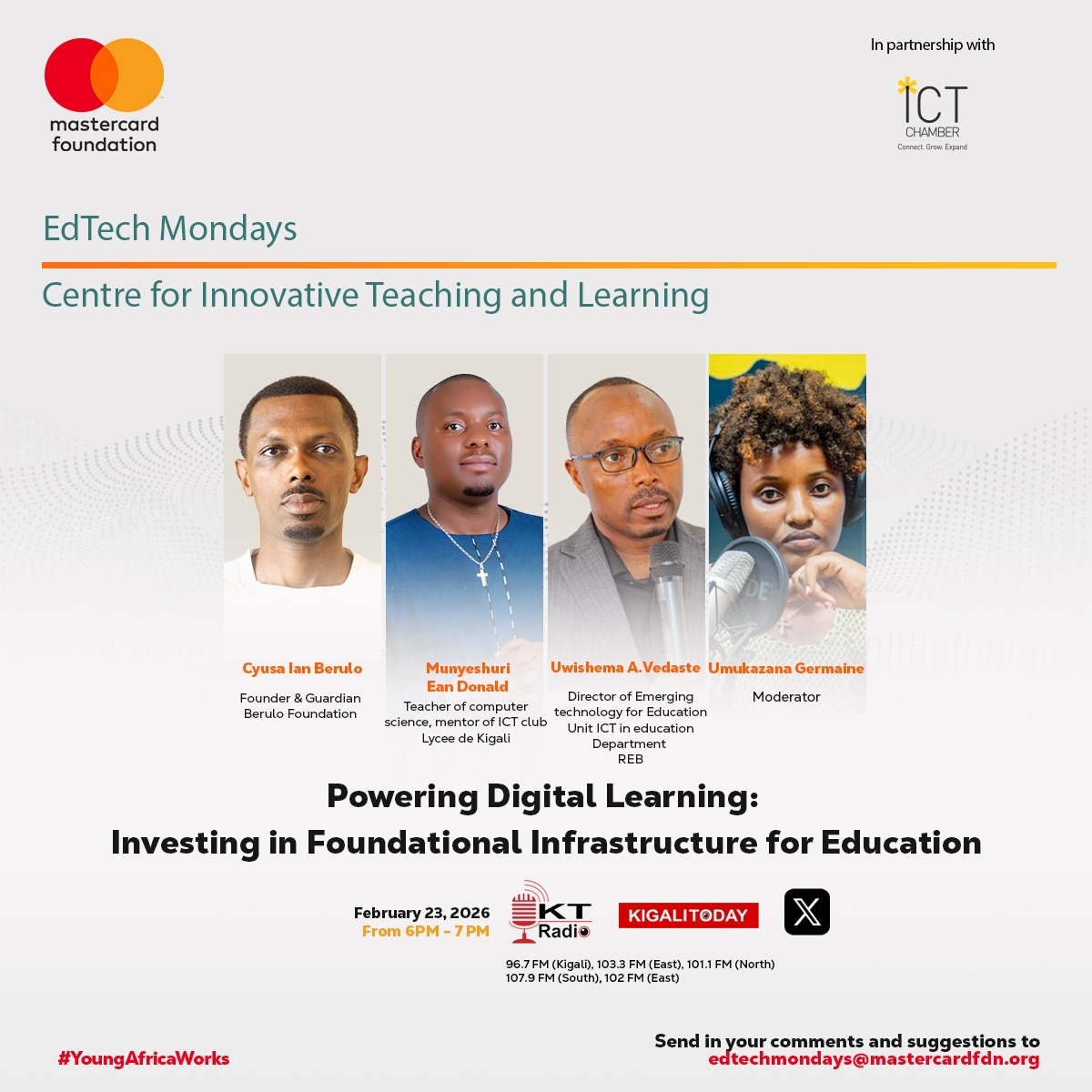
This evening, Monday, February 23, 2026, KT Radio resumes a national dialogue dubbed #EdTechMondays — a platform examining how infrastructure can unlock the full promise of digital learning.
The discussion, supported by the Mastercard Foundation in partnership with the ICT Chamber of the Rwanda Private Sector Federation, comes at a time when Rwanda has already recorded notable gains in integrating Information and Communication Technology (ICT) into classrooms.
As policymakers and educators acknowledge, infrastructure remains both the backbone and the bottleneck of meaningful digital transformation in education.
Over the past few years, collaboration with the Rwanda Basic Education Board (REB) has seen more than 2,000 schools connected to the internet. Initiatives such as the Smart Education Project have extended high-speed connectivity and modern classroom facilities to more than 1,500 schools across the country.
However, while many urban schools are steadily adapting to digital tools, several rural schools continue to grapple with limited connectivity, inconsistent electricity supply and insufficient access to devices.
The gap underscores a fundamental reality: access to the internet alone does not constitute digital transformation. Infrastructure must be comprehensive, reliable and equitably distributed.
Beyond connectivity, the broader digital learning ecosystem demands investment in devices such as laptops, interactive classroom technologies and accessible online learning platforms.
These components are essential to supporting Rwanda’s competence-based curriculum, which emphasizes practical skills, critical thinking and real-world problem-solving. Without adequate tools, the curriculum’s digital ambitions risk remaining theoretical.
Teachers must be equipped not only with devices, but also with the confidence and competence to integrate technology into lesson delivery in ways that enhance, rather than distract from, learning outcomes.
Continuous professional development is therefore emerging as a central pillar of Rwanda’s education technology agenda. Training programmes that focus on practical application, digital pedagogy and infrastructure management are increasingly viewed as indispensable to sustaining progress.
During the KT Radio discussion, stakeholders will reflect on the challenges encountered in implementing and maintaining ICT infrastructure, particularly in remote areas.
Equally important is the role of emerging education technology entrepreneurs, who are working alongside government institutions and schools to strengthen foundational systems and expand innovation.
As Rwanda seeks to scale digital access nationwide, partnerships that leverage private capital, expertise and innovation are becoming critical to accelerating results while maintaining quality standards.
The #EdTechMondays dialogue forms part of a broader national reckoning on how Rwanda can ensure that no learner is left behind in the digital era.
The transformation of classrooms into connected, technology-enabled spaces is about equity, competitiveness and preparing a generation capable of thriving in an increasingly digital global economy.
