




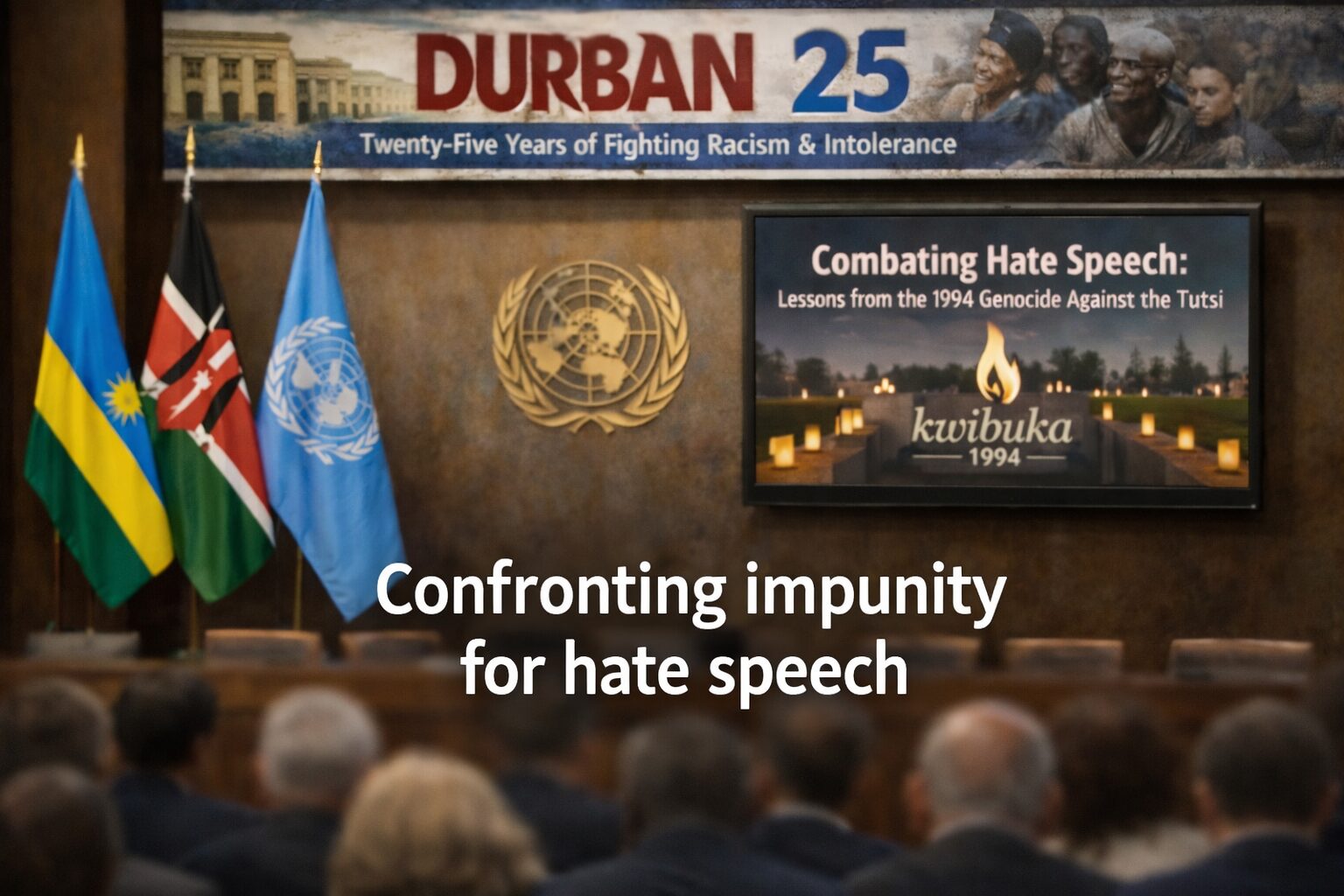
Twenty-five years after the adoption of the Durban declaration and program of action, Rwanda has returned to the international stage with a clear and urgent reminder that impunity for hate speech remains one of the most dangerous fault lines in global peace and security.
At the Palais des Nations in Geneva, a high-level panel hosted by Minister of Foreign Affairs and International Cooperation Amb. Olivier Nduhungirehe convened diplomats, legal scholars and human rights practitioners to interrogate how unchecked incitement continues to fuel violence and destabilize regions.
The commemoration of Durban 25 is grounded in lived history. The 1994 Genocide against the Tutsi was preceded and accompanied by systematic propaganda that dehumanized its victims and normalized extermination.
The international community has since acknowledged that hate speech, when ignored or tolerated, can evolve into atrocity crimes. Against this backdrop, the Geneva dialogue carried both moral weight and political urgency.
The legal and diplomatic imperative
Ambassador James Waweru Ndiragu of Kenya’s permanent mission, who chairs the working group on the effective implementation of the Durban declaration and program of action, highlighted that the Durban framework remains a binding moral compass.
“The Durban declaration was never meant to gather dust. Its principles demand implementation. States must translate commitments into legislation, enforcement and regional cooperation,” he said.
Ambassador Pierre Prosper Richard, former Vice Chair of the committee on the elimination of racial discrimination, warned against the normalization of discriminatory rhetoric.
“Racism and xenophobia are sustained through repetition. When public figures employ language that dehumanizes, and when institutions fail to respond, prejudice becomes embedded in public life,” he noted.
Legal experts Me Florida Kabasinga, Me Nteziryayo Innocent and Me Bernard Maingin addressed the delicate equilibrium between safeguarding freedom of expression and preventing incitement.
Kabasinga underscored that international law already provides guidance. “Freedom of expression is fundamental but it does not extend to advocacy of hatred that incites discrimination, hostility or violence. The law is clear. What is often missing is decisive enforcement,” she said.
She added that accountability mechanisms must be consistent because selective justice weakens credibility. According to her if hate speech is punished in some instances and ignored in others, the deterrent effect disappears.
From early warning to prevention
Ms Alice Nderitu Wairimu, former United Nations special adviser on the prevention of Genocide, drew on global case studies to stress that identity-based incitement is a well-documented precursor to mass atrocities.
“In every context where genocide has occurred, we have seen patterns of dehumanizing language. Prevention begins by recognizing those patterns and acting before they metastasize,” she said.
Michael Wiener, human rights officer in the equality and non-discrimination branch of the office of the High Commissioner for human rights, situated the debate within international human rights law.
“States have a dual obligation. They must protect individuals from discrimination and violence while ensuring that restrictions on speech are lawful, necessary and proportionate. The challenge is not the absence of standards, but the courage to apply them,” he explained.
Rwanda’s Minister of Justice and Attorney General, Dr. Emmanuel Ugirashebuja, anchored the discussion in Rwanda’s historical experience. “Our history demonstrates that words can prepare societies for unspeakable crimes,” he said.
Minister Nduhungirehe, as host of the event, reaffirmed Rwanda’s commitment to multilateral engagement against racism and intolerance. “Durban 25 is a moment of renewal. We must confront impunity wherever it appears. Peace is not sustained by silence in the face of hatred, but by principled and collective action,” he stated.
Combating hate speech is inseparable from defending human dignity and regional stability. For Rwanda, the call to end impunity is rooted in memory, reinforced by law and projected toward a future where prevention, defines the global response.
More broadly, global experience has shown that sustained hate speech and dehumanising narratives often weaken social cohesion and create conditions in which violence becomes acceptable. In Rwanda, organised hate propaganda before and during the 1994 Genocide against the Tutsi played a decisive role in mobilising perpetrators and legitimising the targeting of an entire community.
The Durban 25 commemoration seeks to renew international commitment to confronting these risks by strengthening cooperation among states and turning existing legal and policy commitments into practical prevention tools, with a focus on early warning, accountability and the protection of vulnerable communities.
