




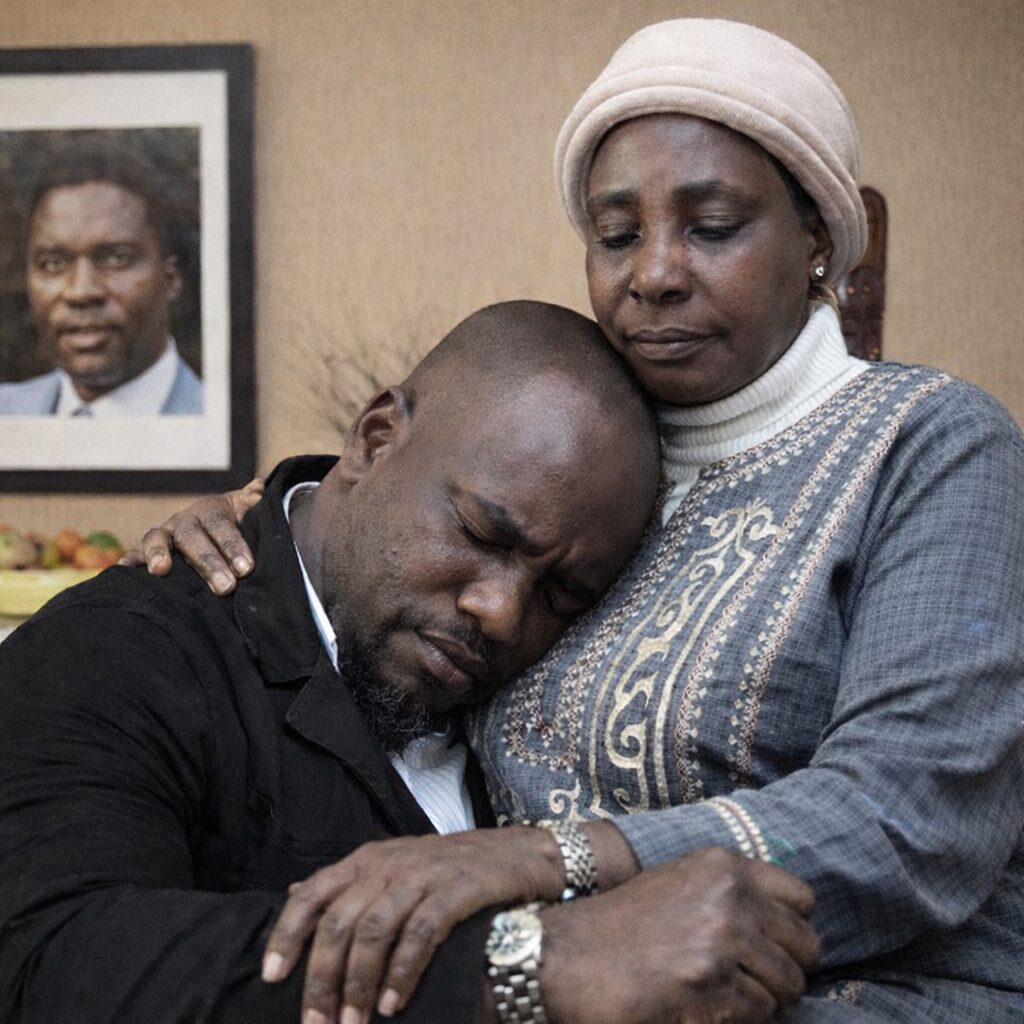
Jean-Luc Habyarimana in the comfort of his mother Agathe Kanziga Habyarimana. They have lived together in France since 1994.
When Jean-Luc Habyarimana surfaced in Kinshasa—received by a government that has publicly vowed regime change in Kigali—the moment was loaded with history.
His visit came on the heels of a freshly released political program in which he pledged to bring democracy, human rights and political reform to Rwanda.
The language is polished. The tone is measured.
But Rwanda’s memory is long.
Jean-Luc is one of the eight children of former President Juvénal Habyarimana and Agathe Kanziga Habyarimana. Often described as the second-born son in the family, he has lived in France for many years, largely distant from the country’s post-1994 reconstruction and reconciliation journey.
Unlike many Rwandans who endured displacement, rebuilding, and national trauma firsthand, Jean-Luc’s political re-emergence comes from abroad.
Before Rwanda examines his manifesto, it must revisit July 5, 1973.
The 1973 Coup
On that day, then–army chief Major General Juvénal Habyarimana overthrew President Grégoire Kayibanda in what was described as a bloodless coup. Kayibanda had led Rwanda since independence in 1962, presiding over the First Republic under the MDR-PARMEHUTU party that claimed have come to emancipate “Hutus”.
The coup was justified as a “moral revolution.” Habyarimana and his allies argued that Kayibanda’s government had failed to manage deep ethnic tensions, regional factionalism between southern and northern elites, economic stagnation, corruption and insecurity.
In 1972–1973, massacres and unrest had intensified, and thousands had fled the country.
But the solution was not reform—it was consolidation.
Kayibanda and senior officials from his government were arrested immediately. In June 1974, a military tribunal sentenced Kayibanda and seven high-ranking officials to death on charges of corruption and mismanagement. The sentences were later commuted to life imprisonment.
Imprisonment, however, became something far more sinister.
Kayibanda was held in secrecy. Accounts place him near Kabgayi, in Kavumu, or in the “special section” of Ruhengeri prison—an infamous detention site where many First Republic dignitaries perished. Reports that have persisted for decades state that Kayibanda and his wife were denied food. Rather than a public execution that might attract international condemnation, starvation provided a quieter elimination.
Kayibanda died on December 15, 1976. His wife, Vérédiana Mukagatare Kayibanda, had died earlier, in October 1974, reportedly from a “mystery illness”—a phrase that has never dispelled suspicions.
Agathe Kanziga Habyarimana herself, in a video released last month, confirmed that Kayibanda’s wife pleaded to be allowed to stay with her husband after the coup. That plea—acknowledged in passing—reinforces a disturbing possibility: that the couple were confined together not for mercy, but for isolation. Removed from public scrutiny. Forgotten behind closed doors. Left to die quietly.
This method was not reserved for Kayibanda alone. Scores of officials from the First Republic—particularly southern elites categorised at the time as “Abanyenduga”—were imprisoned, sidelined or eliminated.
Power shifted decisively northward, consolidating around Habyarimana’s northern Rwanda stronghold. The MDR-PARMEHUTU party was banned. Regional balance gave way to northern dominance.
The 1973 coup was presented as corrective. Instead, it entrenched authoritarianism, introduced ethnic quotas in education and employment, deepened regional divides and laid structural foundations that later fed into catastrophic violence.
This is the inheritance Jean-Luc Habyarimana cannot ignore.
Without Reckoning
Today, Jean-Luc speaks of democracy, pluralism and human rights—the same public-facing language his father once employed while centralizing authority and suppressing rivals.
Words are easy. History is harder.
Jean-Luc bears no personal criminal responsibility for events that occurred before he was an adult. But he carries a political surname inseparable from a chapter marked by coups, purges, detention, starvation and division.
Before aspiring to the presidency, there is a moral sequence that must be respected.
First, Jean-Luc Habyarimana should publicly acknowledge the suffering tied to his father’s rule. Not defensively. Not conditionally. But clearly.
He should apologize to the family of Grégoire Kayibanda—whose patriarch died in detention after being overthrown.
He should apologize to the families of officials imprisoned in the “special section” of Ruhengeri prison and other detention sites, many of whom perished through starvation or execution.
He should apologize to southern communities marginalized in the northward consolidation of power.
He should apologize to Rwandans broadly, for a governance legacy that intensified division and left the nation on a trajectory that would later descend into national tragedy.
An apology is not self-condemnation. It is moral clarity. It signals that ambition does not eclipse memory.
Only after such acknowledgment should Rwandans be given time—real time—to reflect on whether forgiveness is possible.
Forgiveness is not demanded; it is granted.
The Village “Umudugudu”
If Jean-Luc Habyarimana wishes to serve Rwanda, he should begin at the foundation of Rwandan civic life: the village.
Let him return and live among ordinary citizens. Let him engage not as a claimant to the highest office, but as a participant in everyday communal responsibility. Let him demonstrate service, humility and accountability in the smallest administrative unit—the umudugudu.
In Rwanda, even a village leader—fondly referred to as a “Mudugudu”—earns legitimacy through proximity to the people. He mediates disputes, mobilizes community work, and answers directly to neighbors.
Let Jean-Luc first seek that trust.
Let Rwandans observe him as a Mudugudu before entertaining him as a presidential candidate.
Leadership is not inherited by surname. It is earned through demonstrated commitment to shared destiny.
And for Kinshasa?
Jean-Luc’s appearance in Kinshasa complicates matters further. The Congolese government has publicly signaled openness to alternative political futures for Rwanda. Hosting the son of a former Rwandan president is not neutral diplomacy—it is strategic symbolism.
If Jean-Luc’s path to power begins under the patronage of foreign governments openly hostile to Kigali, it risks appearing less as national service and more as geopolitical positioning.
The Habyarimana family has maintained ties with FDLR since it was formed. The family is thc chief financial mobilizer of the FDLR, with ultimate goal to return the genocidal ideology into Rwanda.
Rwanda’s sovereignty and history demand something different: accountability first, ambition second.
Rwanda’s past is not a rhetorical tool to be brushed aside. It is lived memory in households that recall arrests at dawn, disappearances, hunger in detention cells and political silencing.
The starvation of a former head of state is not an anecdote. It is a moral marker in the nation’s political evolution.
If Jean-Luc Habyarimana seeks the presidency, he must first walk through that history, not around it.
He must apologize.
He must allow space for reflection.
He must accept that forgiveness, if granted, will be gradual.
He must begin at the grassroots—at the level of Mudugudu—earning trust one household at a time.
Only then can a serious conversation about higher office begin.
Anything less risks reopening wounds that Rwanda has spent decades trying to close.
