




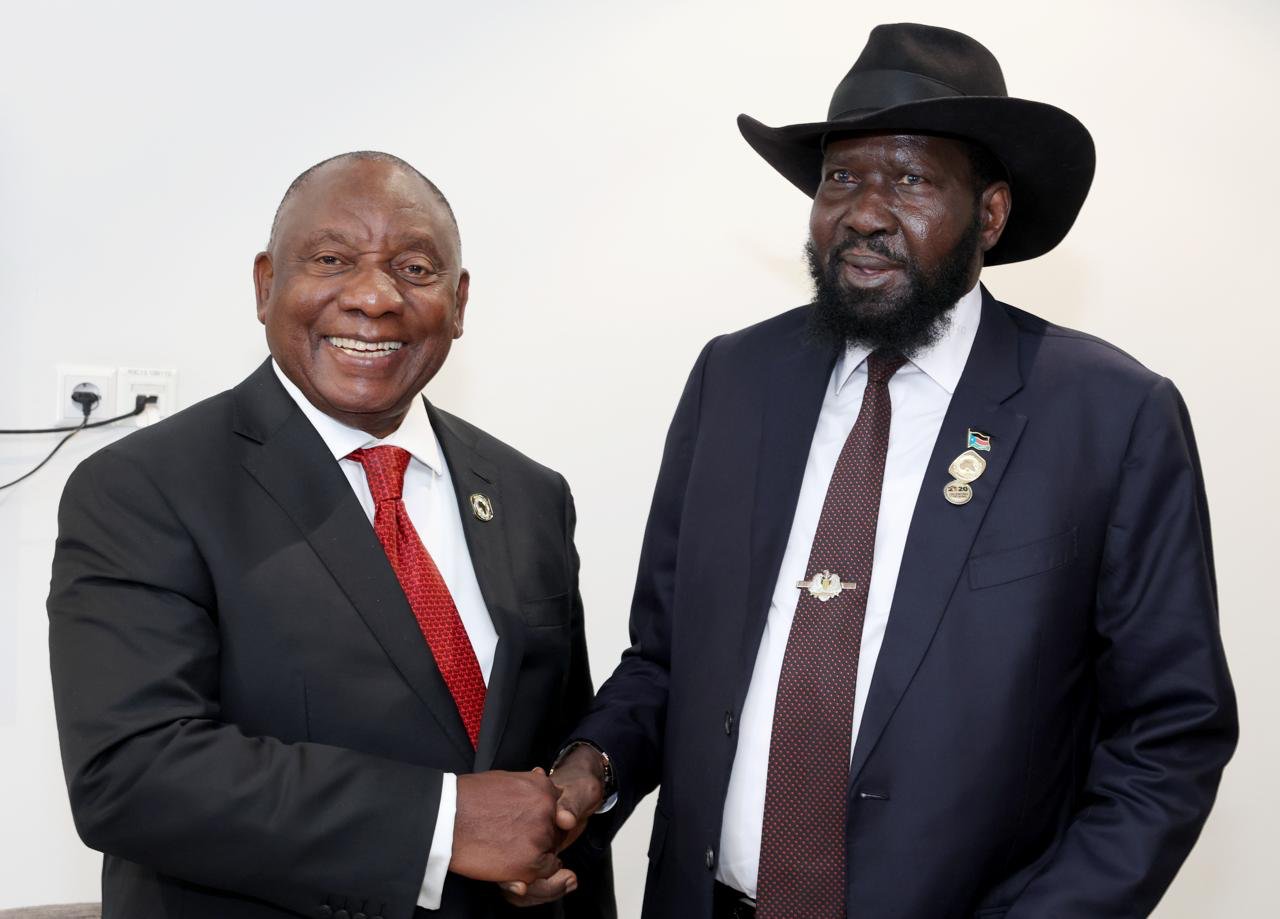
Continental dialogue: President Cyril Ramaphosa (left) says Africa must act collectively to secure lasting peace in South Sudan
President Cyril Ramaphosa has called for urgent and unified action by African leaders to safeguard South Sudan’s fragile peace, warning that decisions taken in the coming months will determine whether the country advances towards stability or slips back into turmoil.
Speaking at the African Union Ad-Hoc High-Level Committee for South Sudan (C5) Plus Summit, Ramaphosa described the meeting as a critical moment for Africa’s youngest nation.
The summit, convened jointly with the United Nations, the Intergovernmental Authority on Development (IGAD) and the East African Community (EAC), marked the first time since 2018 that the committee has met at the level of Heads of State and Government.
In 2018, South Sudan’s leaders signed the Revitalised Agreement on the Resolution of the Conflict in the Republic of South Sudan (R-ARCSS), aimed at ending years of civil war. Nearly eight years later, Ramaphosa noted, implementation of the deal remains slow and uneven.
“As guarantors of the Revitalised Agreement and as sister countries, we are here to support the peace process in South Sudan,” he said, acknowledging that progress so far has been fragile.
Addressing President Salva Kiir Mayardit directly, Ramaphosa said his participation in the summit demonstrated commitment to peace and stability, but stressed that symbolism must be matched by concrete action on the ground.
South Sudan is expected to hold general elections in December 2026, a milestone widely regarded as pivotal to the country’s transition. However, Ramaphosa cautioned that “elections alone will not guarantee lasting peace,” underscoring the need for a conducive political and security environment.
He warned that violence at any stage of the process would undermine public confidence and derail the polls, and called for inclusive national dialogue and legal reforms involving all signatories to the peace agreement and key stakeholders.
Speaking at the summit, Rwanda’s Prime Minister, Dr. Justin Nsengiyumva, said Rwanda stands ready to share its experience in reconciliation and post-conflict rebuilding, and to continue supporting peace efforts alongside the United Nations Mission in South Sudan (UNMISS).
IGAD remains the principal mediator of the peace process, while UNMISS has supported the protection of civilians and humanitarian access since 2011.
Ramaphosa also urged closer coordination among regional actors, noting that Ethiopia, Kenya and Uganda, although not members of the C5, remain deeply invested in South Sudan’s stability.
In a key proposal, the C5 supported the appointment by the Chairperson of the African Union Commission of a former Head of State to mediate among the signatories and facilitate dialogue between President Kiir and First Vice President Riek Machar. Such an initiative, Ramaphosa said, could help unlock persistent political deadlocks.
“We stand ready to support mediation, to monitor implementation and to coordinate our efforts,” he said, calling for a dedicated oversight mechanism involving both the C5 and IGAD to track progress and regularly report to African leaders.
Power struggle stalls South Sudan’s fragile peace
More than a decade after independence, South Sudan remains locked in a prolonged political crisis, with fragile peace arrangements struggling to hold amid persistent divisions at the top of government.
The tensions are centred on the uneasy power-sharing relationship between President Kiir and First Vice President Machar, forged under the 2018 R-ARCSS. While the agreement ended large-scale fighting, it failed to resolve underlying political and security disputes.
The fragile arrangement has come under further strain as Machar faces trial in a case described by his allies as politically motivated, intensifying mistrust and raising concerns over the future of the peace process.
Sporadic clashes involving rival forces and local armed groups have continued in several parts of the country, often driven by ethnic rivalries and competition over land and resources. Thousands have been displaced, worsening an already severe humanitarian situation marked by food shortages and economic decline.
Despite ongoing mediation by regional and international actors, progress on key provisions of the peace deal—such as security sector reforms, the unification of forces, and political restructuring—has been slow and uneven. Analysts warn that without meaningful compromise and credible reforms, the planned 2026 elections could deepen divisions rather than consolidate stability.
Observers stress that sustainable peace will require not only elite political agreements, but also addressing ethnic tensions, ensuring fair access to national resources, and expanding the participation of women and young people in governance. Without renewed political will, South Sudan’s transition risks remaining stalled, with civilians continuing to bear the heaviest burden.
UN calls on Africa to lead the path to peace
The UN has called on African leaders to help deliver peace in the region. UN Secretary-General António Guterres said: “This is 2026 – not 1946,” urging leaders to prioritize peace.
Guterres called for an immediate cessation of hostilities in Sudan, renewed dialogue in South Sudan, and respect for the territorial integrity of the Democratic Republic of the Congo. Across the Sahel, Libya, and the Horn of Africa, he stressed the need for African-led political solutions backed by sustained international support.
Since independence in 2011, South Sudan has endured repeated cycles of conflict and humanitarian crises. For Ramaphosa and his counterparts, the stakes extend beyond the country’s borders.
“The choices made in the coming months will determine whether South Sudan moves towards durable peace or back into cycles of instability,” Ramaphosa said, urging African leaders to act with urgency, courage, and unity.
Whether the renewed diplomatic push can translate into credible elections and sustainable peace will depend on the willingness of South Sudan’s leaders to embrace dialogue — and on Africa’s resolve to hold them to account.
