




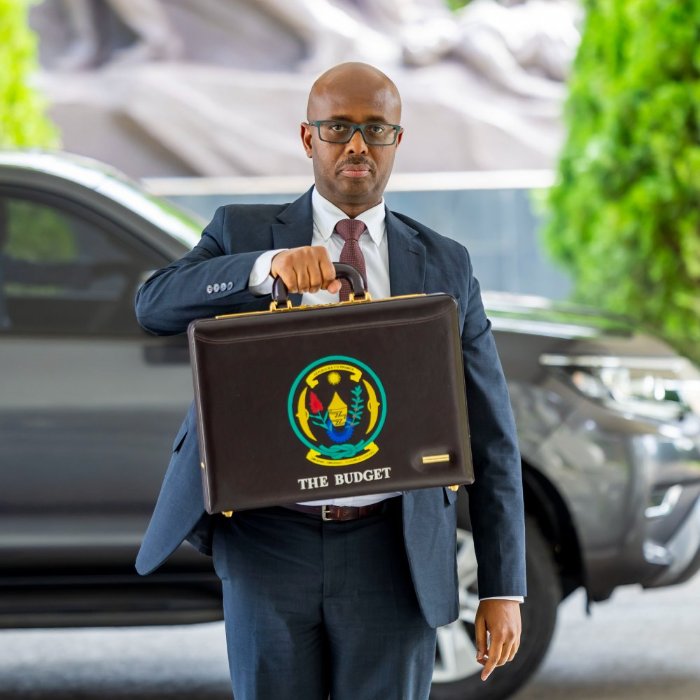
Finance Minister Yusuf Murangwa arrives at Parliament to present the revised budget estimates
Kigali — Rwanda has revised its national budget for the 2025/26 financial year, cutting routine government spending while sharply increasing funding for development projects, in a move aimed at strengthening long-term economic growth.
The revised budget now stands at Frw 6,952.1 billion (about USD 4.79 billion), down from the previously approved Frw 7,032.5 billion. This represents a reduction of Frw 80.4 billion, equivalent to roughly USD 55.4 million.
According to the Ministry of Finance and Economic Planning, the adjustment follows the government’s success in securing more affordable financing for major projects, including the New Kigali International Airport, as well as the rescheduling of a RwandAir loan repayment to the next fiscal year.
These measures have also reduced the country’s need for budgetary loans by Frw 645.4 billion, or approximately USD 444.8 million.
Presenting the revised budget to Parliament, Finance Minister Yusuf Murangwa said the changes reflect prudent financial management.
“This revision reflects prudent fiscal management,” Murangwa said. “By securing better terms for major investments and managing cash flows wisely, we strengthen our fiscal position while protecting core spending.”
One of the biggest changes is a cut in the recurrent budget — which covers day-to-day government operations such as salaries, subsidies, and goods and services.
Recurrent spending has been reduced by Frw 198 billion, bringing it down to Frw 4,114.9 billion. This cut is equivalent to about USD 136.4 million.
At the same time, the government significantly increased funding for development projects. The development budget rose by Frw 253.2 billion, reaching Frw 2,115.8 billion. This increase — worth roughly USD 174.5 million — will support key infrastructure and national priority projects.
The Ministry said the shift from recurrent to development spending shows a strategic focus on long-term growth, with more resources directed toward capital investments that can boost productivity, improve services, and create jobs.
On the revenue side, projected tax and other income has been revised upward by Frw 41 billion, reflecting confidence in the country’s economic performance.
Authorities emphasized that they will continue to closely monitor economic conditions to ensure smooth implementation of the budget while maintaining macroeconomic stability.
The revised budget underscores Rwanda’s effort to balance fiscal discipline with development needs, prioritizing investment in national projects while tightening routine expenditure.
