




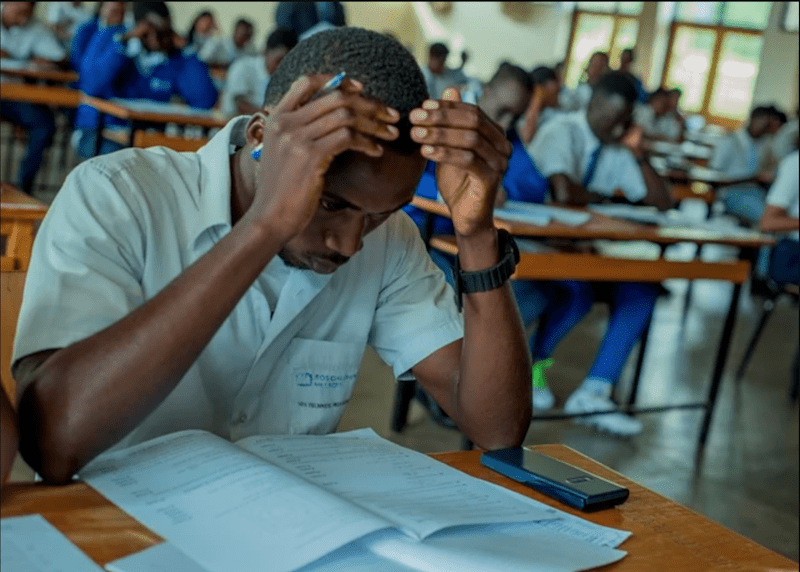
A student is deep in exam mood during the official S3 national exam. The PISA test is a different kind of test
KIGALI, Rwanda — In classrooms stretching from Kigali’s urban schools to remote rural districts, thousands of Rwandan teenagers have quietly taken part in an exam that will not affect their report cards, determine university admission or appear on any school transcript.
Yet the results, due later this year, may shape the future of Rwanda’s education system.
Between April 28 and early June 2025, 7,455 Rwandan students — all aged 15 — sat for the Programme for International Student Assessment, known globally as PISA.
The students were drawn from 213 randomly selected schools across the country: 81 public schools, 18 private schools, 2 international schools and 112 government-supported schools.
Roughly 77 percent of the sampled schools were in rural areas and 23 percent in urban centers, reflecting the country’s demographic balance. Provisions were made to include students with disabilities.
The assessment, administered worldwide by the Organization for Economic Cooperation and Development (OECD), is widely regarded as the most influential global benchmark of how well education systems prepare students for modern life.
Rwanda’s participation in the PISA 2025 cycle marks its first full entry into the triennial study, placing its teenagers alongside peers from more than 80 countries and economies — including high-performing systems such as Germany, Estonia and Singapore.
Is it a national exam?
Unlike Rwanda’s national examinations at the end of Primary 6, Senior 3 or Senior 6, PISA is not a curriculum-based test. It does not ask students to reproduce textbook knowledge.
Instead, it evaluates how effectively 15-year-olds can apply reading, mathematics and science skills to real-world scenarios: interpreting a complex text, solving a budgeting problem, evaluating a scientific claim.
The target population is defined strictly by age — students between 15 years and 3 months and 16 years and 2 months at the time of testing.
In Rwanda’s system, that typically corresponds to Senior 3 (S3), the final year of lower secondary education, though a small number of students in adjacent grades may have qualified if they met the age criteria.
The assessment was largely computer-based, with some paper components where necessary.
In addition to academic tasks, students completed background questionnaires designed to capture information about learning environments, socio-economic context, digital access and attitudes toward school.
These contextual data often prove as influential as test scores themselves, allowing policymakers to analyze gaps between rural and urban learners, boys and girls, or different socio-economic groups.
The full results — both international comparisons and Rwanda’s national report — are scheduled for release in September 2026. No preliminary scores have been made public.
A “critical stage” for Rwanda
This week, education officials moved into the next phase of preparation.
On February 23 and 24, 2026, the National Examination and School Inspection Authority (NESA), under the Ministry of Education, convened a two-day stakeholder consultation in Kigali.
School leaders, policymakers and education experts gathered to review the draft methodology, discuss data processing and consider how the eventual findings should inform reforms.
“This is a critical stage,” said Dr. Bahati Bernard, NESA’s Director General. “Students have completed the assessment, and we are processing the results while gathering feedback to inform education strategies that address local challenges.”
Carlene Seconde Umutoni, NESA’s Deputy Director General, emphasized that the value of PISA lies not in ranking but in diagnosis.
“The strength of PISA lies in how it assesses understanding and practical application,” she said, “linking results to education policy and learning outcomes.”
For Rwanda, the stakes are both technical and symbolic.
Technically, PISA provides a standardized international yardstick. The OECD scale sets an average score of around 500 points across participating economies, with proficiency levels indicating whether students have achieved the baseline competencies considered necessary for effective participation in modern society.
First in EAC Region
Many countries use PISA data to guide teacher training reforms, curriculum revisions and equity measures.
In Africa, Rwanda joins Egypt and Morocco as one of the few countries to have participated in the full OECD PISA assessment rather than the adapted development version.
Within the East African Community, Rwanda is the first and only member state to enter the main global testing framework, marking a significant regional milestone.
Symbolically, Rwanda’s participation signals a shift from measuring access to measuring quality.
Over the past two decades, Rwanda has dramatically expanded school enrollment, achieving near-universal primary attendance and significant gains in gender parity.
Yet challenges remain: lower pre-primary enrollment rates, secondary completion gaps, absenteeism and disparities between rural and urban schools.
Officials have linked PISA participation to broader national goals under Vision 2050 and the Education Sector Strategic Plan 2024–2029, both of which emphasize competency-based learning, digital readiness and inclusive education.
Other countries offer precedent for how PISA can reshape systems.
Germany’s unexpectedly weak performance in the 2000 cycle — an episode often referred to as the “PISA shock” — triggered sweeping reforms in teacher training, curriculum standards and equity measures.
Estonia has used sustained policy attention informed by PISA data to become one of Europe’s top performers, combining high achievement with relatively small socio-economic gaps.
Singapore’s strong results have reinforced its emphasis on rigorous teacher selection and structured curriculum design.
Rwanda’s first set of scores may not rival those systems immediately. Education analysts generally caution that initial participation often establishes a baseline rather than a breakthrough.
But baseline data can be powerful. It allows countries to identify structural weaknesses, benchmark progress and study policies from higher-performing systems that may be adaptable.
For students who participated, the exam carried no personal consequence. They will not receive individual scores, and their schools will not be publicly ranked. PISA is designed to evaluate systems, not students.
Still, when the results are released later this year, they will almost certainly ignite national debate.
How do Rwandan 15-year-olds compare in reading literacy with their counterparts in Germany? Can they solve applied mathematics problems at levels similar to those in Estonia? Are rural-urban gaps widening or narrowing? Are girls performing at parity with boys?
The answers will not determine a single student’s future. But they may influence teacher training modules, curriculum revisions and resource allocation for years to come.
In a country that has staked much of its development vision on human capital, PISA represents something more than an exam.
It is a mirror held up to a generation — and to the system that prepared it — asking a simple but consequential question: How ready are Rwanda’s teenagers for the world they are about to enter?
