



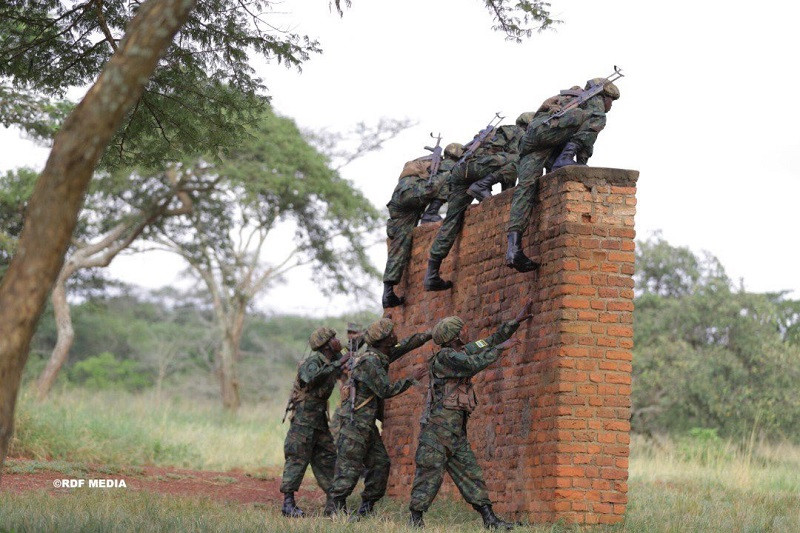
RDF during a training mission
The internet has been abuzz since Monday evening following the United States government’s announcement of sanctions targeting senior Rwanda Defence Force (RDF) officers, a move that has triggered strong reactions among Rwandans.
There is as renewed fierce debate over how the international community is addressing the long-running conflict in eastern Democratic Republic of Congo (DRC).
Across social media platform X, Rwandans have accused Washington of overlooking what they describe as the real and persistent threat to peace in the Great Lakes region: the continued presence and activities of the Democratic Forces for the Liberation of Rwanda (FDLR), a militia operating in eastern Congo and designated by the United States as a terrorist organisation. Many commentators argue that sanctioning Rwandan officials while failing to confront armed groups operating on Congolese territory risks reinforcing a distorted narrative and undermining regional efforts to stabilise eastern Congo.
Selective Sanctions Spark Criticism
Rwanda’s Government Spokesperson, Yolande Makolo, criticised the US decision, saying it diverts attention from what Kigali views as the Congolese government’s support for the FDLR.
“No matter how many lies and resources are invested into propaganda to distract from DRC state sponsorship of the FDLR, this problem is not going away,” Makolo said in a post on X.
The Government of Rwanda has since officially described the sanctions as “one-sided”, warning that selective punitive measures do not address the root causes of insecurity and may instead complicate ongoing diplomatic initiatives.
The sanctions were announced against the backdrop of renewed international mediation efforts between Kigali and Kinshasa. Last year, Rwanda and the DRC signed a peace agreement brokered by United States President Donald Trump, commonly referred to as the Washington Accord. The agreement committed both sides to de-escalation, dialogue and cooperation on security issues in the Great Lakes region.
Rwandan officials argue that the new sanctions undermine the spirit of that accord by placing responsibility for the crisis on one party while overlooking the wider network of armed groups and state actors operating in eastern Congo. Makolo further stated that sanctioning only Rwandan officials risks reinforcing a propaganda narrative promoted by the Congolese authorities without offering a credible solution to the conflict.
The FDLR Threat: Violence, Displacement, and Atrocities
At the centre of Rwanda’s security concerns is the Democratic Forces for the Liberation of Rwanda (FDLR), a militia created in the aftermath of the 1994 Genocide against the Tutsi in Rwanda. The group is largely composed of former members of the Interahamwe militia and elements of the former Rwandan army responsible for carrying out the genocide. The FDLR is designated by the United States as a terrorist organisation.
For more than two decades, the FDLR has been linked by the United Nations and regional security bodies to some of the gravest atrocities in eastern Democratic Republic of Congo. These include large-scale attacks on civilians, mass displacement, systematic extortion, sexual violence, and repeated assaults on villages in North and South Kivu.
The group has also been implicated in the killing of foreign nationals, including American citizens, during attacks carried out by the FDLR and its affiliated elements. In addition, the militia has obstructed humanitarian operations and contributed to chronic instability along the borders of Rwanda, Uganda, and Burundi, making it one of the most destabilising armed groups in the Great Lakes region.
Rwanda maintains that the continued presence of the FDLR in eastern Congo constitutes a direct threat to its national security and remains one of the principal drivers of instability in the region. Kigali has also repeatedly accused the Congolese government of backing and cooperating with the FDLR during military operations in eastern DRC—claims that Kinshasa has consistently denied.
Beyond the security dimension, Rwandan officials and regional analysts point to the long-standing marginalisation of Kinyarwanda-speaking Congolese communities, particularly the Banyamulenge, as a major and unresolved source of conflict. According to Kigali, successive Congolese governments have failed to adequately protect these communities or address persistent grievances related to citizenship recognition, political representation, and physical security. Rwandan authorities argue that this exclusion has fuelled cycles of violence, community self-defence, and armed mobilisation for generations.
Calls for Regional Accountability and Comprehensive Solutions
Public reactions in Rwanda have echoed these concerns. Writing on X, Rwandan commentator Yves Ishimwe said that resolving the conflict in eastern Congo would benefit the entire Great Lakes region but cautioned that lasting peace cannot be achieved without confronting the role of armed groups and their backers.
“For lasting peace in the Great Lakes region, all state support—direct or indirect—to armed groups such as the FDLR must be transparently addressed. Ignoring these concerns only prolongs insecurity and undermines genuine peace efforts,” Ishimwe wrote.
The sanctions have also reignited debate over the political dynamics inside the DRC. President Félix Tshisekedi continues to face growing domestic pressure over the failure to restore security in the eastern provinces, where dozens of armed groups operate and where humanitarian needs remain among the most severe in the world. Some regional commentators argue that Kinshasa is increasingly seeking stronger international backing to offset internal criticism and military setbacks.
Online debates have framed the DRC’s outreach to Washington as part of a broader diplomatic strategy tied to access to the country’s vast reserves of strategic minerals, including cobalt and copper—resources critical to global energy transition and advanced manufacturing.
Although Congolese authorities have not publicly characterised their diplomacy in such terms, the DRC has in recent years intensified engagement with Western governments and companies around critical mineral supply chains.
Rwandan commentators, however, say international pressure on Kigali will not resolve the underlying governance and security challenges within Congo.
“External pressure on Rwanda will not substitute for internal reform in Congo,” wrote Tristan Ngamije on X. “Celebrating sanctions may feel satisfying, but it will not bring peace.” He added that the conflict in eastern Congo has persisted for decades and requires comprehensive political and security reforms rather than selective diplomatic measures. “The instability in eastern Congo did not begin in Washington, and it will not end through Washington,” he said.
In Kinshasa, the Congolese government welcomed the US sanctions, which targeted four senior Rwanda Defence Force commanders, describing the move as a “clear signal” in defence of the country’s sovereignty and territorial integrity. Rwandans online, however, emphasised national resilience and unity.
“Rwanda’s journey has never been easy, but it has always been defined by determination,” wrote social media user Uwimbabazi. “We move forward with confidence, guided by our values, protecting our sovereignty and standing together as one people.”
For many Rwandans engaging in the online debate, the sanctions are viewed not as a pathway to peace but as a distraction from what they see as the real and unresolved drivers of violence in eastern Congo.
Despite the diplomatic tensions, the Government of Rwanda says it remains committed to the Washington Accord and to continued regional and international engagement aimed at stabilising the Great Lakes region. Kigali insists that a durable solution must focus on dismantling armed groups operating in eastern DRC, ensuring accountability for those responsible for atrocities, and guaranteeing protection and political inclusion for vulnerable communities, including the Banyamulenge and other Kinyarwanda-speaking populations.
Rwanda further maintains that peace in the Great Lakes region cannot be secured through sanctions alone, but through sustained dialogue, regional cooperation, and a comprehensive approach to the security, political, and humanitarian challenges that have fuelled conflict in eastern Congo for decades.