



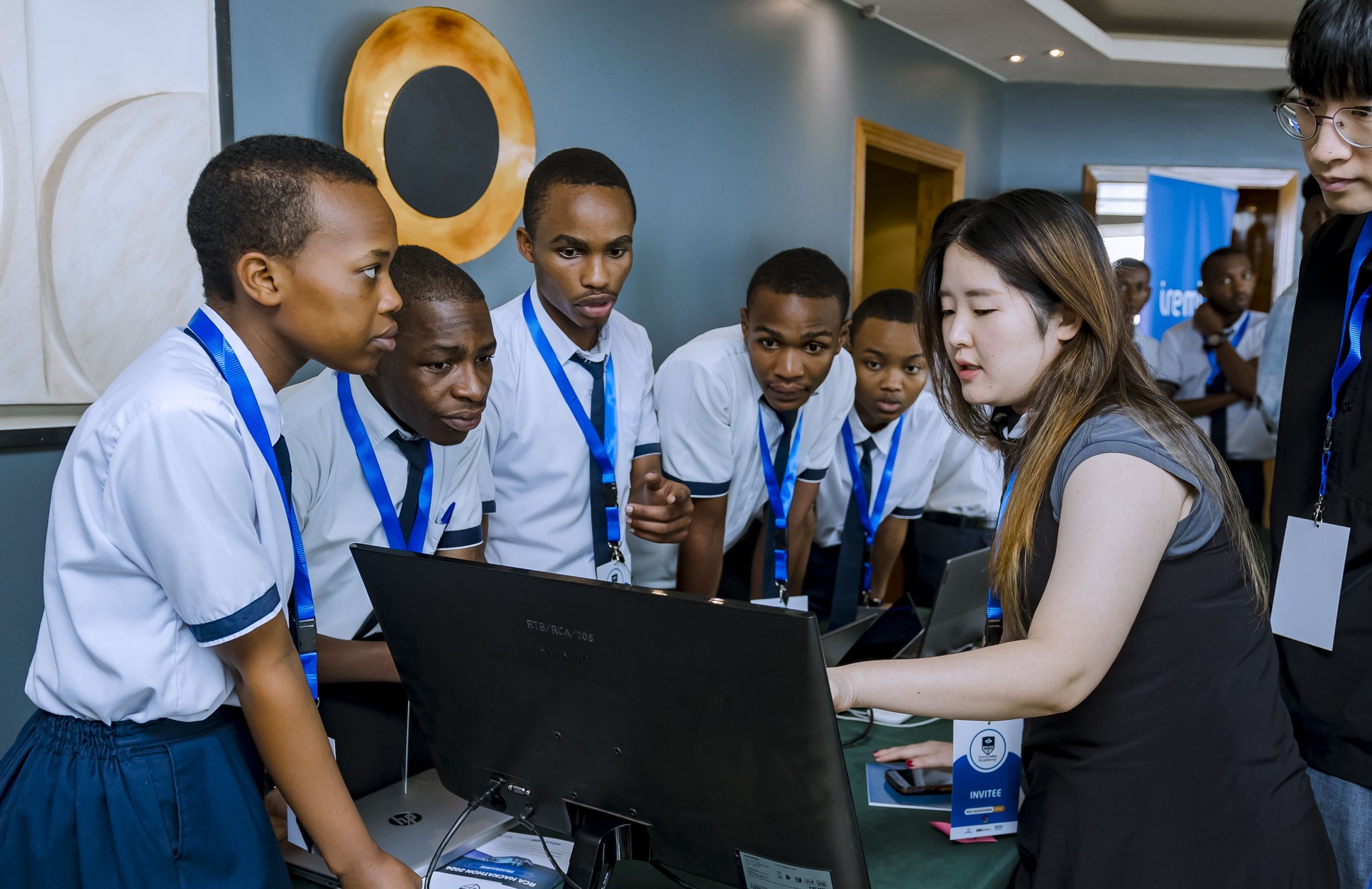
Students at Rwanda Coding Academy showcase some of their talents at an open event held in 2024
KIGALI, Rwanda — As global finance leaders gather in Washington for the World Bank and IMF Spring Meetings, a new World Bank report is drawing attention to an unlikely example of Africa’s digital future: a secondary school in Rwanda.
The report, released to coincide with the meetings, examines Africa’s economic outlook and warns that while many countries continue to grow, that growth is slowing and remains too weak to generate enough jobs.
It argues that the continent’s long-term progress will depend on improving productivity, particularly through stronger skills development.
Among the examples cited is the Rwanda Coding Academy, a specialized public school that trains top-performing students in software engineering and advanced computing while they are still in secondary education.
Located in Nyabihu District in Rwanda’s Western Province, the academy is a government-run, residential institution that admits a small, highly selected group of students each year through a competitive national process.
Typically enrolling between 60 and 100 students per intake, it combines the national curriculum with intensive training in coding, cybersecurity and embedded systems. Since its establishment in 2019, it has produced several cohorts of graduates, many of whom have gone on to pursue advanced studies or enter the technology sector.
The inclusion of the academy signals recognition of Rwanda’s efforts to prepare a new generation for the digital economy.
The report places the country among East Africa’s stronger performers, alongside neighbors like Tanzania and Uganda, with relatively solid growth expected in the near term.
But it also notes that Rwanda’s growth is projected to slow, reflecting broader regional trends. Like many African economies, Rwanda is navigating rising public debt, largely linked to investments in infrastructure and recovery efforts.
At the Spring Meetings in Washington, Rwanda’s delegation is led by Yusuf Murangwa, the Minister of Finance and Economic Planning, alongside Soraya Hakuziyaremye, Governor of the National Bank of Rwanda, as the country engages in high-level discussions on global economic trends, debt pressures and growth prospects across emerging markets.
The report groups Rwanda among countries that are not rich in natural resources, meaning its growth depends heavily on policy choices, human capital and services rather than commodity exports. That makes investments in skills—such as those represented by Rwanda Coding Academy—more critical.
Still, the World Bank cautions that isolated initiatives are not enough. Across Africa, the challenge remains scaling up skills development and aligning education systems with labor market needs, while creating enough jobs to absorb a rapidly growing workforce.
For Rwanda, the message is both an endorsement and a warning: the country is moving in the right direction, but the transition to a broad-based, high-productivity economy is far from complete.

1 comment
We are moving towards their steps
Comments are closed.