



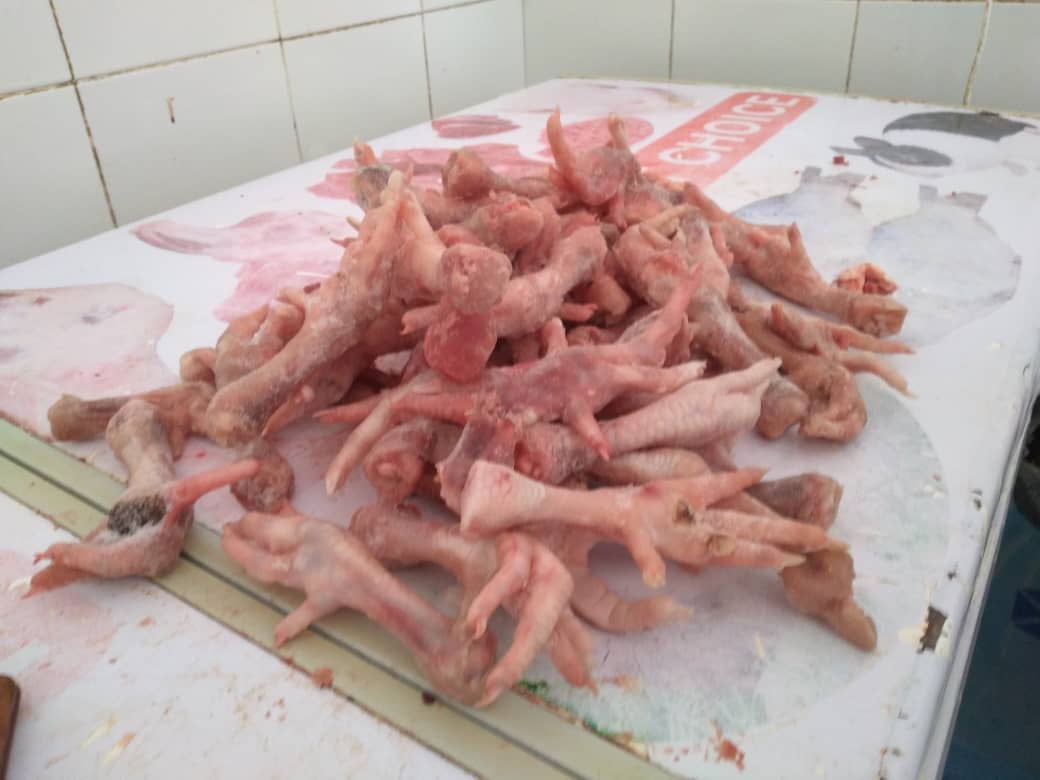
Each kilogram of chicken feet goes for Rwf2,000 at Kimironko market.
KIGALI – A few years ago, chicken feet and heads held almost no commercial value in Rwandan households. Typically the first parts discarded after slaughter, they were either thrown away or left for household pets.
Today, however, these former leftovers follow a completely different trajectory. At Kigali’s bustling Kimironko market, they are meticulously weighed, priced, cleaned, and sold alongside standard cuts of meat.
On any given morning, poultry vendor Emmanuel Ntigurirwa can be found attending to early customers eagerly negotiating over parts of the bird most locals used to overlook.
“Do you still have the feet?” one buyer asks, leaning over a stall filled with neatly arranged poultry cuts.
For Ntigurirwa, this is no longer an unusual request. It is a staple of his daily trade—one that has quietly turned forgotten scraps into a steady stream of income. He didn’t set out to build a niche business; rather, the market found him.
“I started simply because people kept asking for them,” Ntigurirwa recalls while preparing fresh stock behind his stall. “At first, I sold about five kilograms a day. But demand kept climbing. Now, I move around 30 kilograms every single day.”
At his stall, a kilogram of chicken feet sells for Rwf2,000, while chicken heads go for Rwf1,500. In the landscape of the informal market, it is a modest commodity that yields an unexpectedly reliable cash flow.
Interestingly, Ntigurirwa notes that his primary clientele isn’t local. “Very few Rwandans buy them directly,” he explains. “Most of the buyers are expatriates. Even the Rwandans who do buy them are usually sent by their foreign employers.”
A Market Where Nothing Goes to Waste
In the traditional local food economy, parts like the feet and heads were rarely seen as food. But at Ntigurirwa’s stall, they undergo careful processing to prepare them for the pot. The claws are clipped, and the tough, scaly outer skin is scalded and peeled away to reveal the tender tissue beneath.
“Many people don’t realize that chicken feet have a very tough outer layer,” he says. “We clean them thoroughly so they are completely ready for cooking.” While some buyers prefer to take them home as-is, others request them fully prepped depending on their culinary plans.
What is happening at Kimironko market reflects more than just a change in diet; it highlights how value is being redefined within Kigali’s rapidly diversifying urban economy.
Nutritional Benefits of Chicken Feet
Behind the growing demand is an increasing appreciation for the unique health profile of these cuts. According to Innocent Ndikubwayo, a nutritionist at Burehe Health Center in Rulindo district, chicken feet are an excellent source of structural proteins and essential minerals.
Chicken feet are predominantly made up of collagen, a structural protein that helps maintain skin elasticity and firmness while actively supporting joint lubrication and bone density. This makes them particularly beneficial for older adults managing joint pain or arthritis. They also provide a dense supply of calcium and phosphorus, two vital elements required for skeletal strength and cellular tissue repair. In an economic climate where traditional meat prices continue to climb, these cuts offer a highly nutritious, budget-friendly protein alternative.
However, Ndikubwayo stresses that proper preparation is vital. They must be cleaned meticulously and cooked thoroughly to avoid foodborne illness. Furthermore, over-activating their natural fats with too much added oil or salt can negate their health benefits. Cooking times typically range from 45 minutes to over an hour in a standard pot, though a pressure cooker can cut that time significantly.
A Global Delicacy: Chicken Feet Across Cultures
While the trade might seem new to Kigali, chicken feet are celebrated as a culinary staple across many continents. The expatriates frequenting Kimironko market are likely tapping into deeply rooted culinary traditions from their home countries.
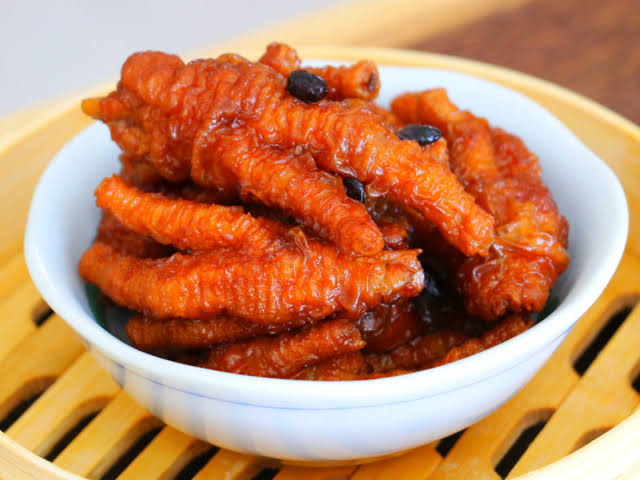
In East and Southeast Asia, specifically China, chicken feet are known as “Phoenix Claws” (Fung Zau) and are a legendary staple of Dim Sum culture. They are deep-fried, simmered, and braised in a savory black bean sauce until puffing up and becoming melt-in-your-mouth tender. They are equally popular as street food and bar snacks across Vietnam, Thailand, and the Philippines, where they are colloquially dubbed “Adidas.”
Across Sub-Saharan Africa, particularly in South Africa, chicken feet are wildly popular and affectionately called “Walkie Talkies”—the feet being the walkies, and the heads being the talkies. There, they are boiled, seasoned, and grilled over open coals as a beloved township street food.
Meanwhile, in the Caribbean and Latin America, including Jamaica, Trinidad, and parts of Central America, chicken feet are heavily utilized to flavor rich, gelatinous vegetable soups or are slow-simmered in seasoned stews with tomatoes and hot peppers.
Value Hidden in Plain Sight
Back at Kimironko Market, the morning rush shows no signs of slowing down. Requests for feet and heads keep coming in casually, as if they had always belonged on the shopping list.
For Ntigurirwa, the shift is entirely practical. What matters most is that an item once thrown into the scrap heap now pays his rent, feeds his family, and sustains a viable commercial trade.
In Kigali’s evolving food scene, value is no longer dictated solely by what is familiar. Sometimes, economic success is found in exactly what someone else chose to throw away.
