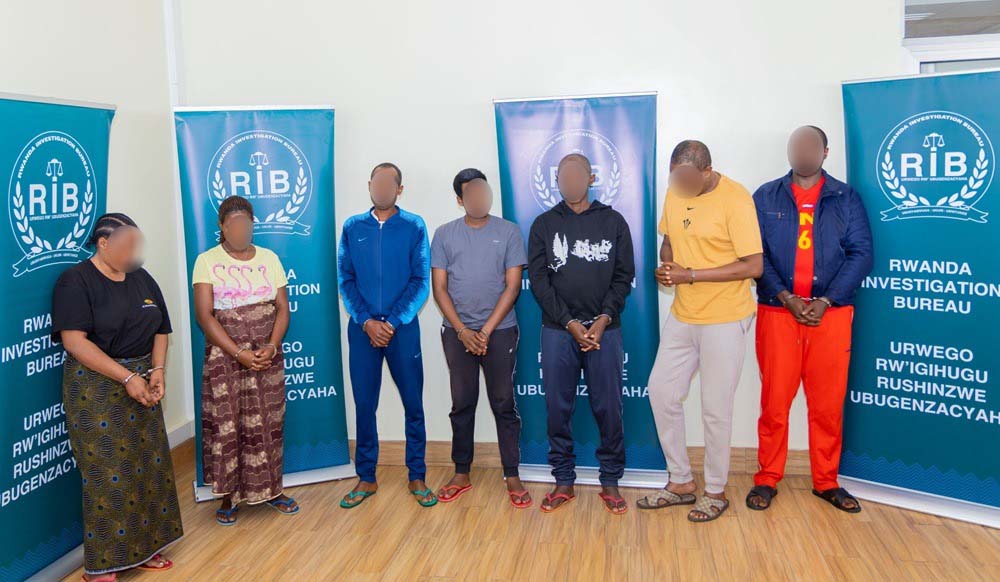
RIB has been working around the clock to deal with digital criminality. These lot was paraded in March last year, as part of an alleged digital criminal network
KIGALI – Rwanda recorded one of Africa’s lowest suspected digital fraud rates in 2025, with fraudulent transaction attempts dropping from 2.7 percent in 2024 to 1.6 percent last year, well below the global average of 3.8 percent.
At first glance, the figures suggest the country is winning the fight against online crime. But a new TransUnion report warns that fraudsters are evolving, shifting away from traditional transaction fraud and targeting individual identity.
The report found that the highest fraud risk in Rwanda now occurs during account creation rather than financial transactions.
In 2025, suspected digital fraud reached 7.7 percent during account creation, compared to 1.6 percent during account login and just 0.5 percent during financial transactions.
“Despite recording lower digital fraud rates than global and regional averages, Rwanda is experiencing a structural change in fraud risk,” said Amritha Reddy, Senior Director of Fraud Product Management at TransUnion Africa.
“Criminals are moving upstream, targeting identity and trust at the point of access rather than transactions, and exploiting early moments where verification is still forming,” she added.
The findings come as Rwanda continues expanding digital services across the economy, increasing the importance of secure online identities and trusted onboarding systems.
Fraud is Falling, But Losses Remain Significant
Despite the decline in overall fraud rates, the financial impact on victims remains substantial.
Among Rwandans who reported losing money to digital fraud over the past year, the median loss stood at Rwf869,249. This is lower than the figures reported in Kenya and South Africa among the countries studied.
The report shows that fraud is also becoming more structurally complex. Money mule scams emerged as the leading cause of losses, accounting for 29 percent of victims.
Account takeover attacks followed at 24 percent, while social engineering, stolen credit card fraud, and unemployment benefits-related fraud each accounted for 22 percent.
Money mule schemes are becoming increasingly attractive to criminal networks because they help move stolen funds while reducing the risk of detection. And as these activities scale, isolated scams evolve into wider systemic risks.
For an ordinary person opening a digital account, it means that fraudsters are increasingly relying on trust and human error rather than technical attacks, which means anyone opening an account must treat their personal information, passwords, and transaction approvals as strictly private.
“Money mules often are the bridge between consumer fraud and broader financial crime. Many are unknowingly recruited through social engineering, enabling criminals to move stolen funds while avoiding detection,” said Reddy.
A Population Under Constant Targeting
The report also found that 60 percent of Rwandans surveyed said they had been targeted by digital fraud attempts between August and December 2025, although only 12 percent reported falling victim.
Phishing remains the most common attack method, showing how social engineering continues to dominate over technical hacking as the preferred entry point for fraudsters.
Retail was identified as the sector facing the highest suspected digital fraud risk involving Rwandan consumers, recording a rate of 7.1 percent in 2025.
At the same time, consumer expectations around digital trust are shifting.
While 73 percent of respondents said easy payment processes were important, 70 percent emphasized confidence that their personal data is secure, and 64 percent highlighted the ease of completing forms and applications.
The findings suggest consumers are increasingly willing to accept additional verification steps if they clearly improve protection.
“Consumers are willing to accept friction when it clearly enhances protection. Security in Rwanda is evolving beyond compliance and emerging as a key driver of brand trust and differentiation,” said Reddy
The New Battle Is Trust
While Rwanda’s fraud rate remains relatively low compared to global and regional benchmarks, TransUnion cautions that falling numbers do not necessarily indicate a shrinking threat.
Instead, the nature of fraud is changing, becoming more automated, more targeted, and more psychologically driven.
Fraudsters are no longer relying solely on breaking systems. They are increasingly building access through manipulated identities and social engineering.
“The central challenge ahead is no longer simply preventing fraud but preserving trust in the digital economy,” said Reddy.
As Rwanda accelerates its digital transformation, the report suggests the country’s next frontier will not just be stopping fraudulent transactions, but securing the identities and trust systems that underpin the entire digital economy.
These insights are based on a global survey of 12,730 consumers in 18 countries and regions, conducted between Nov. 20–Dec. 9, 2025, alongside intelligence from its suite of TransUnion fraud prevention solutions.
TransUnion is a global information and insights company with over 13,000 associates operating in more than 30 countries and territories, including Botswana, Kenya, Malawi, Namibia, Rwanda, South Africa, eSwatini, and Zambia.