


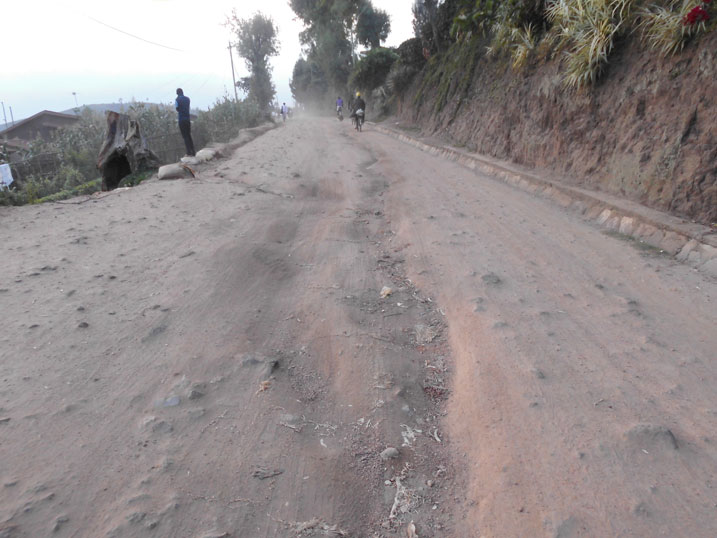
This how the road looks like today. RTDA has to keep maintaining it with laterite until financing is available through regionsl mechanisms
KIGALI — Members of Parliament on Wednesday questioned the Rwanda Transport Development Agency (RTDA) over its decision to spend Rwf392 million on laterite repairs to the Rusizi-Bugarama road, a strategic regional transport corridor that lawmakers say continues to deteriorate despite repeated maintenance works.
The issue emerged during hearings of Parliament’s Public Accounts Committee (PAC), which is examining findings from the Auditor General’s report on the management of public funds during the 2024/25 financial year.
At the center of the debate is an approximately 42-kilometer stretch of road linking Kamembe to Bugarama, one of the most important transport arteries in Rwanda’s southwest.
The road serves as a gateway to both northwestern Burundi and the border crossing into Kamanyola, eastern Democratic Republic of Congo, providing access onward to the city of Uvira. For travelers arriving in Rusizi District from Kigali, the road is the final link connecting Kamembe to two important regional markets.
Its economic significance extends beyond cross-border trade.
Bugarama is one of Rwanda’s major rice-growing regions, producing a significant share of the rice consumed domestically. Large quantities are also exported to neighboring Burundi and eastern DRC, making the road critical for farmers, traders, transporters and regional commerce.
The route is also strategically important because it forms part of the wider transport network connecting Rusizi District to the rest of the country. Rwanda’s southwest is primarily accessed through two major road corridors from Kigali — one passing through Nyungwe National Park, home to some of the country’s leading tourism investments and international hotels, and another through Karongi District along the shores of Lake Kivu.
Once travelers reach Kamembe, the Rusizi-Bugarama road becomes the principal route toward Burundi and eastern DRC.
Yet despite its importance, the road has fallen into severe disrepair and has for years awaited a comprehensive upgrade. Government officials say a long-term rehabilitation project is expected to be financed through a regional infrastructure financing mechanism because the road is considered an important regional access corridor serving multiple countries.
While awaiting that larger investment, RTDA has relied on periodic maintenance using laterite, a reddish soil-rich material that is abundant in the region and relatively inexpensive to obtain.
PAC Chairperson Valens Muhakwa questioned whether the agency’s repeated use of laterite represented value for taxpayers’ money, given the road’s continuing deterioration.
RTDA Acting Director General Imena Munyampenda defended the expenditure, arguing that the agency had been forced to work within severe budget constraints while waiting for a permanent solution.
“We repaired the most damaged sections by adding laterite and filling potholes where necessary,” he told lawmakers.
However, the explanation appeared to reinforce lawmakers’ concerns.
Laterite is commonly used across tropical countries for road maintenance because it is readily available and comparatively cheap.
However, engineers generally regard it as a temporary measure rather than a long-term road surface. Under heavy traffic, laterite quickly erodes, develops potholes and requires frequent replacement.
Munyampenda acknowledged that the material performs poorly on a heavily trafficked route such as Rusizi-Bugarama.
“The road carries a large volume of traffic. Laterite does not remain in place for long under those conditions. Once it is applied, repairs may be required again after about two months,” he said.
That admission prompted lawmakers to question why RTDA continued spending large sums on a solution it knew would not last.
MP Berthelemy Karinijabo argued that repeatedly applying laterite amounted to spending public money on repairs that quickly disappear.
“If you already knew this, more effort should have been made to find a solution that lasts longer. Why spend money on a repair that lasts one or two months when there are alternatives that can remain effective for six months or even a year?” he asked.
The exchange highlighted a dilemma that has increasingly drawn criticism from lawmakers: whether repeated maintenance of a failing road using temporary materials has become more expensive over time than pursuing more durable interventions.
RTDA maintains that its options are limited by funding constraints.
According to Munyampenda, more durable repairs would require crushed stone, specialized road-building equipment and significantly larger budgets than the agency currently receives for maintenance works.
He also noted that road maintenance costs rise sharply when roads have already exceeded their intended lifespan.
“When deterioration reaches a certain stage, repairing one section often causes adjacent sections to fail as well,” he explained.
RTDA further revealed that a full rehabilitation of the road is expected to begin in March 2027, when the corridor is scheduled to be upgraded to an asphalt standard.
Beyond the Rusizi-Bugarama road, the agency is also facing questions over expenditures on 17 other roads highlighted in the Auditor General’s report.
For lawmakers, however, the Rusizi-Bugarama case has become emblematic of a broader challenge facing Rwanda’s infrastructure sector: how to preserve strategically important roads with limited resources while avoiding a cycle of costly temporary fixes that must be repeated again and again.
For the thousands of traders, transporters and farmers who depend on the corridor every day, the debate is about more than road maintenance. It is about the reliability of one of the country’s most important gateways to regional trade.
