


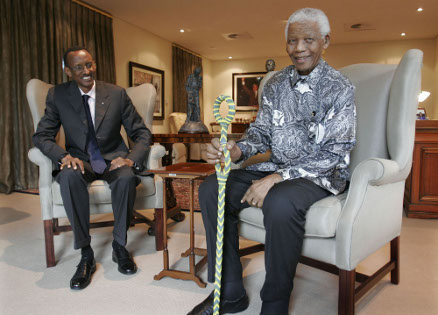
President Paul Kagame meets with former South African President Nelson Mandela at the Nelson Mandela Foundation in Johannesburg, Friday, March 20, 2009. Kagame presented Mandela with walking stick decorated in the colours of the Rwandan flag. (AP Photo/Denis Farrell-POOL)
Recently, South Africa and Rwanda set out to normalize their relations following years of tensions. While most commentary focused on what has caused frictions to begin with, Pretoria and Kigali’s joint declaration was extensive enough to offer cues on what normalized relations would look like.
If agreed-upon measures are implemented, we could see a return to what was a deep friendship post-1994 between the two countries.
Indeed, 1994 was a defining moment for both countries: the fall of the apartheid regime in South Africa and the defeat of the genocidal regime in Rwanda.
At the time, these parallel historical milestones generated deep institutional empathy.
South Africa provided crucial post-genocide support to Rwanda, aiding in civil service training, institutional reconstruction, and offering a model for transitional justice.
Under Mandela’s leadership, South Africa also lent crucial material and moral support for Rwanda’s 1996 intervention in then-Zaire.
However, relations deteriorated sharply under Jacob Zuma’s tenure as South Africa gradually became a safe haven for individuals wanted by Rwanda’s justice system and international justice, including perpetrators of the 1994 Genocide against the Tutsi.
Diplomatic tensions escalated, resulting in reciprocal expulsions of diplomats and a significant breakdown in bilateral engagement. Political dialogue slowed, cooperation mechanisms became inactive, and trust between the two governments weakened considerably.
The lowest point of this relationship came during the conflict in the eastern Democratic Republic of the Congo (DRC). South Africa deployed troops under the Southern African Development Community (SADC) Mission in the DRC (SAMIDRC) and joined Kinshasa’s coalition against the M23 rebel movement.
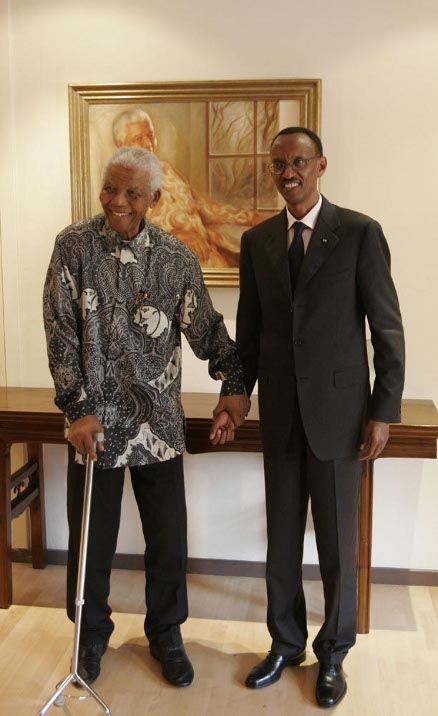
President Paul Kagame meets with former South African President Nelson Mandela at the Nelson Mandela Foundation in Johannesburg, Friday, March 20, 2009. (AP Photo/Denis Farrell-POOL)
From Rwanda’s perspective, South Africa was de facto fighting alongside the genocidal group FDLR, which was, and remains, one of the most effective forces in the coalition and an existential threat to the country.
Today, Kigali and Pretoria seem intent on restoring trust. But what would that look like?
South African Minister of International Relations and Cooperation Ronald Lamola has indicated that South Africa is refining its immigration framework and studying Rwanda’s highly successful digital visa system, suggesting opportunities for policy learning and cooperation.
In the same vein, as indicated by Rwanda’s Foreign Affairs Minister Olivier Nduhungirehe, the resumption of visa issuance for ordinary Rwandan passports would facilitate business travel, tourism, education exchanges, and people-to-people connections.
Another key step would be the revival of the Joint Commission of Cooperation (JCC), a bilateral mechanism that has remained dormant for years. The JCC provides an institutional platform for advancing collaboration across trade, investment, tourism, education, technology, and governance.
Regional peace and security also remain central to the future of relations. Rather than allowing tensions over eastern DRC to dominate the bilateral agenda, both countries are increasingly relying on broader African Union-led initiatives, particularly the Luanda and Nairobi peace processes.
By treating the DRC conflict as a continental challenge requiring political dialogue and regional consensus, Kigali and Pretoria can reduce bilateral friction and focus on constructive engagement. This approach would reflect something former President Mbeki has been repeating all along: that the FDLR must be neutralized and that the rights of Congolese Tutsi must be guaranteed, both of which are the responsibility of the DRC government.
Security cooperation is another area where a normalized relationship would deliver tangible benefits. Both Rwanda and South Africa have deployed forces to combat violent extremism in Mozambique’s Cabo Delgado province.
And although South Africa has pulled out since, a healthy bilateral relationship could still encourage real-time intelligence sharing and stronger collaboration against terrorist threats. Working together rather than in parallel would improve the effectiveness of regional security efforts.
On the global stage, closer cooperation would strengthen Africa’s voice within international institutions. Rwanda and South Africa share interests in advocating for reforms of global governance structures, including the United Nations, and promoting equitable climate financing for developing countries.
Economic cooperation remains perhaps one of the most important dividends of normalization. By normalizing trade and visa channels while managing security differences through continental peace frameworks, both countries can build a stable working relationship. Such an outcome would demonstrate that regional integration, economic cooperation, and diplomatic engagement can coexist alongside complex security considerations, serving the interests of both nations and the African continent as a whole.
Within the framework of the African Continental Free Trade Area (AfCFTA), easier mobility will allow South African corporations to seamlessly utilize Kigali as a strategic regional hub for East Africa. Concurrently, Rwandan entrepreneurs, students, and tourists will regain seamless access to Africa’s most industrialized marketplace.
Ultimately, this reset in diplomatic relations proves that pragmatic diplomacy can successfully dismantle political barriers. Whether the two countries will return to the deep friendship that marked their relations in the immediate aftermath of 1994 remains to be seen. But once again, hopes are high.
