


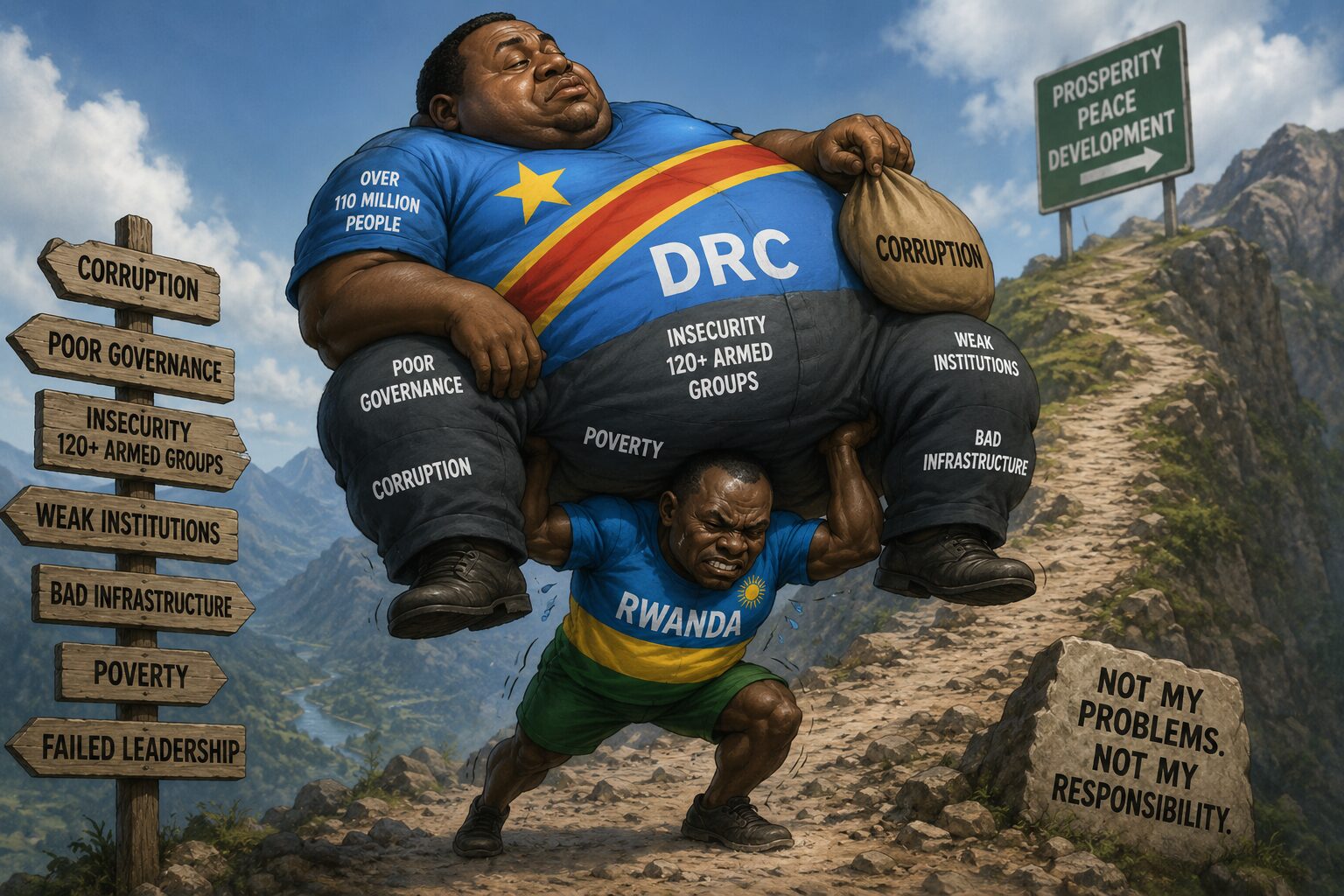
A small country? No! Carrying a burden created elsewhere? Yes!
For decades, the Democratic Republic of Congo (DRC) has held a unique place in Africa’s political and security landscape. The country possesses extraordinary natural wealth and enormous human potential.
By most measures, it should rank among Africa’s leading economic powers. Instead, leaders have struggled to overcome insecurity, poverty, weak infrastructure, and recurring political crises. Few indicators suggest that the country will escape this cycle anytime soon.
In recent years, political leaders and commentators have increasingly focused on Rwanda when discussing the DRC’s challenges, particularly the insecurity that affects the eastern provinces.
While regional tensions and cross-border security concerns remain real, observers should ask an important question: Have Congolese leaders turned Rwanda into a convenient scapegoat for problems that primarily originate within the DRC itself?
The contrast between the two countries stands out immediately.
Rwanda covers just over 26,000 square kilometers and has a population of about 14 million people. The DRC spans more than 2.3 million square kilometers—nearly 90 times larger—and contains more than 110 million people.
The country possesses some of the world’s largest reserves of cobalt, copper, coltan, gold, diamonds, and other strategic minerals. It also enjoys vast agricultural land, extensive forests, and enormous hydroelectric potential.
Despite these advantages, millions of Congolese citizens continue to live in poverty and lack access to basic services. External interference alone cannot explain this reality.
For decades, Congolese governments have weakened the country’s development through corruption, poor governance, weak institutions, inadequate infrastructure, and ineffective management of public resources. State authorities have also failed to establish a strong presence across large parts of the country. International organizations and successive administrations have repeatedly identified these factors as major obstacles to development.
The security crisis in eastern DRC further demonstrates the complexity of the problem. Armed groups thrive where the state fails to provide security and governance.
More than 120 armed groups operate in eastern Congo, pursuing political, ethnic, economic, and criminal objectives. Decades of conflict, ethnic tensions, and competition for natural resources have fuelled their growth.
Some groups emerged from local grievances, while others developed regional or ideological agendas. Their continued presence reflects not only regional tensions but also the state’s inability to establish effective authority across the eastern provinces.
Rwanda frequently appears in official narratives that seek to explain the DRC’s insecurity. Congolese leaders have accused Kigali of supporting various armed movements, particularly M23.
Rwanda has consistently rejected these accusations as unfounded and only framed as a diversion from actual issues affecting the conflict-torn nation including the issues of bad governance.
On the other hand, Rwanda has raised concerns over continued presence of the FDLR in eastern Congo poses a legitimate security threat to Rwanda.
Regardless of where one stands on these disputes, focusing exclusively on Rwanda obscures the DRC’s deeper structural challenges.
No neighboring country caused decades of corruption inside the DRC. No neighboring country forced Congolese institutions to remain weak. No neighboring country prevented authorities from building infrastructure, improving public services, strengthening governance, or extending state authority throughout the national territory.
The DRC can achieve peace and prosperity only if it confronts these internal weaknesses directly. The country needs stronger institutions, greater accountability, professional security forces, transparent resource management, and effective public administration.
The DRC’s potential remains immense. Its young population, strategic location, and abundant mineral resources offer opportunities that many nations can only envy.
However, the country will only realize that potential when its leaders and institutions address the governance and security failures that have hindered progress for generations.
Rwanda may be scapegoated for political expediency, but shifting blame will not resolve the DRC’s deep-rooted governance deficits and systemic corruption.
The DRC’s future depends primarily on what Congolese leaders do within their own borders. Sustainable development begins when nations take responsibility for their challenges and commit themselves to meaningful reform.
