


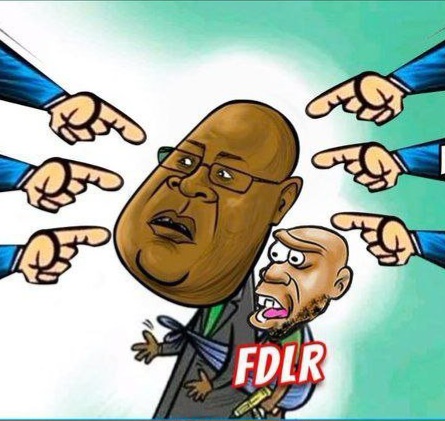
DR Congo President Félix Tshisekedi is providing international legitimacy to the FDLR, a militia that massacred in Rwanda and continued in his country
After years of refusing to neutralise the genocidal FDLR, Kinshasa is now floating a new idea: relocating some of the group’s fighters to a third African country.
The proposal came from DRC Minister of Regional Integration Anzuluni, who told RFI that a country had already been identified to receive certain FDLR members. He declined to name it, citing ongoing discussions. The move is yet another breach of the Washington Accords.
Is relocation quietly being positioned as a substitute for neutralisation. The answer is no. In all likelihood, no country would willingly associate itself with a genocidal militia. Even Kinshasa and Gitega still deny their well-documented collaboration with and support for the FDLR, for good reason.
It is shameful. That very shame makes it certain that no third country is actually in talks with Kinshasa to host members of a genocidal group. This is just another tactical manoeuvre, a convenient story to explain away delays in fulfilling commitments that Kinshasa has no real intention of honouring.
The minister’s announcement follows sharp backlash from Kigali over reports that the FDLR had signed a protocol with Kinshasa to surrender, on the condition that some form of political dialogue would take place between Kigali and the group. Rwanda dismissed the idea as nonsensical, and for obvious reasons.
The FDLR is not a legitimate political party, nor is it a recognised negotiating partner under the Washington framework. Its neutralisation is a clear security commitment agreed between Rwanda and the DRC, and the Concept of Operations, CONOPS explicitly provides for targeted military action against it.
The group has no place at the table in discussions about Rwanda’s political future. In fact, it is fair to assume that Kigali will not accept any arrangement that allows the FDLR to reinvent itself.
Moreover, an attempt to recast the FDLR as a political actor undermines the very peace process meant to eradicate the threat it poses.
The recent protocol signed between the DRC regime and the FDLR is nothing more than a political ploy, a stalling tactic by President Tshisekedi to evade his responsibility to disarm a genocidal organisation.
For years, Rwanda has presented evidence that Kinshasa supports armed groups hostile to it, including the FDLR. UN Group of Experts reports now confirm that FDLR elements are embedded within the Congolese army, FARDC.
Kigali has repeatedly warned against efforts to whitewash a group whose origins are tied to the forces behind the 1994 Genocide against the Tutsi.
The problem goes beyond military collusion. Congolese authorities and their allied networks have increasingly tried to present FDLR-linked figures, such as Jean-Luc Habyarimana, Thomas Nahimana, Thadée Kwitonda, and Fabien Singaye, as legitimate representatives of Rwandan political opposition. This is a deliberate attempt to build a political façade for anti-Kigali networks.
Kinshasa’s shifting rhetoric tells its own story. At different times, the Congolese government has denied the FDLR’s presence, downplayed it, claimed it was confined to M23-held territory, and now acknowledges it only in the context of demobilisation. These inconsistencies reveal a deep lack of seriousness about resolving the problem.
The FDLR issue is also inseparable from the question of Rwandan refugees. Rwanda has a long history of receiving returnees from the DRC and elsewhere, with established reintegration mechanisms in place. But there is a crucial distinction between civilians seeking to return home and armed individuals potentially wanted for serious crimes. Civilians should be helped to return safely; combatants must first disarm and, where appropriate, face justice.
The Washington Accords already offer a clear framework. The problem lies in the implementation. If Washington expects Rwanda to uphold its end of the bargain, the same standard must apply to Kinshasa. No peace agreement can work if one party is repeatedly allowed to delay or reinterpret its obligations.
The Great Lakes region does not need another temporary fix. It needs implementation, verification, and accountability. On the FDLR, the time for political games is over.
