



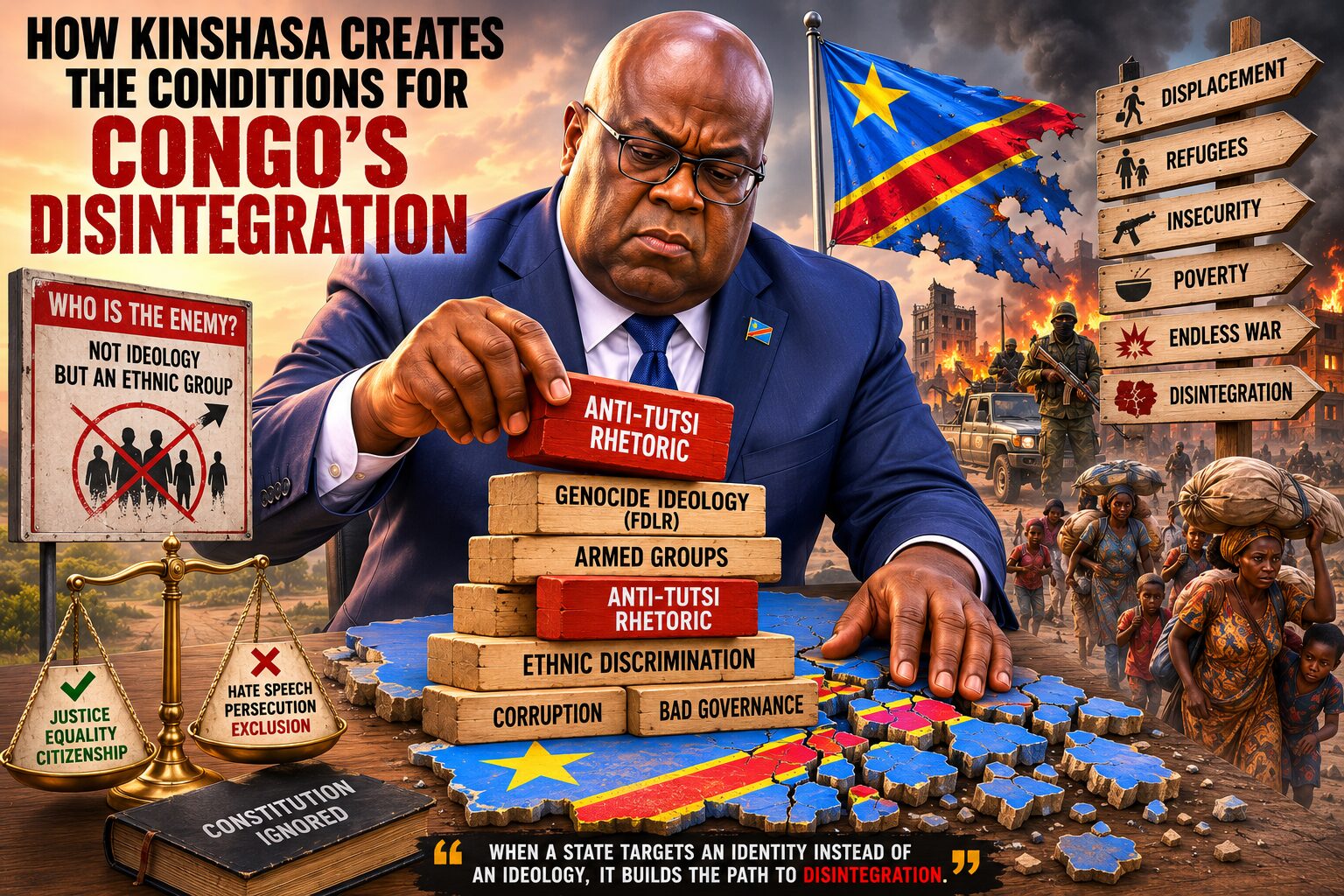
The DRC crisis has attracted considerable commentary in international and regional media, yet one critical aspect is consistently overlooked: the Tshisekedi administration, rather than drawing lessons from post-genocide Rwanda’s approach to peacebuilding, has instead chosen to mimic the very genocidal regime that drove the country to near-total destruction in 1994.
In doing so, Kinshasa has actively created the conditions for Congo’s own disintegration. Here is how.
Kinshasa’s most fundamental mistake lies in its definition of the enemy.
Kigali’s stance has always been clear: the enemy posing an existential threat to Rwandan security is genocide ideology, regardless of the armed group or political formation that carries and promotes it, be it the RDR, ALIR, FDLR, FLN, or any of their splinter factions.
Kinshasa, by contrast, defines its enemy as an ethnic community, one whose very citizenship is constantly called into question. These two definitions carry vastly different implications for peace within each country.
Rwanda’s definition leaves room for redemption: renounce genocide ideology, and you are reintegrated into the national community.
The DRC’s definition, however, offers only two alternatives to the targeted group: fight for survival or flee the country. Since ethnic identity is not something one can choose or shed at will, no path to redemption exists once the state defines your mere existence as the enemy.
The results speak for themselves. Rwanda has successfully disarmed, repatriated, and reintegrated thousands of ex-FAR soldiers, former FDLR combatants, and their dependants into its national fabric. That was possible because the objective was never the destruction of an ethnic group, but the neutralisation of the genocidal ideology that a faction of that group had embraced.
In contrast, the conflict in the DRC persists because it targets an identity, the Congolese Tutsi, thereby transforming an ethnic minority into a threat to the Congolese state.
By embracing anti-Tutsi rhetoric, Kinshasa found a convenient scapegoat for its own failures: its inability to govern, secure, or deliver basic services to its eastern territories. The resulting conflicts have created a refugee crisis that, in turn, fuels rebellions, as members of Congolese Tutsi communities, denied their rights as citizens, seek to enforce them by force of arms.
This structural hostility is not new. It dates back to the era of Mobutu Sese Seko, who exacerbated anti-Tutsi hostility within Congo by granting sanctuary to fleeing génocidaires in 1994, allowing them to establish a state-within-a-state on Congolese soil. Rather than disarming these genocidal forces, successive Congolese administrations have instrumentalised them.
This created a tragic paradox: Kinshasa arms foreigners who are Rwandans and architects of the 1994 genocide against the Tutsi, in the name of “protecting” its sovereignty, thereby institutionalising genocidal ideology within its own state structures, which invariably creates tensions with Kigali.
This fundamental asymmetry explains the three-decade impasse. When one side is fighting an existential battle against an ideology of extermination, while the other turns its guns against an entire ethnic identity, compromise becomes impossible.
Kinshasa’s refusal to isolate and eliminate genocidal ideology fuels Rwanda’s security anxieties, while the systematic persecution of Congolese Tutsis triggers recurring cycles of local armed resistance, drawing Rwanda in whenever the FDLR is involved.
Until the DRC shifts its target from an inherent human identity to the destructive ideology festering within its borders, the structural drivers of this thirty-year war will remain untouched. And they could very well lead to Congo’s disintegration.
Indeed, who would willingly call home a state that has declared their very existence a problem in need of a final solution?
