



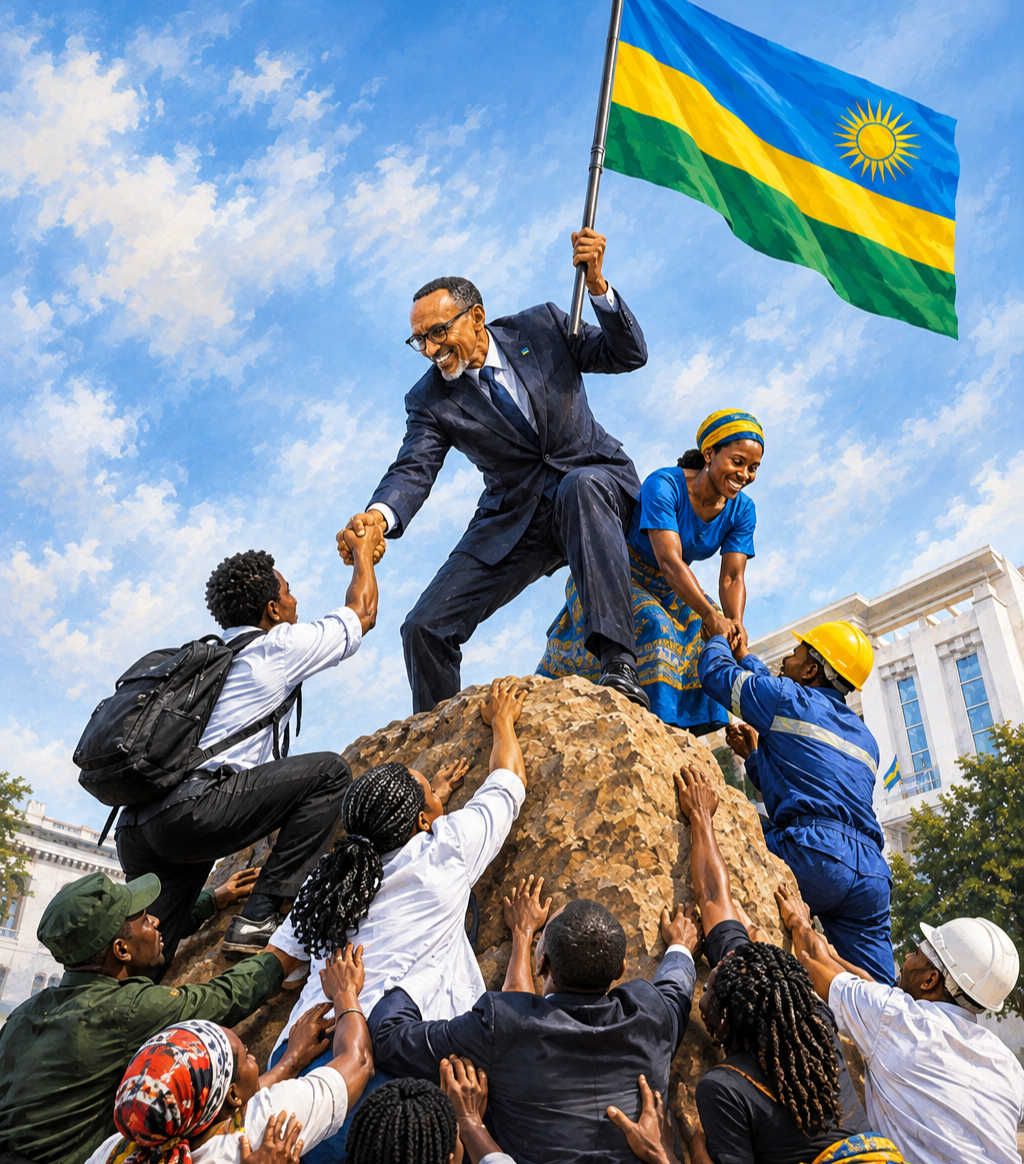
President Paul Kagame: “Aid must do those things that will see people wean off aid.”
For a country emerging from the devastation of the 1994 Genocide against the Tutsi, becoming self-reliant was always an audacious ambition.
When President Paul Kagame assumed the presidency in 2000, Rwanda was rebuilding its institutions, economy and social fabric after unimaginable destruction. International assistance was indispensable to that recovery.
But Rwanda never intended to remain permanently dependent on aid. In fact, President Kagame had already made this objective clear in a 2009 interview with CNN, when he explained what he wanted to achieve during his tenure in relation to foreign aid: “Aid must do those things that will see people wean off aid.”
More than a decade later, Rwanda’s shift from donor reliance toward greater domestic resource mobilization, trade, investment and strategic partnerships suggests that this was not simply rhetoric.
On September 18, 2026, Rwanda reached an important milestone in that journey when the Cabinet adopted the Rwanda Development Cooperation Policy (RDCP) 2026 to 2050, replacing the 2006 Aid Policy.
The shift reflects a broader transformation in the way Rwanda approaches international relations. The country increasingly wants its partnerships with the outside world to be defined not simply by aid, but by trade, investment, technology, knowledge and mutually beneficial cooperation.
This does not mean the end of international assistance. Grants remain part of Rwanda’s financing structure. But their relative importance has declined significantly.
In the 2026/27 national budget of about Rwf 7.8 trillion, domestic resources account for roughly 68 percent, while foreign grants represent about 7 percent of the total financing envelope.
That transition did not happen overnight. It is the result of a deliberate strategy built over more than two decades.
For a small, landlocked country, geography is a permanent economic constraint. Rwanda therefore invested heavily in diplomacy and international connectivity.
Diplomatic relationships have increasingly become channels for investment, tourism, trade, technology transfer and strategic cooperation.
Rwanda has sought to position itself not simply as a recipient of international support, but as a partner pursuing opportunities across Africa and around the world.
In this sense, diplomacy functions much like infrastructure. It connects Rwanda to markets, capital, institutions, expertise and ideas that might otherwise remain beyond its reach.
Development, however, requires stability. Businesses invest when they can plan ahead. People build livelihoods when they feel secure. Governments can pursue long-term programmes when institutions are functioning and society is stable.
Rwanda’s post 1994 development strategy has therefore placed security, institutional capacity and national cohesion at the centre of the country’s reconstruction. This has helped create the environment in which infrastructure, healthcare, education and private investment could expand over time.
Security is not simply treated as a political objective. It is also regarded as an economic foundation.
The strongest evidence of reduced aid dependency is ultimately the ability to generate resources through economic activity.
Rwanda’s investment and export performance illustrates this direction. The Rwanda Development Board reported US$2.62 billion in registered investment across 799 projects in 2025, while export receipts reached US$3.6 billion.
These figures represent a different kind of relationship with the international community. They reflect businesses investing, producing, exporting and creating economic value rather than simply transferring development assistance.
For a landlocked economy, expanding trade and attracting investment are essential to strengthening economic sovereignty.
Rwanda has also turned tourism into an important economic and diplomatic asset. Tourism generated approximately US$685 million in 2025, while the Meetings, Incentives, Conferences and Exhibitions sector generated nearly US$95 million.
But the importance of MICE goes far beyond conference revenues. International events bring investors, policymakers, entrepreneurs, researchers and business leaders to Kigali. They create relationships and networks that can lead to partnerships long after an event has ended.
Rwanda’s journey can therefore be understood in three broad phases.
From 1994 to 2006, the country was primarily in a humanitarian and reconstruction era, when international assistance played a critical role in helping Rwanda survive and rebuild.
From 2006 to 2026, Rwanda entered a period of recovery and transformation, using development assistance strategically while strengthening domestic institutions and expanding its economic capacity.
From 2026 onward, Rwanda is increasingly entering an era of sovereign partnerships, in which aid remains one instrument among many, but trade, investment, innovation and strategic cooperation occupy a much larger role.
The achievement is not that Rwanda has eliminated every form of external financing. Rather, it is that external assistance no longer defines the entire architecture of Rwanda’s development.
The strategic objective is increasingly clear: Rwanda does not simply want to receive from the world. It wants to exchange value with it.
