



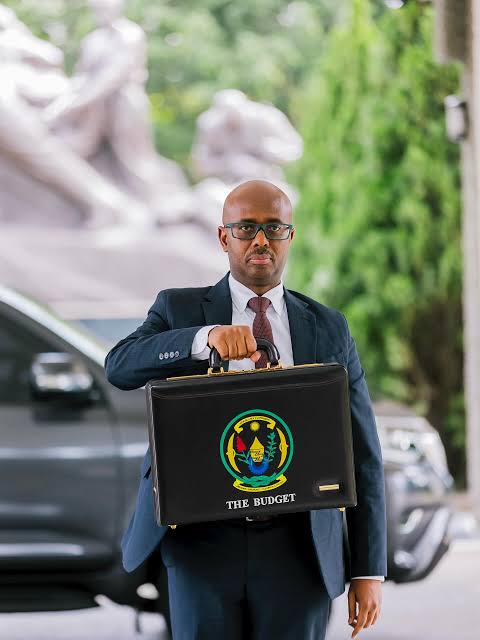
Finance Minister Yusuf Murangwa arrives at Parliament for presentation of the annual budget framework. It’s one of the mechanisms in place that oversee how he spends taxpayers money
KIGALI – Government has secured $100 million (Rwf 140bn) in new financing from the World Bank to advance major reforms aimed at strengthening domestic revenue collection, improving public spending efficiency, and accelerating job creation across the country.
The financing, approved by the World Bank’s Board of Executive Directors, supports the Revenue Improvement and Spending Efficiency Program-for-Results (PforR), a national initiative designed to modernize tax systems, enhance accountability, and reinforce service delivery from central government down to district level.
The program will be implemented by the Ministry of Finance and Economic Planning (MINECOFIN) in collaboration with the Ministry of Local Government (MINALOC).
According to the World Bank, the PforR program is aligned with the Second National Strategy for Transformation (NST-2), which prioritizes building an efficient, transparent, and citizen-centered public sector.
Rwanda’s growing fiscal landscape underscores the urgency of these reforms. In just under 30 years, the national budget has expanded from less than Rwf100 billion to over Rwf7 trillion today.
This dramatic growth means the country now handles significantly larger public resources that require strong systems, controls, and accountability mechanisms.
Over the years, the Auditor General has consistently highlighted stalled projects despite the availability of funds, and has flagged billions of francs that could not be fully accounted for—not due to theft, but because responsible officials failed to follow established procedures.
In some instances, the required controls do not exist at all, reinforcing the need for modernization and efficiency across government systems.
Three Areas
The new World Bank–funded program focuses on three pillars:
Increasing domestic revenue mobilization – Expanding the use of electronic billing machines (EBMs) for VAT compliance and modernizing property tax registration and valuation systems.
Enhancing efficiency and transparency of national-level public spending – Strengthening feasibility studies for public investments, improving project execution, institutionalizing asset management, tightening procurement procedures, and enhancing oversight of state-owned enterprises.
Strengthening local-level planning and accountability – Supporting districts to prepare evidence-based development strategies, publish budget performance reports, strengthen financial management, and design viable local economic development (LED) projects.
As part of new measures to wide the tax base, 14 new taxes were introduced in July. Some will be brought in over the comibg 5 years, with expectation to raise over Rwf 350bln ($300m).
