


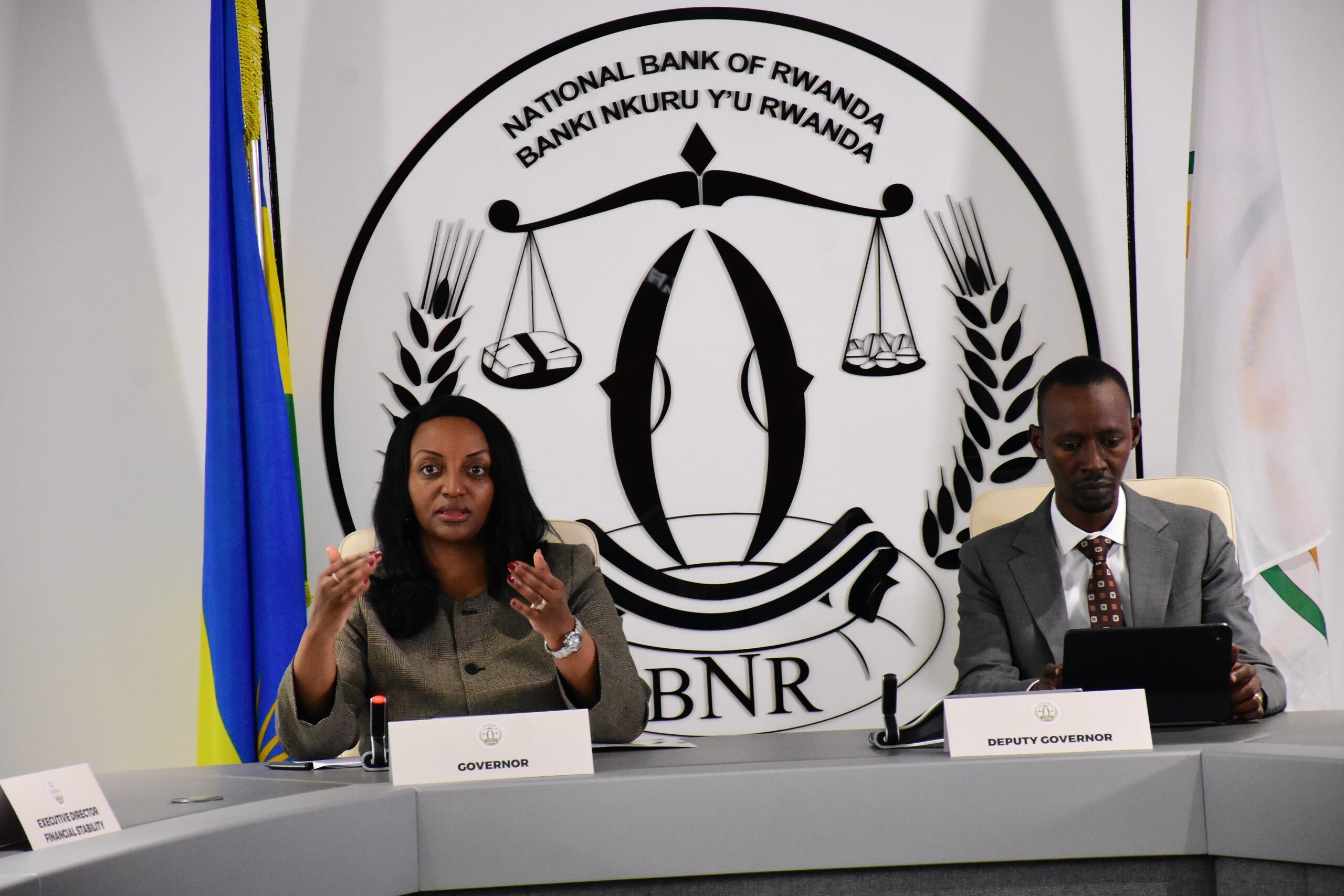
Central Bank Governor, Soraya Munyana Hakuziyaremye, and Deputy Governor Nick Barigye, during the session.
Rwanda has a clear eye steadily gazing at becoming a regional financial hub, a good reason to begin with the financial sector in looking at the prognostications of the Central Bank’s quarterly Monetary Policy and Financial Stability committee (MPC and FSC) Meetings, to examine the performance of the country’s economy.
Other than the almost predictable fluctuations in headline inflation, in their quarterly meetings, Rwanda’s Central Bank economists usually report steady progress of the country’s economy, rarely ever any dramatic news.
This quarter would not have been much different, so much so, in fact, that perhaps the unusual news would have been that the Governor, Suraya Hakuziyaremye, was carrying a bit of a cold.
As it turned out, however, her news on the ever growing financial sector will no doubt have been just a bit of the medicine both she and the economy needed to throw off any rainy season sniffles.
Central bank governors traditionally begin their presentation with an outlook on monetary policy, after a quick summary of the outlook around the world and Sub Saharan Africa, but we are overturning the tradition a little, in honour of the financial sector’s especially good performance.
An exception to the upturning of the normal order must however be inflation, not to keep anyone in suspense. As for any other central bank, the primary focus is on the rate of inflation. Headline inflation has ticked up to 7.2% from 6.7% in the second quarter, and is projected to average 6.9%, and 5.8% in 2026. Accordingly, the committee decided to maintain the bank rate at 6.75%.
But the financial sector can justifiably boast this quarte’s big news. “The financial stability committee assessed the overall stability of Rwanda’s financial sector, and concluded that it remains sound, resilient and well positioned to support the economy” the Governor assured.
There ought to be a saying, “Central Bank Governor smile, economy’s delight” or something to that effect. “And we can go through the rationale behind this optimistic assertion” said the Governor with a smile. The report was eye-catching. As of September 2025, the financial sector’s total assets reached Rwf15.3trillion, for the first time ever, a rise of 24.3%.
And the main driver of this growth was higher deposits in banks and Microfinance institutions, an increase in contributions to the public pension fund, strong investment income, as well as higher insurance premiums.
Notably, every subsector contributed to the growth, with newcomers Non Deposit Taking Institutions (NDTFIS), announcing themselves with an impressive 48.1% expansion. It is perhaps a measure of how well the sector overall performed, that the sub-sector growing the least, insurance, rose by a comparatively low 15.8%.
And it is in insurance that the bank noted a bit of a fly in the ointment, the delay in premium receivables. The bank advises premium receivables to be collected within a period of sixty days.
Beyond this period, institutions risk exposing themselves to credit and liquidity risks, up to and including difficulty with settling claims. The bank does however expect improvement, perhaps even by the next quarter, having taken action this year, to encourage better compliance with the sixty day regulation.
With the ever alert central bank as the regulator, it is almost guaranteed that the financial sector will remain well capitalized, ready to meet its obligations, with liquidity ratios to guard against unforeseen shocks above regulatory requirements.
“At the end of September 2025, the Capital Adequacy Ratios (CAR) of banks and micro finance institutions (MFIs) stood at 21.4 percent and 35.3 percent, respectively, well above the minimum threshold” according to the MPC statement. “This” it continued, “reflects their capacity to absorb potential losses. Private insurers demonstrated strong financial health, with a solvency of 254 percent, indicating ability to meet their obligations.”
Banks are required to keep a liquidity ratio that would enable them to withstand a thirty day demand for liquidity, should circumstances call for it. This stands at 302.9%, with MFIs reaching 65% and insurers 115%.
The solid foundations extended to lending institutions, where adequate liquidity buffers support credit inter-mediation, their customers’ lending and borrowing requirements. And lending remained the core activity for both banks and MFIs, respectively accounting for 50.6% and 66.9% of the sub sectors’ total assets. New bank loans reached Rwf1.9 trillion, with credit extended in MFIs, not too far behind, on Rwf702 billion.
The all important pension sector continued its strong growth. With higher contributions and greater income from investments, total assets increased by 33% to Rwf 2.6 trillion, as of September 2025. It was a similar picture with Ejo Heza pension scheme, whose assets grew by 29.2% on the back of rising contributions and good investment performance.
There were reports of operational risk loses but the committee judged these to be minor. Nonetheless, to further strengthen the sector’s resilience, especially in the light of digitisation of financial services, the Central Bank, together with the National Cyber Security Authority (NCSA) conducted joint inspections to assess the cyber security and operational risks in the banking sector, and its compliance with regulation requirements.
The committee reported a decrease in fraud, thanks to coordinated action by regulators and government. Through the Fraud Prevention Forum, the bank continues to monitor implementation of recommended preventive measures, enhance oversight of risks from fraud during inspections and coordinate sector wide responses to fraud.
And as the Governor noted as a reminder, “sustained economic growth underpins financial sector expansion.” The bank looks at global and continental conditions and assesses how far they are likely to affect the domestic economy.
On the domestic front, as the Governor reiterated, the primary mandate which “remains ensuring price stability, but also safeguarding a stable and inclusive financial system…”
The rationale for decisions taken by the MPC and FSC are in line with several factors, including, the bank’s “commitment to prudent macro economic management, which is really the foundation for investment and trade, but most importantly, for trust in our financial system.”
Looking farther afield, the global economy is performing better than expected, thanks to the easing of recent trade tensions, stability of supply chains, despite the fact that geopolitical tensions and trade policy uncertainties remain.
The International Monetary Fund (IMF) expects global gross domestic product (GDP) to slow to 3.2% this year, and 3.1% in 2026, down from 3.2% in 2024. For Sub Saharan Africa, growth is expected to stabilise at 4.1% this year, with no change from last year, going slightly up to 4.4% next year.
Global inflation had been expected to be higher, affected by trade tariffs from the United States of America (USA), and related trade shifts, but the private sector managed to adopt, front loading stocks and diversifying supply chains.
Global inflation is projected to fall to 4.2% this year up from 5.8% last year and falling further to 3.7% in 2026. In Sub Saharan Africa it is projected to fall this year to a high of 13.1%, from an even higher 20.3% last year.
The high inflation in Sub-Saharan Africa is mainly due to currency pressures and volatile food prices in some countries in Southern and the Horn of Africa, where in some instances, inflation has risen to 50% and above, affecting the rest of Sub Saharan Africa.
Commodity prices are an important determinant of external balances and inflation globally and domestically for Rwanda. Energy prices are projected to fall by 12.4% this year, falling further to 10.2% in 2026.
This is mainly due to a fall in crude oil prices, following the Organisation of Petroleum Exporting Countries (OPEC) decision to increase production and supply.
Although crude oil prices are expected to continue declining by as much as close to 16% this year, Rwandans should not expect fuel pump prices to reflect that fall, mainly due to transport costs.
Food prices are expected to fall by 6.1% this year, which should translate to lower imported inflation for Rwanda. Other commodities, metals and minerals remain high on average, increasing by 1.8%. This is to some advantage for Rwanda’s economy, as it raises export earnings.
Rwanda’s merchandise exports, rose by 15% this year, supported mainly by strong performances in traditional exports of coffee, tea and minerals, thanks to stable domestic production and favourable global prices of these commodities.
The manufacturing sector continues to grow, and this is reflected in exports of hitherto non traditional exports, which rose by a massive 50.5%, supported by manufactured goods, including cooking oil, wheat flour and animal feeds.
Imports increased by 7.4%, more slowly than exports, and mainly due to higher consumption of goods, in particular, medicines and corn. This increased the trade deficit by 2.8%, compared to the same period last year, but remains lower than in previous years.
Additionally, strong performances in tourism, air transport and remittances, continue to be a support to Rwanda’s external sector. International foreign exchange reserves remain adequate, with 4.2 months of imports, well above the required four months import coverage.

All of which have helped Rwanda’s currency to stabilise. The Rwanda franc depreciated against the US dollar by 4.03% as of September this year, improving from a depreciation of 6.49% over the corresponding period last year.
This has also been due to weakening of the dollar against other major currencies, and Rwanda’s enhanced foreign exchange market regulations to curb speculative tendencies in the foreign exchange market.
And looking over five years of currency depreciation, which in 2023 reached 13.76% over nine months, the committee is confident that the improvement to 4.03% is based on firm foundations.
Rwanda’s economy continues to perform well, growing to 7.8% in the second quarter of this year. This was mainly on the strength of the services sector, which grew by 8.5%, supported by trade, finance and ICT (Information Communication Technology) sectors. Industry grew by 7% thanks to mining, manufacturing and construction.
Agriculture grew by 7.6% in the second quarter of this year, boosted by exports of mainly coffee, but exports of other food crops though modest were also significant, contributing to the 7.8 GDP growth in the second quarter.
Although GDP figures for the third quarter are yet to be published by the Rwanda National Institute for Statistics (NISR), the bank’s projection, based on analysis of the Composite Index of Economic Activity (CIEA) which increased by 13.2% in the third quarter, and includes manufacturing and service sectors’ performance, suggest that GDP growth will remain strong.
Monetary conditions reflect the bank’s easing of monetary policy stance last year. The Interbank lending rate fell to 5.85%, down from 7.25% in the same period last year. The lending rates are lowered to 15.78%, down from 16.06% last year, and the deposit rate to 8.67% down from 10.36%, last year, due to ample liquidity in the banking system.
Inflation remains within the target of 2-8%. The slight rise to 7.2% was due to core and energy inflation, offsetting the drop in fresh food inflation, which is expected to remain low during the harvest season.
The projections can, of course, change due to any unforeseen changes in rainfall, in the case of food inflation for example, geopolitical tensions and shifts in global trade policies.
