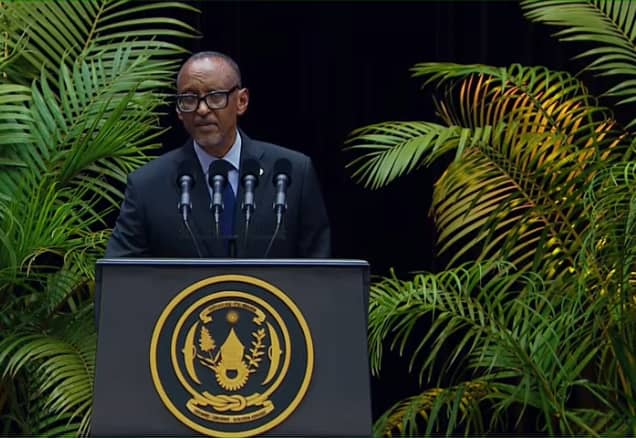
President Kagame sends a clear message to the diplomatic community: Rwanda will not compromise on its national security as the conflict in Eastern DRC continues to escalate.
President Paul Kagame has reaffirmed Rwanda’s determination to safeguard its national security, telling members of the diplomatic corps that the country cannot remain passive in the face of persistent threats linked to armed groups operating in eastern Democratic Republic of the Congo.
Speaking during a diplomatic dinner held in Kigali, Kagame addressed ambassadors and international partners on the shifting global political landscape and the continued instability in the Great Lakes region. He stressed that Rwanda values its international partnerships but warned that no country can afford indifference to emerging geopolitical realities.
“We do not take your partnership lightly, and I thank you for it,” Kagame said. “But nowadays none of us can afford to be indifferent to political trends around the world. It is clear that the global environment is changing, sometimes in unpredictable ways.”
Security Concerns Rooted in Long-Standing Conflict
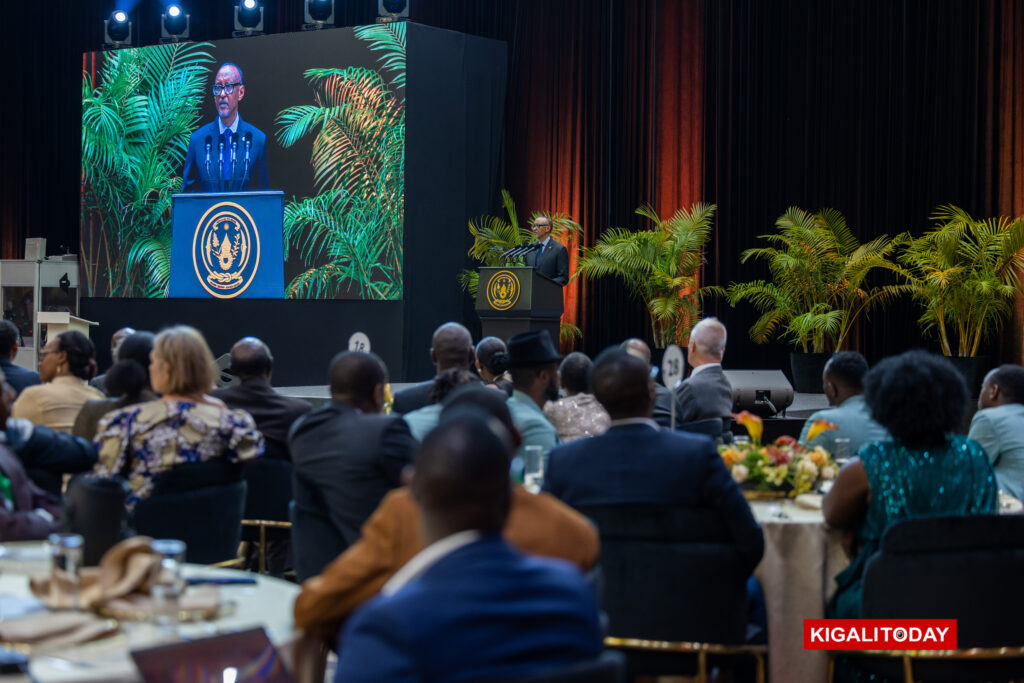
President Kagame told diplomats that lasting regional stability hinges on confronting the ‘neglect and complacency’ that have fueled conflict in eastern DRC for decades.
The president pointed out that the conflict in eastern Congo is neither new nor complicated to understand, but rather one that has endured for decades due to neglect and failure to address its root causes.
“The conflict in eastern DRC is not new,” Kagame said. “It has been prolonged for decades due to neglect and complacency, particularly by those who have the power to make the biggest difference in resolving it.”
Central to Rwanda’s concerns, he explained, is the continued presence of the Democratic Forces for the Liberation of Rwanda, an armed militia composed in part of elements linked to perpetrators of the 1994 Genocide against the Tutsi.
Kagame said the ideology associated with the group remains a serious threat not only to Rwanda but also to the stability of the wider region.
“When our security concerns stem from the continual presence of the FDLR and its violent extremist ideology, there should be no ambiguity about our responsibility,” he said. “The right and duty of every nation is to ensure the safety of its borders and its people.”
Call for Equal Responsibility in Peace Efforts
Kagame also urged international partners to adopt a balanced approach in addressing the conflict, emphasizing that peace agreements must bind all parties equally.
By definition, he said, any peace framework should require every actor involved to meet its obligations.
“A signed peace agreement should bind all parties equally, and implementation should follow the same principle,” Kagame noted. “However, that has not always been our experience.”
He referred to diplomatic efforts aimed at easing tensions in the region, including initiatives supported by the United States, stressing that durable peace requires addressing the structural drivers of the conflict rather than relying on short-term measures.
According to Kagame, Rwanda often faces a difficult dilemma when its legitimate security concerns are overlooked.
“As things stand, we face an impossible choice,” he said. “Either permit the continued presence of hostile forces near our borders or defend ourselves and be condemned for doing so.”
Commitment to Lasting Peace
Despite the tensions, Kagame reiterated that Rwanda remains committed to peace and regional cooperation, adding that defensive measures taken by the country are aimed solely at protecting its people.
“The Government of Rwanda wants peace,” he told diplomats. “But we want a genuine and lasting peace from which we can build future prosperity.”
He added that Rwanda would be prepared to lift defensive measures once all parties fulfill their obligations under existing agreements designed to stabilize eastern Congo.
Reflecting on Rwanda’s trajectory over the past three decades, Kagame said the country’s resilience has been built on determination and a commitment to prevent the return of violent extremism.
“Rwanda is strong enough to face its circumstances,” he said. “And precisely because we know the dangers of violent ethnic extremism, we have made a promise to ourselves never to return to that dark past.”
The president concluded by urging the diplomatic community to support a fair and realistic path toward peace in the region, emphasizing that stability can only be achieved when every party is held to the same standards and responsibilities.