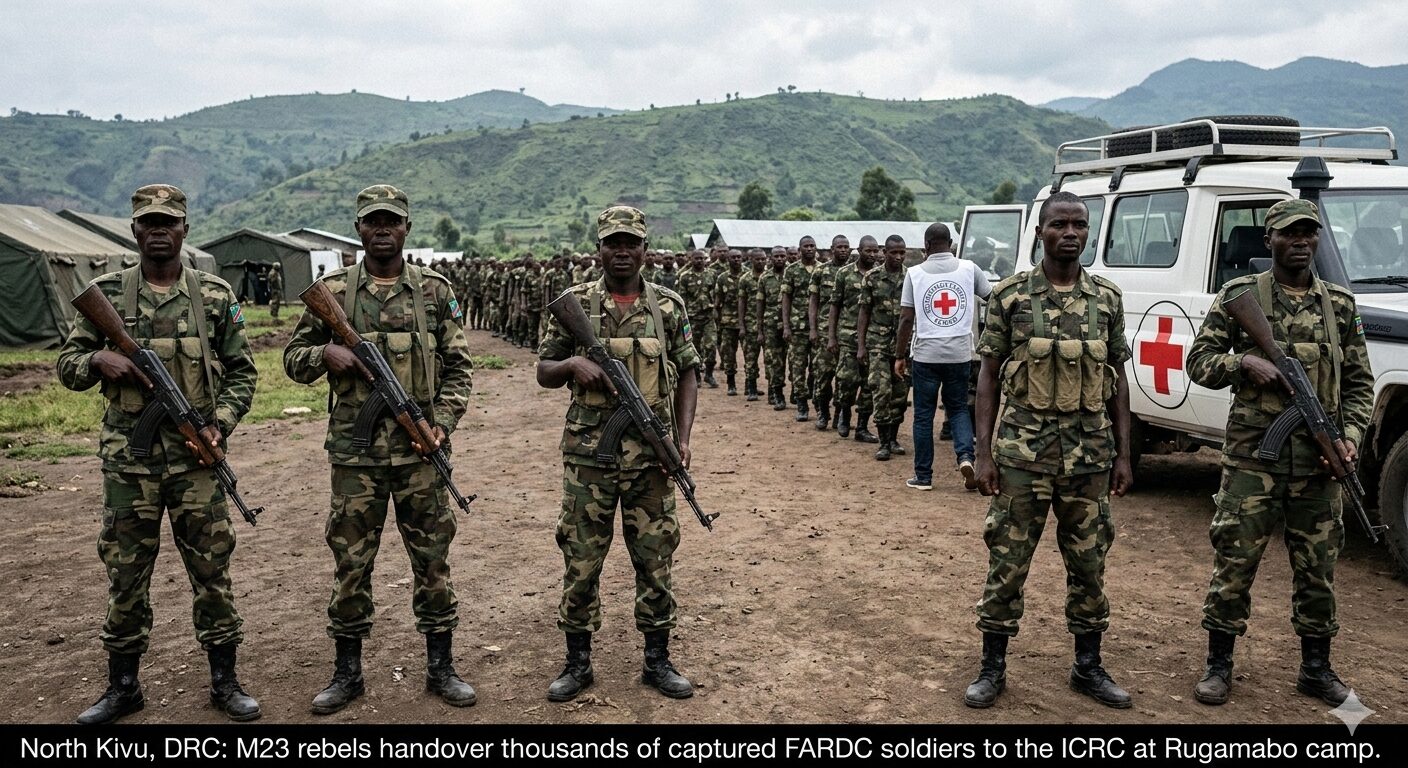
AFC/M23 has handed over 5,000 captured FARDC soldiers to the International Committee of the Red Cross (ICRC) for repatriation to Kinshasa. The group described the move as a humanitarian gesture aimed at easing regional tensions, reaffirming its commitment to international humanitarian law. AI Generated photo.
In a significant humanitarian development, the Congo River Alliance/March 23 Movement (AFC/M23) announced the release of over 5,000 captured members of the Congolese Armed Forces (FARDC) on Monday.
The announcement was made today via the AFC/M23’s official page on X, detailing a handover ceremony that took place at the Rugamabo camp in North Kivu province.
The operation was conducted under the supervision of the International Committee of the Red Cross (ICRC), with the captured personnel slated for repatriation to Kinshasa.
A Gesture Toward De-escalation
The AFC/M23 has framed the release as a “concrete action in favor of de-escalation,” citing a commitment to international humanitarian law and existing confidence-building measures.
However, this diplomatic overture—shared directly with the public via social media—was paired with a sharp critique of the central government’s current trajectory.
The movement accused President Félix Tshisekedi’s administration of “obstinacy,” claiming that Kinshasa has consistently refused to release AFC/M23 members held in state custody while simultaneously engaging in the arbitrary detention of individuals based on their ethnic appearance.
Strategic Escalation in Kisangani
The prisoner release comes amidst a widening theater of war. Recently, the AFC/M23 confirmed the deployment of specialized commando units to Kisangani—nearly 900km from Goma—to conduct “night operations” against Bangoka International Airport.
The movement stated that these elite forces carried out drone strikes on February 1 and March 1, 2026, targeting what it claims is a key logistical hub for military drone attacks.
The AFC/M23 maintains these strikes are a defensive measure to “neutralize the threat at its source” and protect civilians in the Kivus.
Accusations of “Generalized War”
Beyond the issue of detainees, the AFC/M23 used its digital platform to allege that the government has persisted in ceasefire violations that specifically target civilian populations and their property, effectively imposing a “generalized war” on the region.
The group’s leadership has called upon international mediators and partners to take note of these developments, warning that the humanitarian crisis is being exacerbated by Kinshasa’s refusal to engage in meaningful dialogue.
“The blood of Congolese people shed by Félix Tshisekedi will neither be ignored nor swept under the rug,” the group stated in its digital communiqué, signaling that despite the prisoner release, the ideological and military divide remains deep.
The conflict in eastern DRC remains one of the world’s most volatile humanitarian crises. By the time of writing this story, the Congolese government had not issued a formal response via official channels regarding the status of the repatriated soldiers or the accusations leveled against the presidency.