



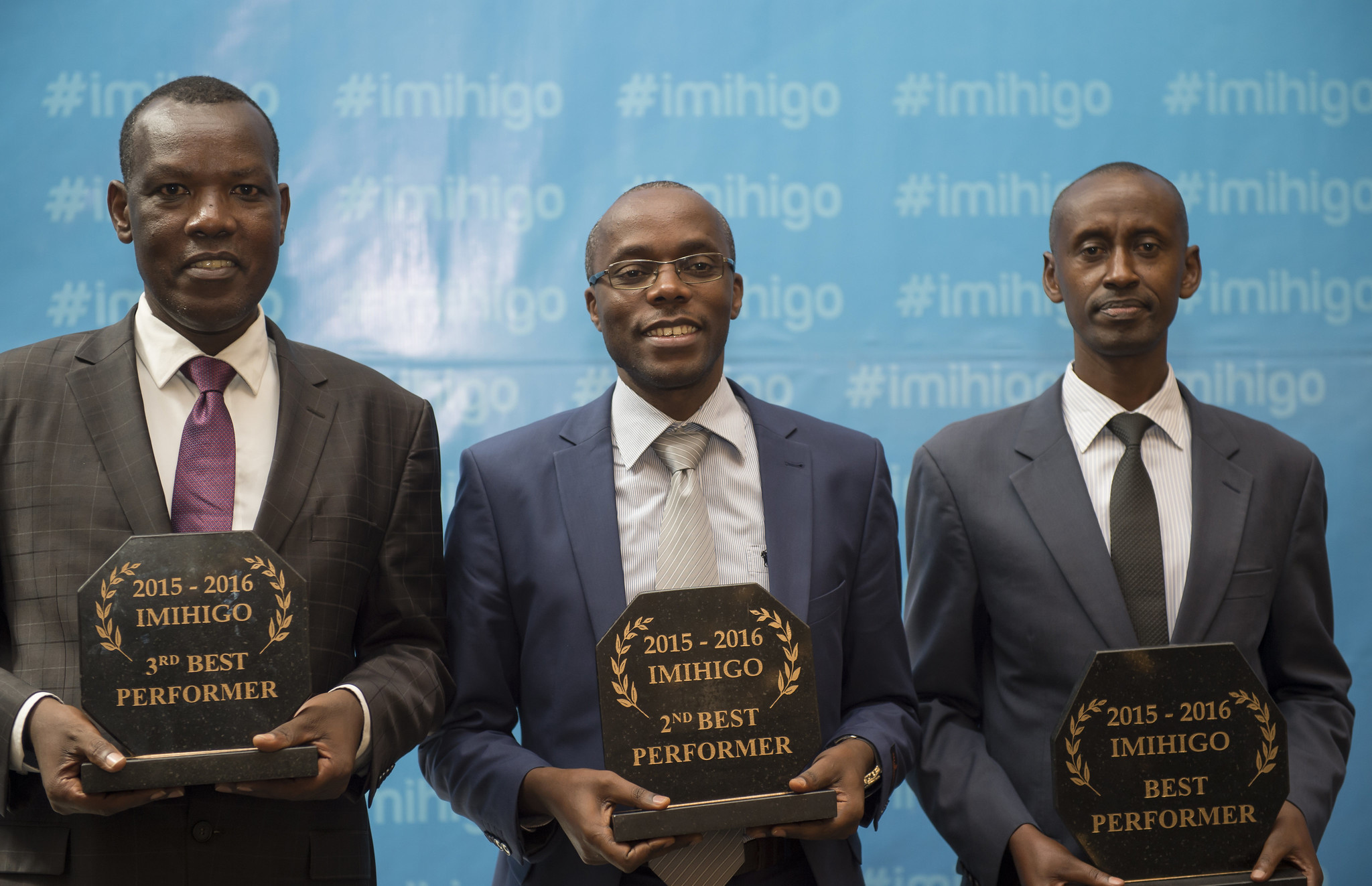
This was signing of Imihigo (Performance Contracts) | Kigali, 9 September 2016. Gasabo district emerged first. Each, we have had performining districts awarded, not this year 2026
KIGALI — Rwanda’s latest Imihigo performance assessment reads, at first glance, like a familiar administrative document: progress recorded, challenges acknowledged, recommendations issued. But embedded within its findings is a more consequential signal — not of failure, but of a system under mounting strain.
Introduced in 2006, Imihigo — Rwanda’s performance contract system — marks nearly two decades this year as one of the country’s most consequential governance innovations, driving accountability from the presidency down to district mayors.
Rooted in a pre-colonial tradition of public pledges, it helped transform a centralized post-genocide state into a results-driven administration, aligning national priorities with local delivery and earning Rwanda a reputation for disciplined execution. Each year, its high-profile signing ceremonies and public rankings reinforced both competition and accountability.
But as the system approaches its 20-year mark, a different tone is emerging.
At a recent meeting of central and local government leaders in Gako, President Paul Kagame delivered an unusually blunt warning, questioning the performance of officials and urging those unable to meet their responsibilities to step aside.
He criticized what he described as a culture of passivity, where leaders wait for direction rather than take initiative, and expressed frustration at repeated failures in implementation. The remarks signaled more than dissatisfaction with individual performance — they pointed to concern that the system itself may no longer be correcting its own weaknesses.
The latest Imihigo assessment appears to reinforce that concern.
The assessment, done by the National Institute of Statistics, notes a “decline in performance across most districts,” a finding that would typically suggest implementation problems.
Yet the explanation it offers is more revealing. The decline, it says, is largely due to “lower scores obtained in setting ambitious targets and efforts made in setting output indicators.”
That distinction matters. It suggests that performance is no longer judged solely by what districts achieve, but also by how ambitious they choose to be when setting their targets. The evaluation framework itself confirms this, explicitly incorporating the “level of ambition” in its scoring methodology.
In practice, this shifts the system from a purely results-based model to one that shapes behavior. Districts are incentivized not only to deliver, but to declare ambition — a dynamic that risks rewarding projection as much as performance.
Over time, such a structure can encourage what analysts describe as performative compliance: meeting the expectations of the system on paper, even as operational realities diverge.
At the same time, the report points to a quieter but equally significant development.
“Some districts have become less committed to setting and closely monitoring Imihigo implementation,” it observes, alongside references to “limited leadership engagement.”
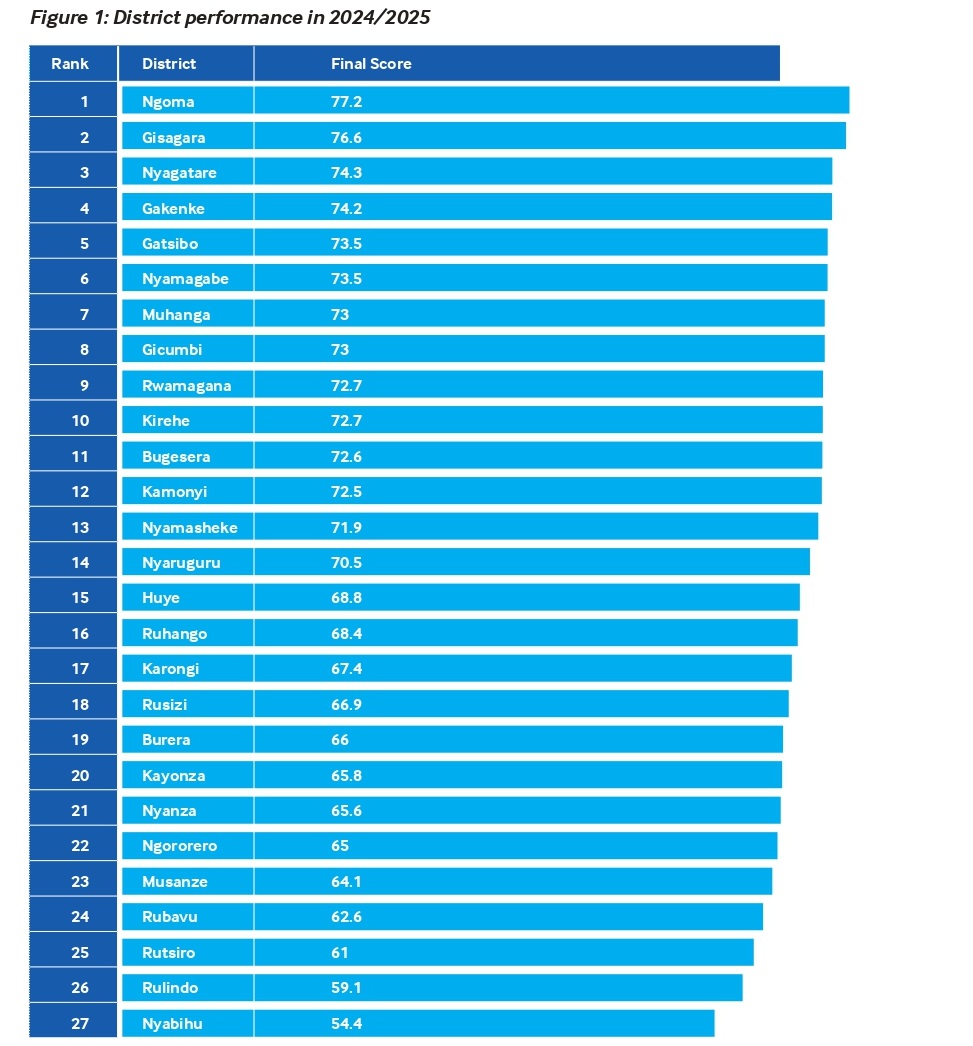
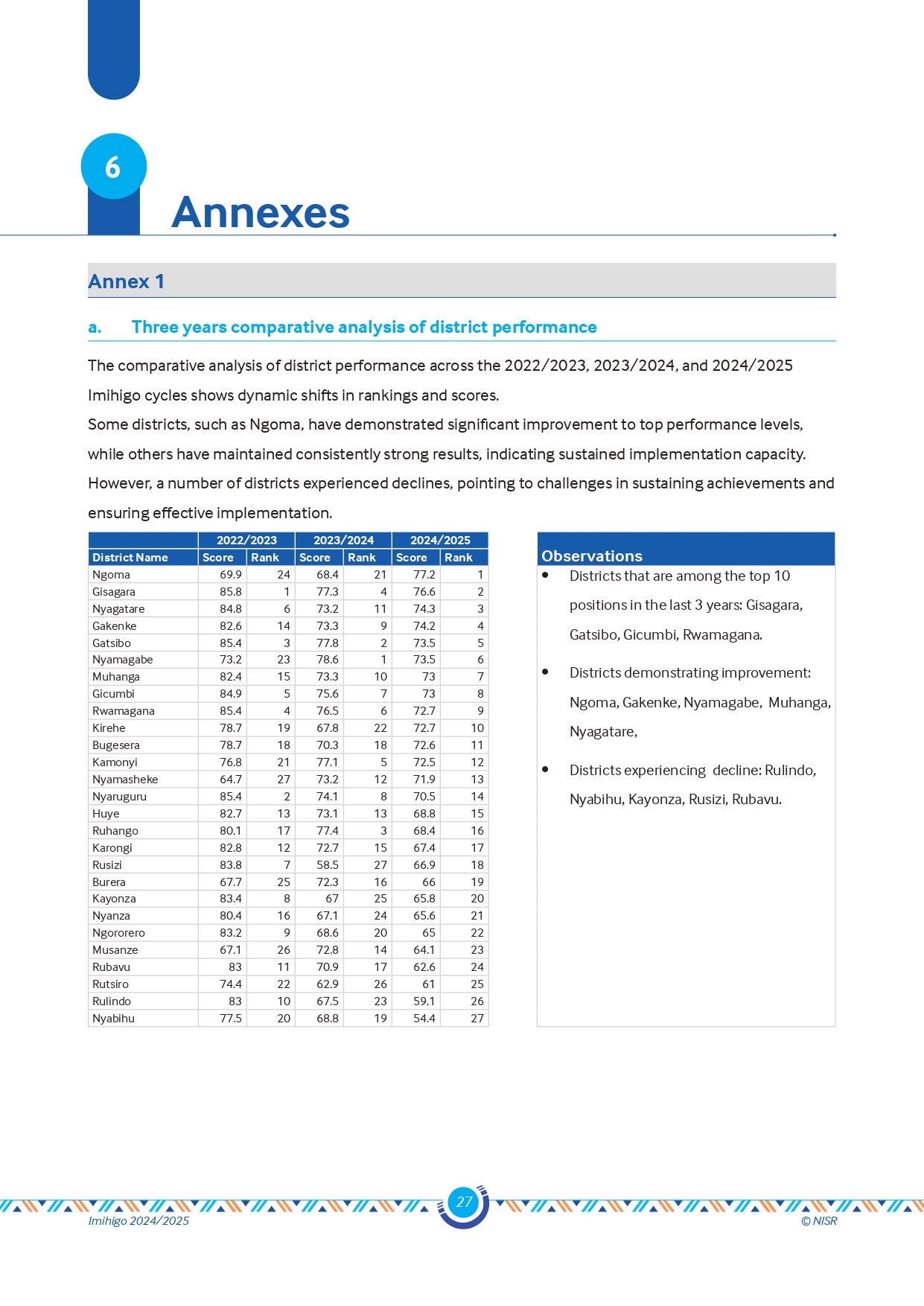
Across provinces, performance trends reinforce this concern, with most regions showing a gradual decline over a three-year period.
Taken together, these signals suggest a system experiencing fatigue — not in its formal structure, but in the level of internal ownership required to sustain it.
Where discipline weakens in a centralized performance model, compliance often persists, but becomes increasingly procedural — a dynamic that mirrors the frustrations expressed by President Kagame in his recent address.
Nowhere are these pressures more visible than in Kigali, which has three districts: Nyarugenge, Kicukiro and Gasabo.
The City of Kigali recorded an overall score of 59.3 percent, among the lowest nationally, with underperformance concentrated in road infrastructure and human security indicators.
For a city with the country’s highest concentration of resources and institutional capacity, the result is striking.
Its challenges, the report notes, stem from the complexity of large-scale infrastructure projects — including financing constraints, regulatory approvals, and coordination delays. These are not failures of intent, but indicators of system limits.
Urban development, by its nature, requires the alignment of procurement systems, contractors, funding flows, and regulatory oversight. When any one component slows, the entire process is affected.
This is reflected more broadly in sectoral performance. Urbanization recorded the lowest score of all sectors at 51.96 percent, a figure that has remained largely stagnant over three years.
The causes cited — procurement delays, contractor shortages, slow disbursement of funds, and reliance on imported materials — point to an execution system under pressure from multiple directions at once.
In such an environment, bottlenecks do not remain isolated. They compound.
The report is unusually direct in its assessment of planning itself. It acknowledges that “planning and budgeting processes remain unrealistic,” with timelines for complex projects often “impractical.”
This suggests a widening gap between ambition and feasibility — one in which targets are set beyond the operational capacity required to deliver them.
That gap has consequences. Budget cuts from external partners are cited as a factor disrupting implementation, indicating that some commitments are not fully backed by secured financing. In effect, planning and funding are not always aligned, introducing volatility into a system designed for precision.
Regional disparities add another layer of complexity. The Western Province recorded the lowest overall performance at 64.2 percent, alongside the steepest decline over three years. Districts such as rural ones Nyabihu, Rutsiro, and highly urbanised Rubavu, remain among the lowest performers nationally.
Despite repeated identification of these gaps, the pattern persists — suggesting that uniform targets applied across unequal conditions may be reinforcing, rather than reducing, disparities.
Beneath these structural pressures lies a more sensitive issue: the integrity of reporting. The report acknowledges “cases where some incomplete Imihigo indicators are reported as fully achieved,” alongside broader concerns about data quality, including inaccuracies and inconsistencies.
In a system that depends on accurate reporting to function, such distortions carry significant implications. If performance is overstated — whether due to pressure, capacity gaps, or misaligned incentives — the ability to diagnose problems early is weakened. Decisions continue to be made, but on a foundation that may not fully reflect reality.
A similar concern emerges in the report’s focus on sustainability. Projects dating back to the 2018–2019 fiscal year were assessed for their “physical condition, maintenance, quality, and continued usability.” This retrospective emphasis suggests a recognition that completion alone does not guarantee long-term impact — and that some projects may degrade after delivery.
Taken together, these findings describe a system that is still functioning, but with diminishing precision. Targets are being set, projects are being implemented, and performance is being recorded.
Yet the alignment between ambition, execution, and measurement appears increasingly strained.
The risk is not immediate breakdown. It is more subtle.
As incentives shift toward signaling ambition, as execution systems struggle to keep pace with complex demands, and as reporting pressures intensify, the gap between performance as measured and performance as experienced may widen. In such conditions, systems do not fail visibly. They continue to produce results — but with declining accuracy about what those results truly represent.
For Rwanda’s Imihigo model, long defined by discipline and accountability, that distinction is critical. Its strength has been not only in driving performance, but in reflecting it accurately.
As Imihigo approaches its 20-year milestone, the question is no longer whether it worked. The evidence suggests it did. The more pressing question is whether a system designed to enforce discipline and delivery can continue to function effectively in a more complex phase of governance — or whether it is beginning to strain under the weight of its own success.
