



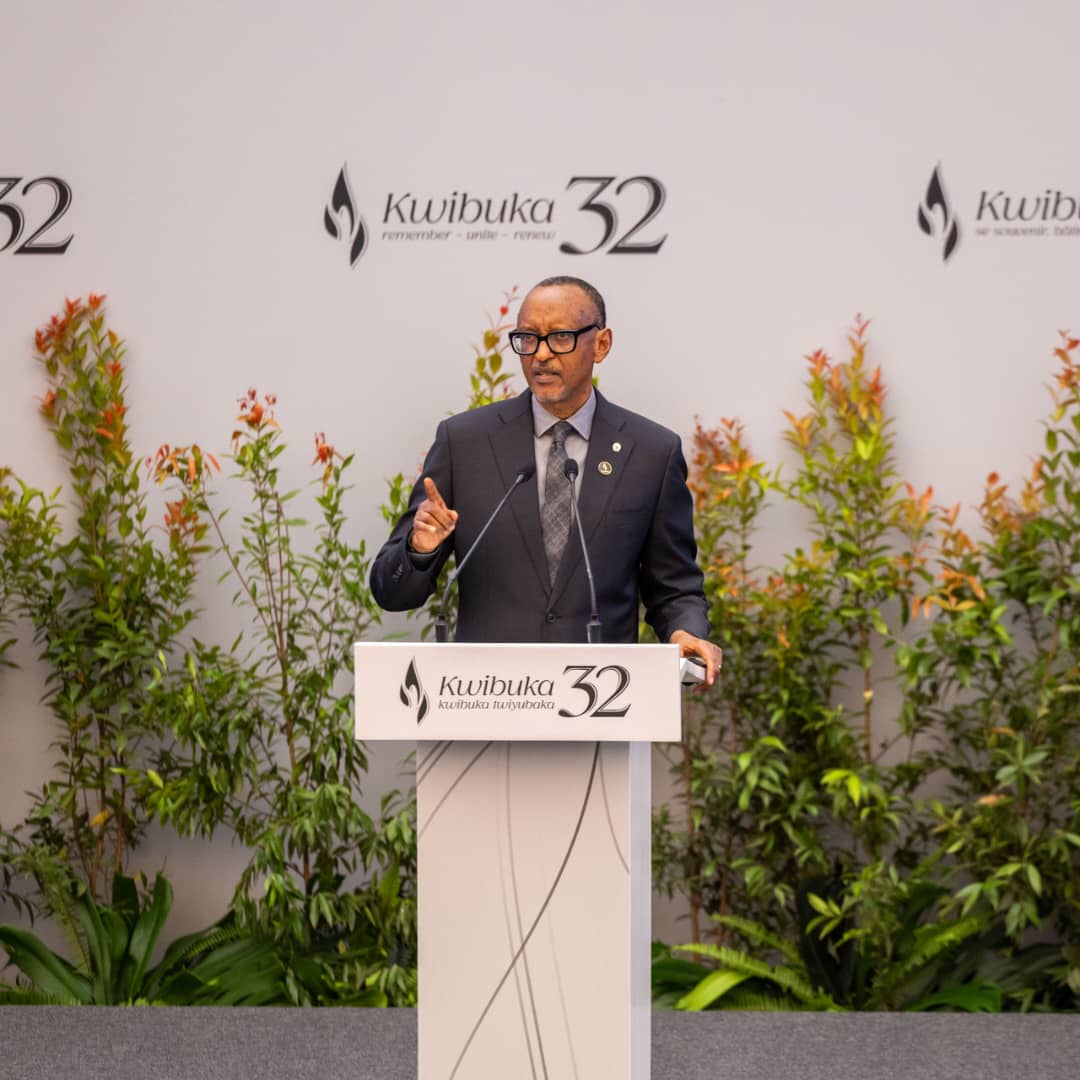
President Paul Kagame speaking this Tuesday
KIGALI — President Paul Kagame used his Kwibuka32 address to deliver a firm and unapologetic defense of Rwanda’s security posture, linking the country’s present-day policies directly to the lessons of the 1994 Genocide against the Tutsi.
Speaking at the Kigali Genocide Memorial, Kagame argued that Rwanda’s approach to security—often criticized internationally—cannot be separated from the historical reality of abandonment and the continued presence of armed groups in the region.
“No amount of sanctions or insults from outside can ever tarnish the honor and integrity of Rwanda’s defense and security forces,” he said, praising the professionalism of the Rwanda Defence Force (RDF).
Kagame stressed that Rwanda’s security doctrine is grounded in the experience of 1994, when the international community failed to act and the country was left to stop the genocide largely on its own.
“It had to be the Rwandan Patriotic Army that led the campaign against the genocide and ended it,” he said.
He added that this experience shaped the “culture and character” of today’s RDF, which he said was forged in those “dramatic moments” and continues to guide its operations, both domestically and in international peacekeeping missions.
Kagame noted that Rwanda’s forces have since earned “universal respect” in peacekeeping roles abroad, reinforcing his argument that they operate with discipline and integrity.
Sanctions and Criticism
Without naming specific countries, Kagame pushed back strongly against external pressure and sanctions targeting Rwanda, describing them as unjust and disconnected from reality.
“I look forward to raising this matter of sanctions at the highest level to understand the basis for such an injustice,” he said.
He categorised such measures as a contradiction—penalizing Rwanda for defending itself while ignoring the threats it faces.
According to Kagame, Rwanda’s central security principle is clear: the protection of civilians comes first.
“Rwandans understand the cost of tolerating extremism,” he said, emphasizing that the country cannot afford complacency in the face of danger.
Threat of Armed Groups
A significant portion of Kagame’s remarks focused on the continued threat posed by armed groups linked to the perpetrators of the genocide, particularly the FDLR.
He explained that after the genocide, members of the former regime’s army and militias fled into what is now the Democratic Republic of Congo, where they reorganized and launched cross-border attacks against Rwanda.
“These forces organized into what is now known as the FDLR and launched a sustained insurgency,” he said, noting that the violence claimed tens of thousands more lives.
Kagame described Rwanda’s subsequent military efforts as defensive measures aimed at securing its borders and preventing a recurrence of such attacks.
“This is not a problem that should be left to Rwanda alone,” he said, arguing that failure to address these groups collectively only emboldens them.
Political Maneuvers
Kagame also addressed recent political activities in the region, including gatherings in Kinshasa involving individuals linked to the former Rwandan regime.
Referring to such meetings—reportedly involving children, associates and relatives of former President Juvénal Habyarimana—Kagame dismissed them as inconsequential.
“All of that is just noise. It cannot amount to anything that will happen here again,” he said.
His remarks signaled confidence in Rwanda’s internal stability, as well as a refusal to view such developments as credible threats.
A Message of Resolve
Kagame’s strongest message came in a forceful declaration of Rwanda’s determination to defend itself under any circumstances.
“You cannot kill someone twice. Rwanda cannot die twice,” he said, before adding a stark warning: “Before you kill Rwanda, Rwanda will kill you.”
The statement underscored a broader theme of the speech—that Rwanda’s survival is non-negotiable, and that the country is prepared to act decisively to protect its people.
He reiterated this point in simpler terms as well: “Genocide cannot happen here again. It won’t happen.”
Self-Reliance
Underlying Kagame’s remarks was a clear philosophy: Rwanda cannot depend solely on external actors for its security.
The failures of 1994, he suggested, demonstrated the risks of relying on international intervention, making self-reliance a necessity rather than a choice.
At the same time, Kagame called for greater international cooperation—particularly in addressing armed groups and extremism—but on terms that recognize Rwanda’s legitimate security concerns.
“What we ask is for partners to join with us to fight extremism, rather than punishing Rwanda for defending itself,” he said.
Never Again, by All Means Necessary
As Kwibuka32 begins, Kagame’s message on security was unmistakable: remembrance is not only about honoring the past—it is about ensuring protection in the present.
For Rwanda, the promise of “Never Again” is not abstract. It is a policy, a doctrine, and a line that cannot be crossed.
And as Kagame made clear, it is a commitment the country intends to uphold—by all means necessary.
