


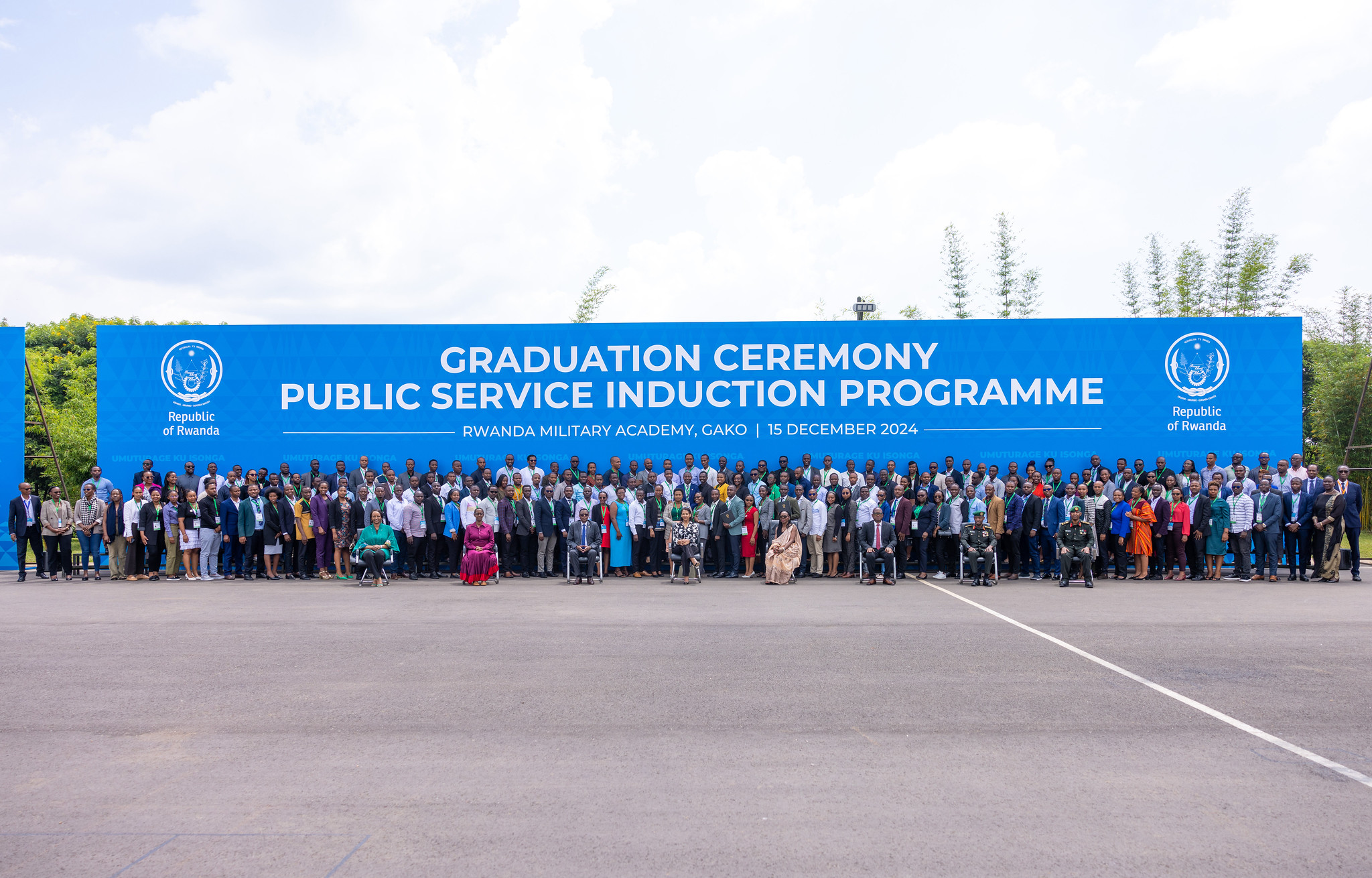
Government employees attend a regular performance improvement program for all civil servants
The money the government keeps readily available to pay for key day-to-day expenses such as civil service benefits, debt obligations, supplier payments, and unexpected emergencies has risen to more than Rwf 760 billion, according to the latest report by the Office of the Auditor General.
This represents an increase of about 36.4 percent from the Rwf 557 billion recorded the previous year.
The state auditor describes the development as part of a broader improvement in public financial management and the government’s short-term financial position.
In accounting terms, the money falls under what are known as “cash and cash equivalents” — funds that the government can access relatively quickly to meet immediate obligations such as salaries, payments to contractors, debt servicing, fuel purchases, and emergency expenditures.
For the ordinary person, the concept is closer to a household or business reserve account.
A family may own land, a house, or a vehicle, but still struggle if it lacks cash available for daily needs. Governments operate similarly.
A country can possess billions in infrastructure and investments while facing difficulties if liquid funds are low.
The increase therefore matters less as a symbol of wealth than as a measure of financial flexibility.
Countries with weak liquidity positions often face delayed payments to suppliers, accumulation of unpaid bills, or dependence on short-term borrowing to sustain operations.
Stronger cash reserves reduce those pressures and give governments greater room to manage unexpected shocks, including fluctuations in tax revenues or delays in foreign financing.
The rise comes during a period in which Rwanda is restructuring the way it records and monitors public finances.
The government recently began implementing international accrual-based accounting standards, a system used in many advanced economies that requires states to track not only revenues and expenditures, but also assets, liabilities, and broader financial positions.
Under the older cash-based system, governments primarily recorded money entering and leaving the treasury. The new framework goes further, attempting to measure what the state owns, what it owes, and how its resources change over time.
That transition has already produced some of the most detailed financial disclosures in Rwanda’s recent history.
In the same audit cycle, the government estimated the value of all public assets at roughly Rwf 22 trillion, including road infrastructure valued at nearly Rwf 3.8 trillion, government buildings worth about Rwf 3.5 trillion, and public land estimated at over Rwf 3 trillion.
The larger cash position sits within that broader financial restructuring.
Still, the Rwf 760 billion should not be understood as money freely available for unrestricted spending. Large portions of government cash balances are often tied to ongoing projects, earmarked programs, scheduled repayments, or donor-funded activities.
The improved cash position means the government is now in a stronger position to reliably pay its roughly 400,000 civil servants and meet other day-to-day obligations.
In practice, part of the reserve may already be committed long before it is spent.
What the figure does suggest is that the treasury entered the new fiscal year with stronger immediate financial capacity than before.
The increase also coincided with significant growth in government revenues.
According to the Auditor General, Alexis Kamuhire’s report, overall revenues rose sharply during the year, while tax collections exceeded targets set in the national budget.
Across much of the developing world, governments frequently struggle to maintain stable liquidity even when economic growth appears strong on paper.
Infrastructure projects may expand while treasury systems remain weak, leaving states vulnerable to sudden financial pressure.
Rwanda’s latest figures point to a government attempting to strengthen not only what it builds, but also the systems used to manage and sustain those investments.
The challenge ahead may be less about accumulating cash than maintaining it. Large reserves can disappear quickly under pressure from debt repayments, infrastructure spending, or economic shocks.
The more difficult task for governments is sustaining financial flexibility over time while continuing to fund public services and long-term development goals.
For Rwanda, the latest audit suggests that public finance management is becoming more structured, more measurable, and increasingly judged not only by how much the government spends, but by the resilience of the financial position behind that spending.
