




Dr Diane Karusisi (R) speaks to former banker Alfred Kalisa at the Forum“Healthy Competition” Is Slowly Lowering Rwanda’s Credit Costs – Bank of Kigali CEO
At a side session of the Africa CEO Forum 2026 focused on one of African business’s most persistent complaints — the high cost of borrowing — Dr Diane Karusisi argued that competition among lenders is beginning to ease pressure on businesses in Rwanda.
“The cost of credit has been marginally dropping over the past couple of years,” Karusisi said during the discussion themed; “Has Africa’s Cost of Corporate and SME Credit Become Too High?”
The chief executive officer Bank of Kigali, Rwanda’s largest commercial lender, attributed the gradual decline largely to what she described as “healthy competition” among banks.
“We are competing with Equity Bank,” she said. “And this competition has been very positive for clients.”
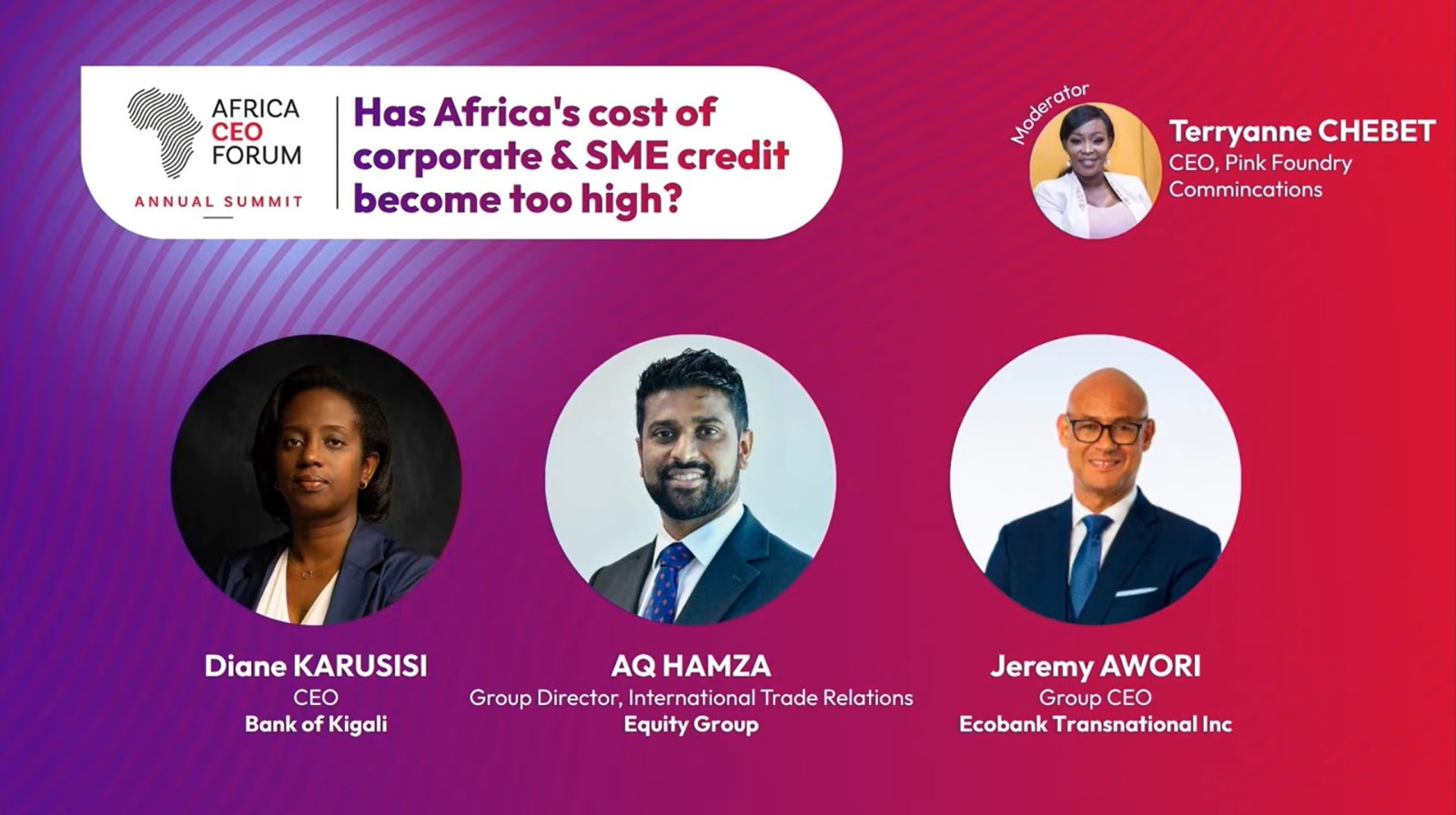
Karusisi shared the appearance with Jeremy Awori, Group CEO of Ecobank Transnational Inc., and AQ Hamza, the Group Director for International Trade Relations at Equity Group Holdings, as the discussion turned into a broader debate about why credit across Africa remains expensive despite growing pressure on banks to finance industrialization and private-sector growth.
The conversation unfolded as African business leaders gathered at the annual forum to debate how the continent can finance manufacturing, infrastructure and business expansion at a time of tightening global financial conditions and rising demand for capital.
Across much of Africa, businesses — particularly small and medium-sized enterprises — continue to complain that access to affordable credit remains one of the biggest barriers to growth.
Karusisi acknowledged that borrowers rarely consider lending rates genuinely affordable.
“Clients will never tell you that it’s cheap,” she said.
But she suggested that the larger frustration increasingly lies elsewhere: inefficiency.
According to Karusisi, many businesses are now more concerned about delays, paperwork and slow approval systems than about the interest rates themselves.
“What clients are telling us today is that beyond the cost,” she said, “they want to see us compress the documentation and make sure the lending process is way more efficient.”
In many cases, she explained, entrepreneurs lose commercial opportunities simply because approvals take too long.
“When the process is long and the turnaround time is weeks instead of days,” she said, “there are lost opportunities for businessmen.”
Karusisi argued that efficient service can matter as much as price.
“When you have good service,” she said, “clients are ready to pay you more.”
The session later shifted toward a broader structural issue affecting African banking systems: why lending rates often remain high even when central banks lower policy rates.
Karusisi responded by pointing to a deeper imbalance inside many African economies.
“The demand for credit is high, but people are not saving,” she said.
Commercial banks, she explained, largely finance loans through deposits collected from customers and institutional investors rather than directly from central banks.
That creates what bankers describe as a maturity mismatch: most deposits entering banks are short-term, while businesses increasingly seek medium- and long-term financing for expansion projects, factories and capital investments.
“People are looking for longer-term credit when our funding is shorter,” she said.
“That mismatch has a cost.”
Karusisi described the challenge as structural rather than simply monetary.
“Savings rates are low, and the demand for credit is quite high,” she said.
Throughout the Africa CEO Forum 2026, executives have repeatedly returned to concerns that Africa’s financial systems remain too shallow to support the scale of industrial growth the continent hopes to achieve.
This year’s forum focused heavily on how African economies can build stronger regional champions, finance industrialization and reduce dependence on external capital.
But many speakers acknowledged that those ambitions may remain difficult to achieve without deeper savings pools and more efficient banking systems.
Karusisi’s comments captured that tension directly: African banks are being asked to finance long-term transformation while operating in economies where long-term capital remains scarce.
“We want to be as efficient as possible to support your needs,” she said.
“But the cost is built in the macros.”
