
Rwandan filmmaker Marie-Clémentine Dusabejambo (left) at Cannes Film Festival 2026
Rwandan filmmaker Marie-Clémentine Dusabejambo has made history with her debut feature film Ben’Imana, becoming the first Rwandan-directed feature to be selected for the official lineup of the Cannes Film Festival.
The film was screened in the “Un Certain Regard” section at the 2026 Cannes Film Festival, one of the world’s most prestigious showcases for distinctive and emerging voices in global cinema.
The selection marks a major milestone for Rwanda’s growing film industry and a breakthrough moment for East African storytelling on the international stage.
A Landmark for Rwanda’s Film Industry
Although films linked to Rwanda have previously appeared at Cannes, none had been directed by a Rwandan filmmaker.
The 2007 film “Munyurangabo” was screened at the festival and earned critical acclaim, but it was directed by American filmmaker Lee Isaac Chung.
Dusabejambo’s achievement is therefore unprecedented: the first time a Rwandan filmmaker has brought a locally directed feature film to Cannes’ official selection.
Her accomplishment reflects the steady growth of Rwanda’s creative sector and the increasing global recognition of African cinema.
A Story of Trauma, Healing and Reconciliation
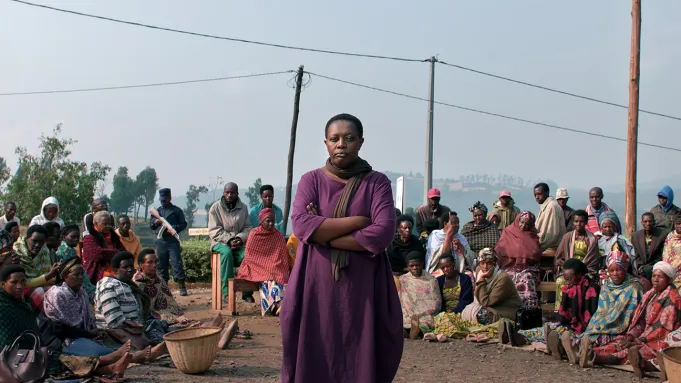
Clémentine U. Nyirinkindi in ‘Ben’Imana’ (Children of God) film
Set in Rwanda in 2012, nearly two decades after the 1994 Genocide against the Tutsi, “Ben’Imana” (loosely translated as “Children of God”) tells the story of Veneranda, a genocide survivor who has dedicated herself to reconciliation and community healing.
Her world is upended when her teenage daughter becomes unexpectedly pregnant, forcing long-buried trauma and unresolved family tensions to resurface.
The film explores how the legacy of genocide continues to shape intimate family relationships and the lives of a new generation born after the tragedy.
Early reviews from Cannes have praised the film’s emotional restraint and sensitive storytelling.
The Hollywood Reporter described it as a deeply human portrait of memory, silence and reconciliation, highlighting its exploration of “the aftershocks of history within ordinary family life.”
Several critics have also cited “Ben’Imana” as one of the standout African debuts at this year’s festival.
A Proudly Rwandan Production

Some of the film Ben’Imana cast recognised
The film was produced largely by Rwandan talent, with an overwhelmingly local crew and a cast featuring mostly non-professional actors.
The cast includes Clémentine U. Nyirinkindi, Kesia Kelly Nishimwe, Isabelle Kabano, Arivere Kagoyire, Antoinette Uwamahoro, Léocadie Uwabeza, Aimé Valens Tuyisenge, Hamida Uwimana, Adelite Mugabo, Clémence Murorunkwere, Josephine Mukamusoni, Elvis Ngabo and Donatilia Uwicyeza.
The soundtrack includes original music by renowned Rwandan singer and producer Igor Mabano, known for his Afro-soul and R&B-inspired sound.
Before directing her first feature, Dusabejambo had built an impressive reputation through award-winning short films including: “A Place for Myself”, “Icyasha”, “Behind the World” and “Lyiza”.
Her work often explores themes of identity, exclusion, reconciliation and social justice, with a particular focus on women and marginalized communities.
Opening Doors for Rwandan Cinema

Sandrine Umutoni, Minister of State for Youth and Arts represented the Government of Rwanda
Industry observers say the Cannes selection is likely to create new opportunities for Rwanda’s film sector, including international co-productions, distribution deals and increased investment in local storytelling.
“This is the first time we have seen a Rwandan film receive more than five minutes of applause after its screening,” said Aimable Twahirwa, a Rwandan film enthusiast following the festival from Kigali.
“It is also the first time that an audience of more than 1,200 film professionals asked for the film to be screened again. That is highly unusual at Cannes.”
The film has already attracted interest from international distributors and streaming platforms following its premiere.
Beyond its success at Cannes, “Ben’Imana” arrives at a time when African stories are gaining greater prominence in global cinema.
For Rwanda, the film’s selection is a powerful symbol of how a young national cinema is finding its place on one of the world’s most celebrated cultural stages.
At the center of that achievement is Marie-Clémentine Dusabejambo, whose debut feature has become both a personal triumph and a landmark in Rwanda’s cultural history.

Recognition of minds behind the film ‘Ben’Imana’

Rwandan actors get a full applause before hitting the stage