



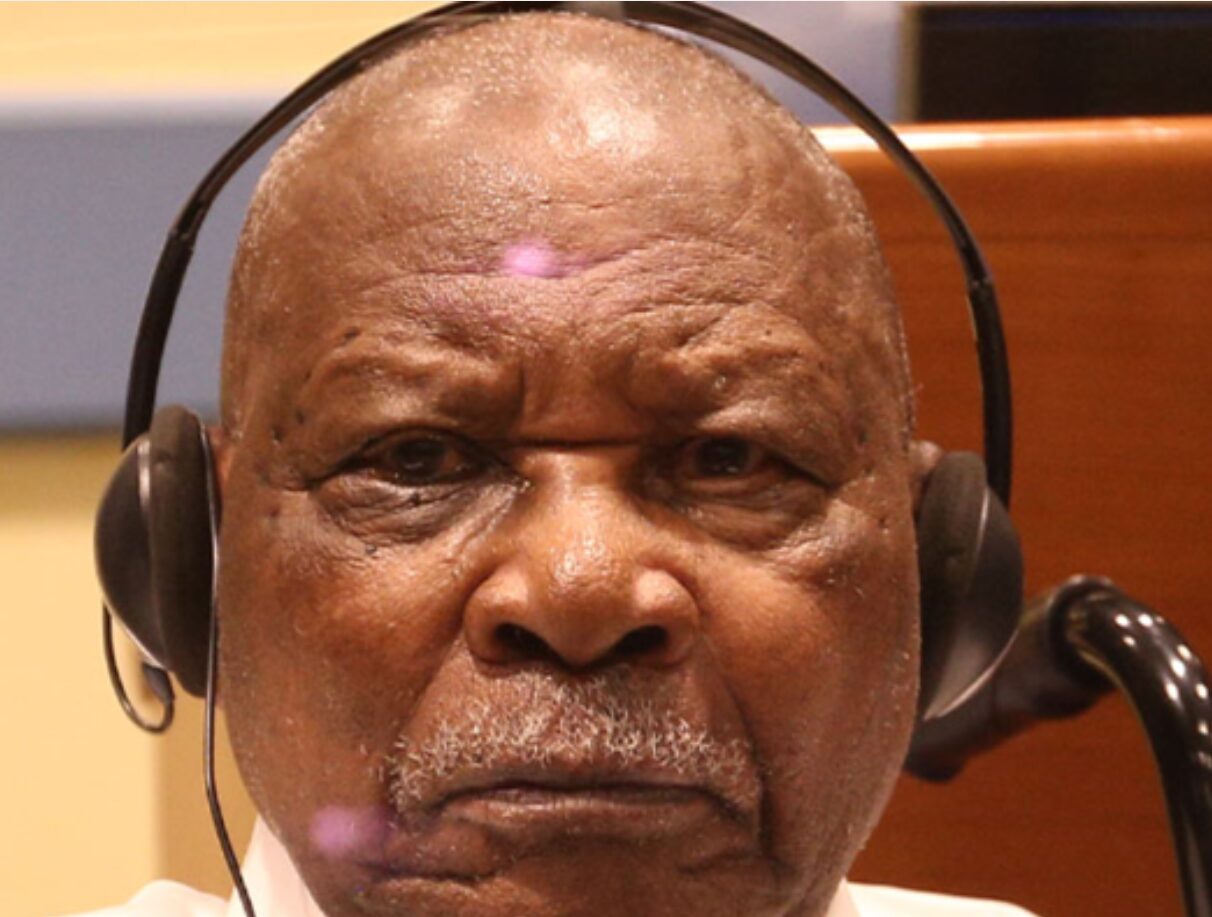
WATERLOO, Belgium — There were no television cameras.
No crowds gathered outside a cemetery gate. No political speeches were delivered, and no public announcement marked the moment.
On a quiet day in Waterloo, south of Brussels, Félicien Kabuga was buried inside a family vault during a private ceremony attended by relatives.
For a man whose name once echoed through courtrooms, diplomatic cables, international arrest warrants and genocide investigations across continents, the silence was remarkable. One of the wealthiest men Rwanda had ever produced, one of the world’s most wanted fugitives, and a man accused of helping finance the machinery of the 1994 Genocide against the Tutsi, Kabuga’s final farewell passed almost unnoticed.
Kabuga died on May 16, 2026, at the age of 93 in a hospital in The Hague while under the custody of the United Nations International Residual Mechanism for Criminal Tribunals, the institution responsible for completing the remaining work of the Rwanda tribunal. His death ended one of the longest-running pursuits in modern international justice, but it did not end with the verdict many survivors had spent decades waiting to hear. Instead, it ended with an unfinished trial.
For many survivors of the genocide against the Tutsi, Kabuga’s death closed a chapter without providing closure. There would be no final judgment, no sentencing and no definitive legal conclusion. The man prosecutors described as the chief financier of the genocide died before history could fully speak through the courtroom.
Kabuga’s rise had mirrored the ascent of Rwanda’s political elite during the years preceding the genocide. Through tea estates, import-export businesses, real estate investments and extensive commercial networks, he became one of the richest men in the country. His influence extended far beyond business.
Two of his daughters married sons of President Juvénal Habyarimana. Another daughter married Augustin Ngirabatware, who would later be convicted by the International Criminal Tribunal for Rwanda. These marriages were not merely family connections. They placed Kabuga at the center of the network that came to dominate political and economic power in Rwanda’s final years before the genocide.
Prosecutors later alleged that he used that influence to support the extremist project that culminated in mass murder. Investigators accused him of financing the importation of machetes, supporting the Interahamwe militia and funding some of the most notorious instruments of genocide propaganda.
Most significantly, he was accused of helping finance and direct Radio Télévision Libre des Mille Collines, better known as RTLM. The station became infamous for broadcasting hate speech, identifying targets, encouraging violence and helping mobilizing killers across the country. Its broadcasts transformed prejudice into action and helped turn genocide into a national campaign.
Kabuga was also linked to Kangura, the extremist newspaper whose anti-Tutsi propaganda became part of the ideological groundwork for genocide. Prosecutors argued that his role extended beyond financing individual actors and organizations.
According to their case, he helped fund the infrastructure of hatred and violence that made the genocide possible. The genocide did not begin with killings alone; it began with preparation, and prosecutors maintained that Kabuga helped pay for much of that preparation.
When the genocide ended and the former genocidal government collapsed, Kabuga disappeared. For more than a quarter century he evaded capture. He reportedly moved through several countries, benefiting from family networks, business connections and the inability—or unwillingness—of multiple states to bring him to justice.
Investigators traced his presence to the Democratic Republic of the Congo, Kenya, Switzerland, Germany and elsewhere. The pursuit became one of the largest international manhunts linked to the genocide.
Then, in May 2020, French authorities arrested him in a modest apartment outside Paris. The arrest stunned observers. After twenty-six years on the run, survivors finally believed justice was within reach. His transfer to The Hague appeared to mark the beginning of a historic reckoning.
But time had already become his greatest ally. Medical evaluations eventually determined that Kabuga suffered from advanced dementia. Judges concluded that he was no longer capable of meaningfully participating in his own defense, and his trial was suspended. The proceedings that many believed would become one of the most consequential genocide trials of the century slowly ground to a halt.
For legal institutions, it was a medical reality. For many survivors, it felt like justice slipping away. When Kabuga died in custody this year, the unresolved questions followed him.
No country had been willing to receive him upon release. No government wanted the burden of hosting one of the most controversial figures connected to the genocide. Yet in death, a resting place was eventually found: Belgium.
The burial took place discreetly in Waterloo, a town best known internationally for another historic defeat more than two centuries ago.
Local authorities offered no public comment, and the exact cemetery location was not disclosed publicly. There were no photographs, no public viewing and no ceremony open to observers. The burial was handled quietly, almost invisibly.
The contrast with Kabuga’s life could hardly have been greater. For decades, he had lived surrounded by influence, wealth and attention. His business empire touched politics. His family connections reached the presidency. His name appeared in international headlines from Kigali to Paris, Nairobi to The Hague. Yet his final journey ended not before a crowd, but in near-total privacy.
Perhaps that is fitting. Kabuga’s life ultimately became a story of contradictions: a billionaire who ended his final years in detention; a powerful businessman who died unwanted by any country; and a man accused of financing one of the worst crimes of the twentieth century who never heard a final verdict. He now leaves behind a legacy that remains deeply contested.
For survivors, the silence surrounding his funeral is unlikely to matter as much as the silence left by the unfinished trial. The cemetery in Waterloo may now hold his remains, but the debate over his legacy, his responsibility and the justice that never arrived remains very much alive.
The grave is closed. History’s judgment is not.
